


Table of Contents
Introduction
The search engine is the single most influential technology shaping how customers find businesses today, and it has been quietly reinventing itself every few years for the last three decades.
From the text-only crawlers of the early 1990s to Google’s revolution, Microsoft’s launch of Bing, Yahoo’s pioneering directory, and now the AI-powered generative search experiences from Google, Bing Copilot, ChatGPT Search, and Perplexity, the search landscape has never stood still.
For executives, marketers, and digital strategy leaders, understanding the evolution of search engines is no longer trivia. It is a strategic map that reveals exactly how buyer behavior, content visibility, and competitive advantage are shifting in Google 2026 and beyond.
As of January 2026, Google still commands roughly 90% of global search across all devices, but its lead is narrowing for the first time in over a decade, while AI-powered search platforms have grown more than 200% year over year.
This guide walks you through the full search engine evolution timeline, decodes the rise of Google, Bing, and Yahoo, explains the new optimization disciplines of AIO and AEO, and shows you how to apply these shifts to your own website, including your on-site search.
Why the Evolution of Search Matters to Business Leaders?
Search engines are no longer just navigation tools. They are buyer-discovery engines, brand reputation arbiters, and increasingly, answer machines that decide whether your business gets mentioned at all.
The shift from keyword-matching to intent-understanding to AI-generated answers has compressed the buyer journey: customers now expect a synthesized, conversational response, often without ever clicking a link.
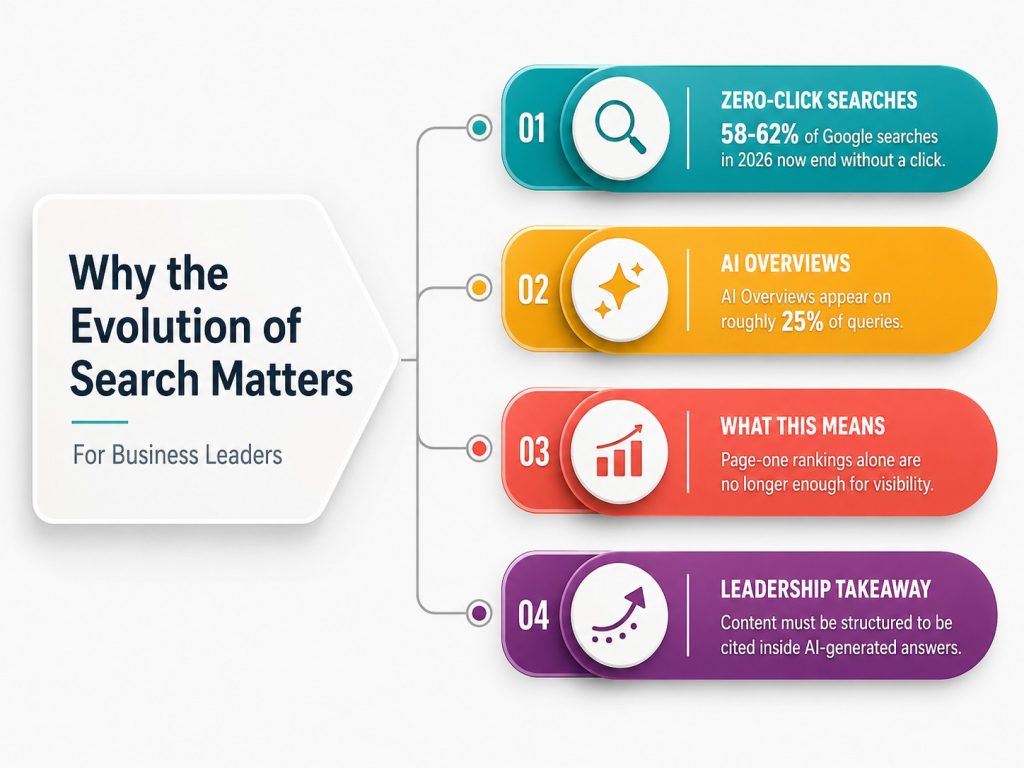
- Recent industry data shows that 58-62% of Google searches in 2026 end without a click, and AI Overviews now appear on roughly 25% of queries.
- For business leaders, this means visibility must be re-engineered ranking on page one is no longer enough; your content must be structured to be cited inside AI-generated answers.
The Pre-Google Era: The Foundations of Search (1990-1997)
The story begins in 1990 with Archie, a tool that indexed FTP file names, not web pages. There was no World Wide Web yet, no clickable results, no ranking. It was crude, but it was the first time humans could query a database of internet resources by name.
The next leap came in 1993 with Aliweb and JumpStation, the first true crawler-based search engines that scanned the early web and built indexes of pages.
Then came the era of the great directories and pioneer engines:
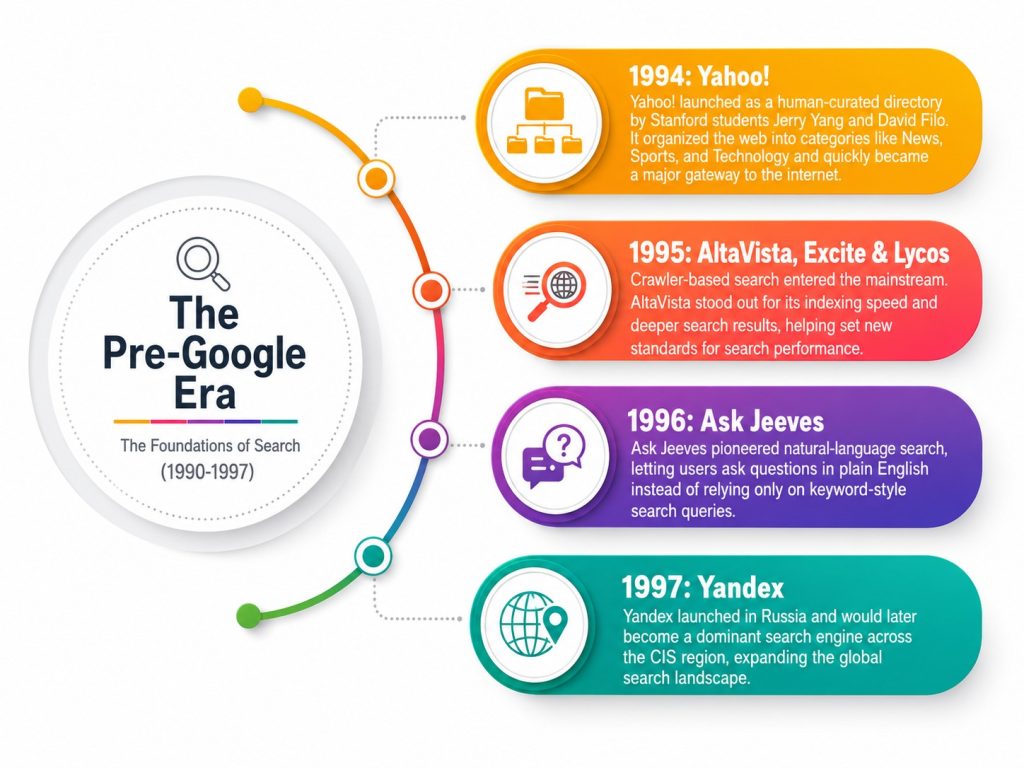
- 1994: Yahoo! launched as a human-curated directory by Stanford students Jerry Yang and David Filo, organizing the web into categories like News, Sports, and Technology. It quickly became the most popular gateway to the internet.
- 1995: AltaVista, Excite, and Lycos brought powerful crawler-based search to the mainstream. AltaVista, in particular, set new standards for indexing speed and result depth.
- 1996: Ask Jeeves (now Ask.com) pioneered natural-language search, letting users ask questions in plain English.
- 1997: Yandex launched in Russia and would eventually dominate the CIS region.
These early engines were powerful for their time but suffered from one major flaw: they ranked pages largely on keyword frequency, which made them easy to manipulate and noisy to use.
The Google Revolution: PageRank and the Rise of Modern Search (1998-2010)
In 1998, two Stanford PhD students named Larry Page and Sergey Brin launched Google, and the search industry was never the same. Their breakthrough was the PageRank algorithm, which ranked pages based on the quantity and quality of links pointing to them, treating links as votes of confidence.
Suddenly, relevance was determined by the collective behavior of the web itself, not by which page repeated a keyword most often.
Google’s rise was relentless:
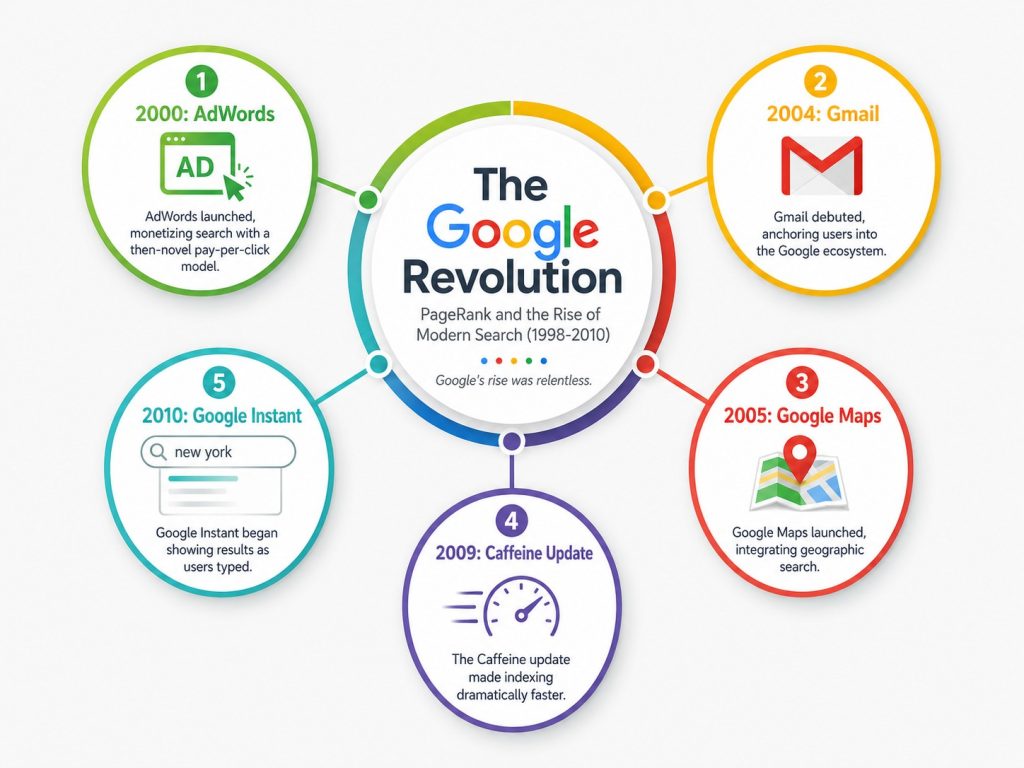
- 2000: AdWords launched, monetizing search with a then-novel pay-per-click model.
- 2004: Gmail debuted, anchoring users into the Google ecosystem.
- 2005: Google Maps launched, integrating geographic search.
- 2009: The Caffeine update made indexing dramatically faster.
- 2010: Google Instant began showing results as users typed.
Over the same period, Google built an entire suite of services that reinforced its search dominance: Google Translate, Google Shopping, Google Scholar, and YouTube (acquired in 2006), now itself the second-largest search engine in the world.
By 2010, Google’s market share in most Western markets exceeded 80%, and the world had effectively standardized on a single front door to the internet.
The Bing Era and Search Diversification (2009-2020)
Microsoft had been in the search game since 1998 as MSN Search, evolving through Windows Live Search and Live Search. In June 2009, the company rebranded and relaunched its engine as Bing, this time with a stronger visual interface, integrated travel and shopping tools, and a clear ambition to challenge Google.
That same year, Bing struck a landmark agreement with Yahoo!, the Search Alliance, in which Bing would power Yahoo’s organic search results. To this day, Yahoo Search runs on Bing’s underlying technology, and together they account for a meaningful share of desktop search traffic, particularly in the United States.
Bing carved out a real position over the years:
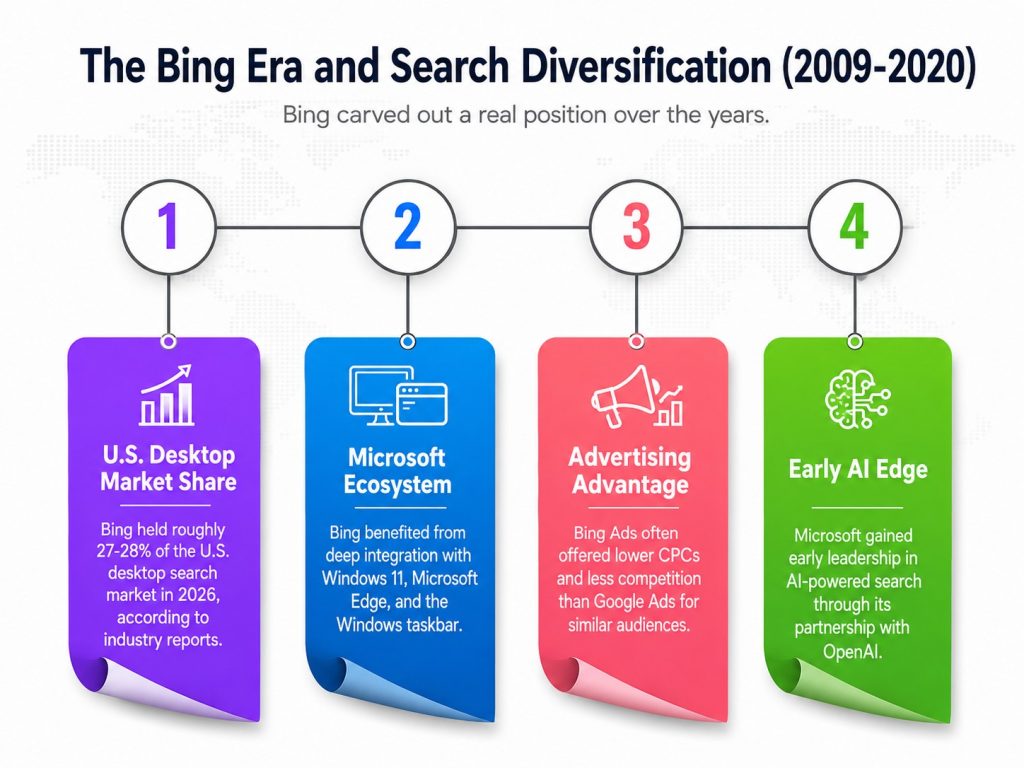
- 27-28% desktop search market share in the U.S. in 2026, according to industry reports.
- Deep integration with Windows 11, Microsoft Edge, and the Windows taskbar.
- A strategic competitive edge through advertising: Bing Ads compared to Google Ads often delivers significantly lower CPCs and less competition for similar audiences.
- Early leadership in AI integration through Microsoft’s partnership with OpenAI.
Bing has never seriously threatened Google’s global dominance, but it has consistently been the most viable alternative, and as of 2026, it is benefiting more than any other engine from the AI search shift.
The AI Revolution: SGE, AI Overviews, and Generative Search
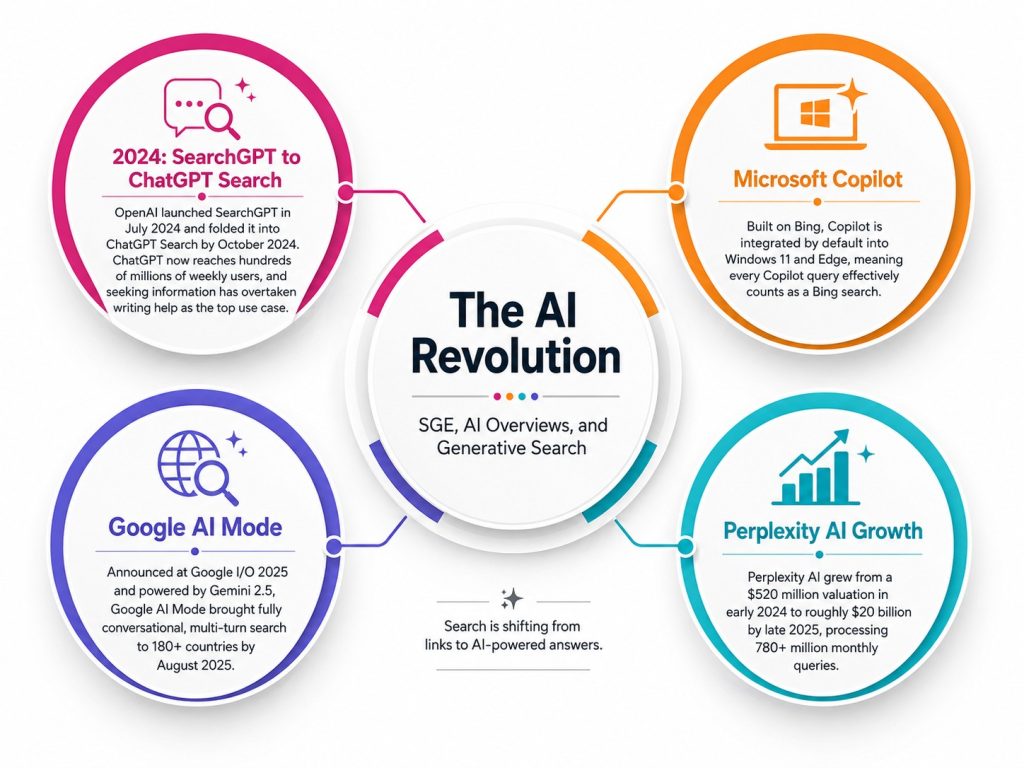
The biggest structural shift in search history began in May 2023, when Google unveiled the Search Generative Experience (SGE) at Google I/O.
By May 2024, Google rebranded SGE as AI Overviews and rolled it out broadly across the U.S.; by late 2025, it was reaching over a billion people across 200+ countries and more than 40 languages.
Meanwhile, the rest of the AI search ecosystem exploded:
- OpenAI launched SearchGPT as a prototype in July 2024 and folded it into ChatGPT Search by October 2024. ChatGPT now reaches hundreds of millions of weekly users, and “seeking information” has overtaken “writing help” as the top use case.
- Microsoft Copilot (built on Bing) is now integrated by default into Windows 11 and Edge, meaning every Copilot query effectively counts as a Bing search.
- Perplexity AI grew from a $520 million valuation in early 2024 to roughly $20 billion by late 2025, processing 780+ million monthly queries.
- Google AI Mode, announced at Google I/O 2026 and powered by Gemini 2.5, brought fully conversational, multi-turn search to 180+ countries.
From SEO to AIO and AEO: The New Optimization Playbook
For two decades, Search Engine Optimization (SEO) was the dominant discipline. In the AI-search era, SEO remains foundational, but two new disciplines are emerging alongside it:
- Artificial Intelligence Optimization (AIO) focuses on structuring your content so that AI systems, such as Google’s Gemini, OpenAI’s GPT models, Anthropic’s Claude, Perplexity, and others, can understand context, intent, and nuance, and surface your brand inside generative search responses.
- AIO is less about exact-match keywords and more about semantic depth, fact-density, and clear topical authority.
- Answer Engine Optimization (AEO) is about crafting content that directly answers the kinds of questions people now ask AI assistants and voice search tools.
- Short, factual, clearly structured answers, often in FAQ, definition-box, or step-list format, are dramatically more likely to be quoted by an AI overview than long, meandering paragraphs.
On-Site Search: The Often-Overlooked Search Frontier
Most discussions of search focus on Google, Bing, and Yahoo. But the search bar inside your own website is just as commercially important often more so, because the users who use it are already on your site and ready to buy.
If a visitor cannot find a product, article, or service on your website quickly, they will leave and likely never return. A strong on-site search experience can lift conversion rates by double-digit percentages and dramatically improve customer satisfaction.
Types of On-Site Search Solutions
There are three primary categories of on-site search technology developers can choose from:
- Free and Open Source Search solutions like Apache Solr or ElasticSearch’s community editions are ideal for teams with engineering capacity.
- Open Source Enterprise commercially supported versions of open-source platforms, offering hardening, security, and SLAs.
- Proprietary Enterprise fully managed solutions like Algolia, Coveo, and Bloomreach, offering AI-powered relevance, personalization, and analytics out of the box.
- The right choice depends on traffic volume, engineering resources, and the centrality of search to your business model.
What's Next: The Future of Search
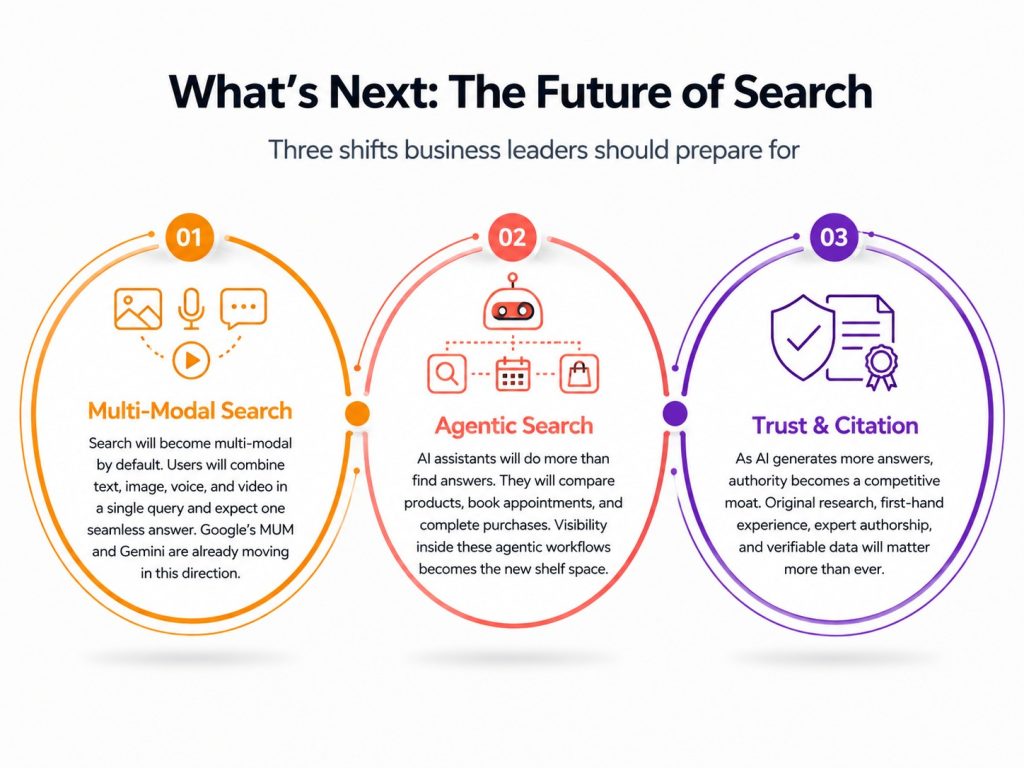
Three forces will shape the next phase of search:
- Multi-modal search will become the default. Users will routinely search by combining text, image, voice, and even video in a single query, expecting the engine to handle all of it.
- Google’s MUM and Gemini are already moving in this direction.
- Agentic search will reshape commerce. AI assistants will not just find answers, they will execute tasks: comparing products, booking appointments, and completing purchases. Visibility inside these agentic workflows is the new shelf space.
- Trust and citation become competitive moats. As AI generates more answers, users (and the AI systems themselves) will lean harder on signals of authority: original research, first-hand experience, expert authorship, and verifiable data.
- Brands that publish genuinely useful, fact-dense content will win disproportionate visibility.