


Table of Contents
Introduction
AMD ROCm™ (Radeon Open Compute) is an open-source software platform that helps developers build and run AI and high-performance computing applications on AMD GPUs. It works across different environments, including cloud servers, edge devices, and personal computers.
AI is moving towards cloud computing, powering everything from enterprise data centers and generative AI applications to personal devices, robotics, and intelligent machines. As AI workloads become more advanced, organizations need flexible platforms that provide scalability, openness, and freedom to innovate.
The evolution of ROCm (Radeon Open Compute) began as AMD focused on creating an open alternative for GPU computing that gives developers greater flexibility, transparency, and control over their AI infrastructure.
Instead of relying on a closed software ecosystem, ROCm was developed to support open-source innovation and enable researchers, enterprises, and developers to optimize applications using AMD accelerated computing platforms.
In this guide, we’ll explore what AMD ROCm is, why it was created, its key capabilities, and how it is helping accelerate AI innovation across cloud, enterprise, edge, and personal computing environments.
AMD ROCm™: One Platform for Every Type of AI
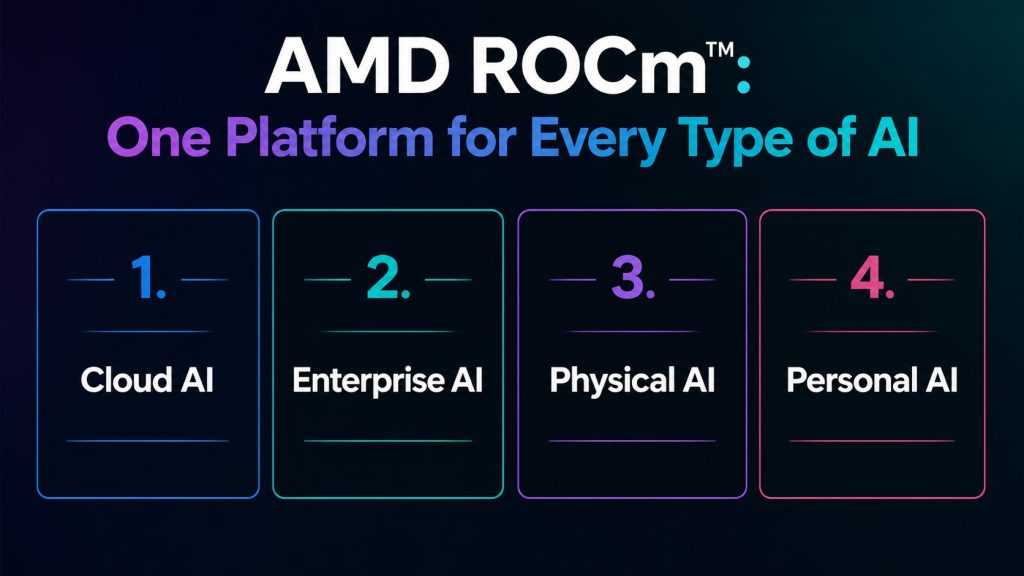
Artificial intelligence is expanding beyond traditional data centers into every part of computing, from large-scale cloud infrastructure to enterprise systems, intelligent machines, and personal AI applications. AMD ROCm™ provides an open-source software foundation that helps developers build, optimize, and deploy AI workloads across these diverse environments.
Unlike closed AI software ecosystems, ROCm is designed around openness, flexibility, and developer choice. It provides the essential tools, libraries, frameworks, and runtime technologies to accelerate AI development on AMD GPUs while supporting modern AI workloads, including training, fine-tuning, inference, and high-performance computing.
Cloud AI
ROCm enables scalable AI workloads in cloud environments by supporting powerful AMD Instinct™ GPUs for large-scale model training, generative AI, and AI inference. Developers and organizations can build cloud-based AI solutions using optimized frameworks, containers, and distributed computing technologies.
Enterprise AI
For businesses adopting AI, ROCm provides an open platform for developing secure and scalable AI applications. It supports enterprise workloads including data analytics, machine learning, automation, scientific computing, and industry-specific AI solutions while giving organizations greater flexibility in their hardware and software choices.
Physical AI
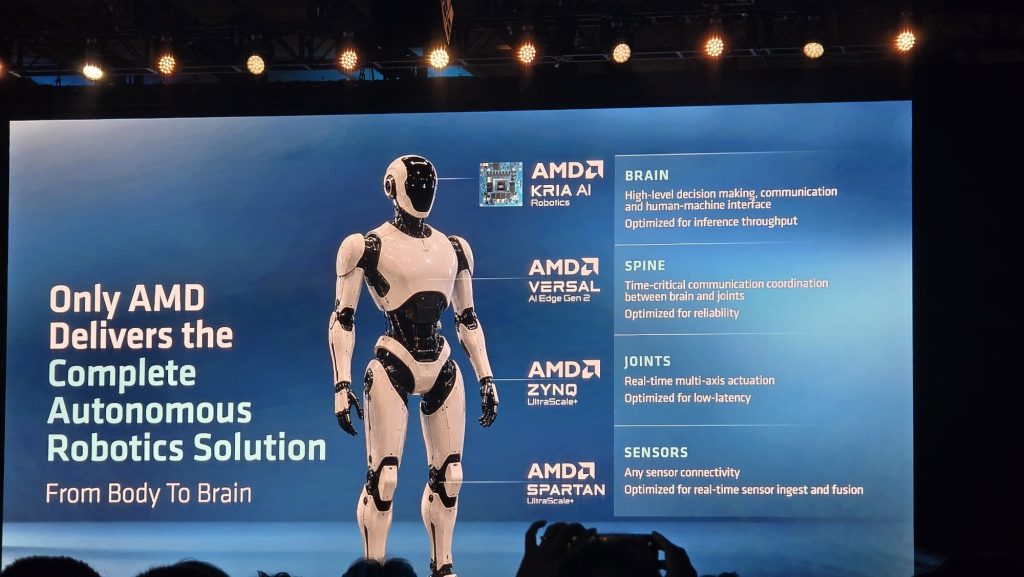
Physical AI brings intelligence into the real world through robotics, autonomous systems, industrial automation, and simulation. ROCm helps power these AI systems by enabling accelerated computing for training models, running simulations, processing real-time data, and deploying intelligent machines.
Personal AI
AI is moving closer to individuals through AI-powered PCs, workstations, and personal applications. ROCm supports developers creating local AI experiences, private AI assistants, creative AI tools, and other personal computing applications by bringing accelerated AI capabilities closer to users.
AMD ROCm Overview
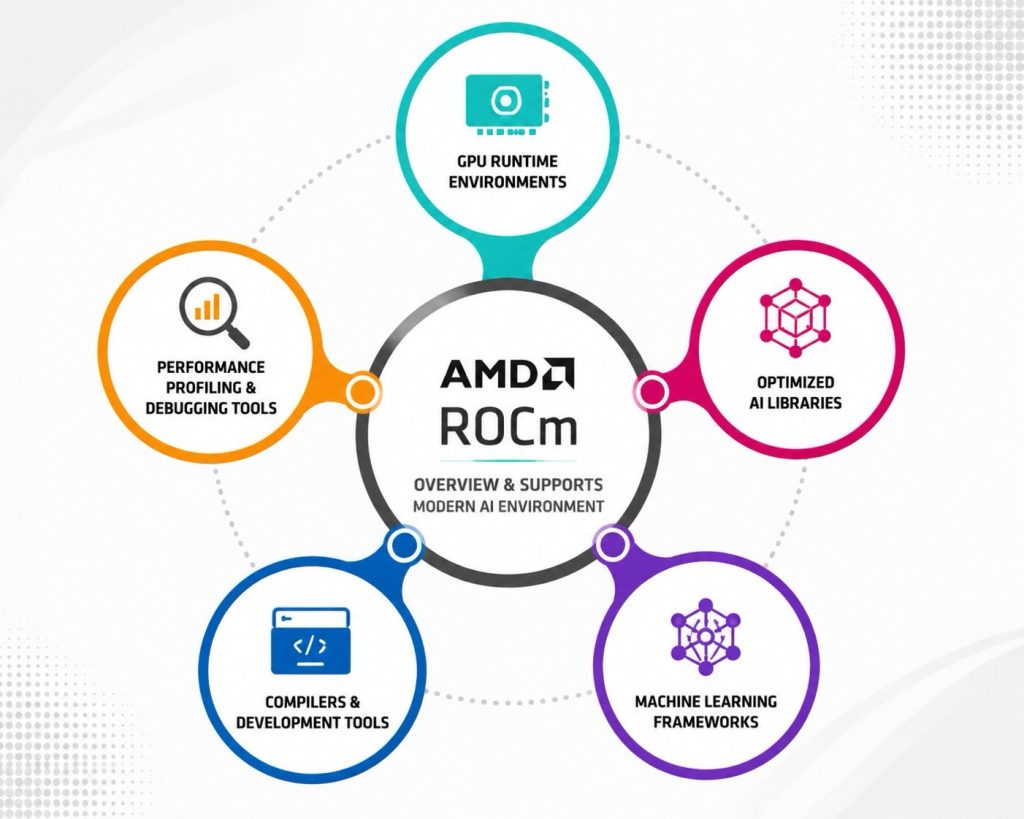
Behind every powerful AI application is a complex software ecosystem that helps hardware, models, and developers work together. AMD ROCm is designed to provide that foundation. AMD ROCm™ is an open-source compute platform designed to accelerate AI workloads across cloud, enterprise, edge, and personal computing environments.
It enables developers to build, train, optimize, and deploy AI and high-performance computing (HPC) applications using AMD Instinct™ GPUs.
Instead of creating a closed environment, AMD built ROCm around openness and compatibility, allowing developers to use popular AI frameworks, tools, and libraries they already know.
From training large AI models to running real-time inference applications, ROCm provides the essential components needed to support AI workloads.
Key components include:
- GPU Runtime Environments: Enable efficient communication between AI applications and AMD GPU hardware.
- Optimized AI Libraries: Improve performance for machine learning, deep learning, and scientific computing workloads.
- Machine Learning Framework Support: Works with popular platforms including PyTorch, TensorFlow, JAX, and ONNX Runtime.
- Compilers and Development Tools: Help developers build and optimize AI applications.
Performance Monitoring Tools: Provide profiling, debugging, and optimization capabilities.
AMD ROCm History
AMD ROCm™ (Radeon Open Compute platform) launched in 2016 as an open-source GPU software stack to accelerate computing on AMD hardware. It evolved from an HPC-focused platform into a key foundation for AI, deep learning, and large-scale GPU workloads.
Before ROCm
AMD explored multiple GPU computing solutions but faced ecosystem and adoption challenges.
- Close to Metal & Stream: Early GPGPU platforms with limited developer adoption.
- HSA & OpenCL: Open standards that lacked deep AI framework integration.
ROCm Launch and Growth (2016–2020)
ROCm unified AMD’s GPU software ecosystem and improved compatibility with existing GPU applications.
- HIP & HIPIFY: Enabled easier CUDA code migration to AMD GPUs.
- Open-Source Stack: Combined tools, libraries, and runtimes into one platform.
AI & Supercomputing Expansion (2021–2023)
ROCm expanded into AI and large-scale computing through stronger framework support.
- Exascale Systems: Powered supercomputers like Frontier and El Capitan.
- AI Framework Support: Added native integration with PyTorch and TensorFlow.
Modern ROCm Era (2024–2026)
ROCm became a production-ready AI platform with faster development cycles.
- AI Ecosystem Support: Enabled modern LLM and AI workloads through projects like vLLM.
- TheRock Architecture: Introduced a modular design for faster updates.
- Six-Week Releases: Accelerated feature improvements and hardware support.
GPU and APU in AMD ROCm
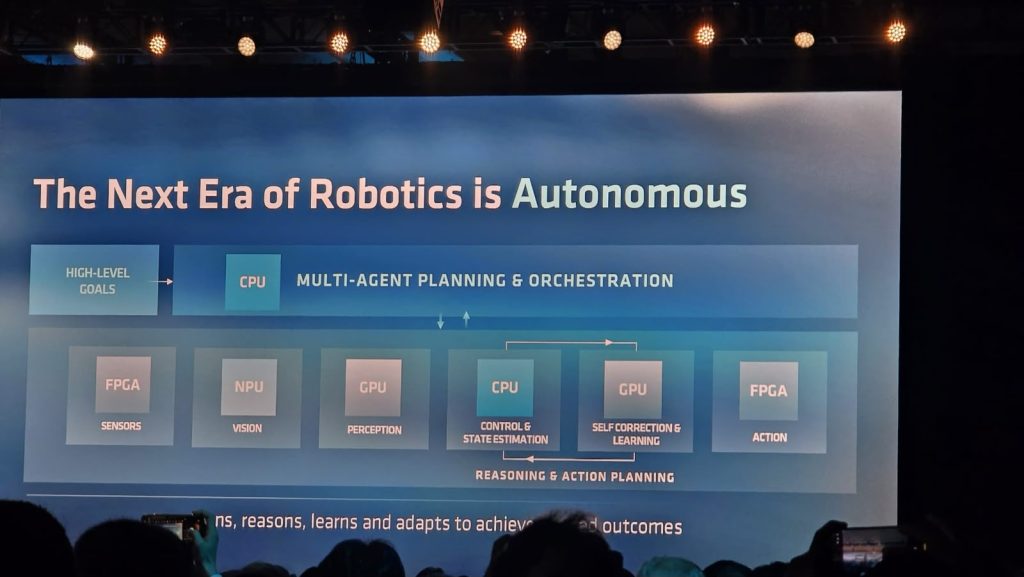
Built on AMD Instinct™ GPUs and AMD CDNA™ architecture, ROCm helps organizations create scalable AI solutions across cloud, enterprise, edge, and personal computing environments.
In AMD ROCm (Radeon Open Compute), APU and GPU refer to the two different hardware architectures that the software stack uses to accelerate Artificial Intelligence (AI) and High-Performance Computing (HPC) workloads. The primary difference lies in how their internal processors and memory systems interact.
- GPU in ROCm: A GPU (Graphics Processing Unit) in the context of ROCm
- APU in ROCm: An APU (Accelerated Processing Unit) is a hybrid chip that fuses a CPU and a high-performance GPU onto a single piece of silicon.
AMD ROCm™ Framework Compatibility
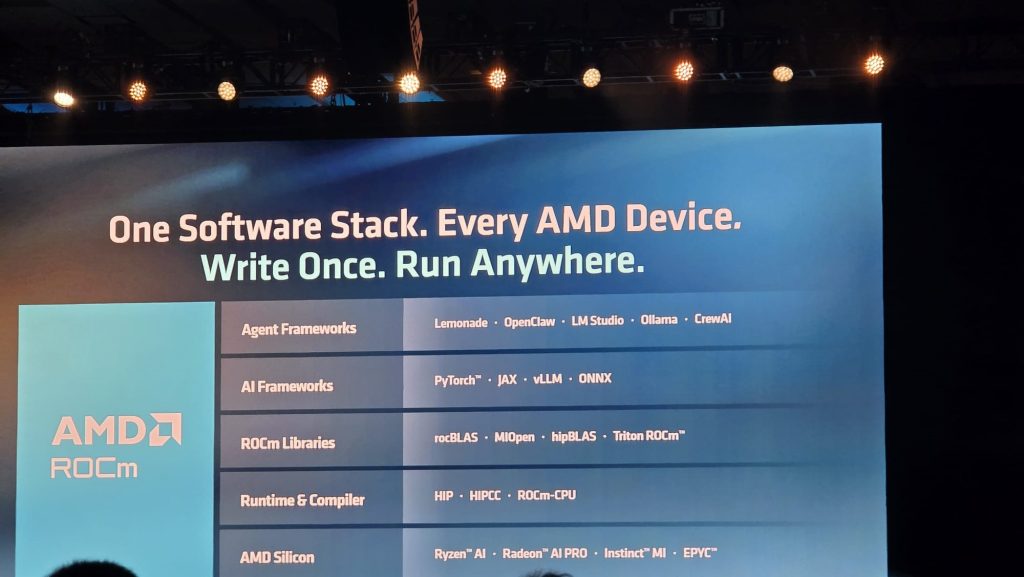
AMD ROCm™ supports leading AI frameworks, helping developers build and deploy AI applications on compatible AMD platforms.
| AI Framework | ROCm Support |
| PyTorch | Supports AI training, fine-tuning, and inference on AMD GPUs. |
| TensorFlow | Enables machine learning workloads with AMD GPU acceleration. |
| JAX / XLA | Accelerates AI and high-performance computing workloads. |
| ONNX Runtime | Supports optimized AI model deployment and inference. |
ROCm Hardware and Software Compatibility
ROCm compatibility varies by ROCm version, hardware, operating system, and framework support. AMD provides a compatibility matrix to verify supported configurations.
| Compatibility Area | Support |
| Hardware | AMD Instinct™ GPUs, Radeon™ GPUs, and supported AMD platforms |
| Operating Systems | Compatible Linux distributions and environments |
| Frameworks | PyTorch, TensorFlow, JAX, ONNX Runtime, and more |
| ROCm Versions | Version-specific hardware and software support |
Why AMD Built ROCm
Major goals:
- Open-source AI software ecosystem
- Hardware and software flexibility
- Support for modern AI frameworks
- Easier AI development and deployment
- Scalable performance from workstation to data center environments
Key Highlights of AMD ROCm™
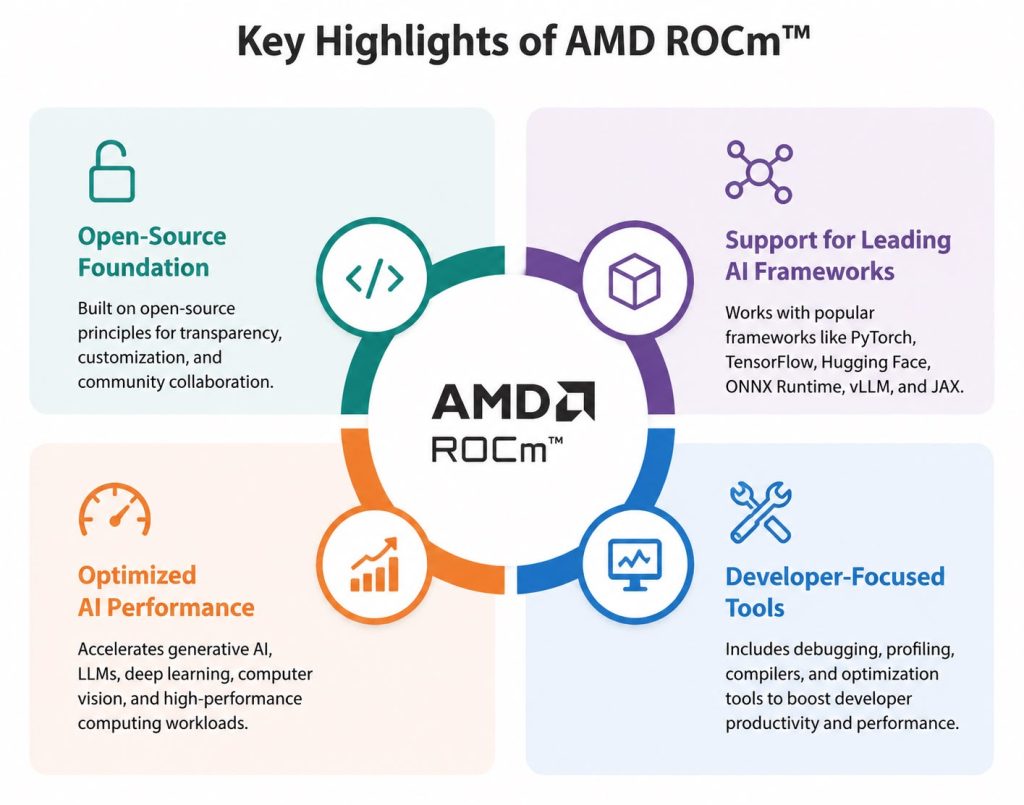
AMD ROCm combines open software capabilities with AMD Instinct™ GPUs to create a complete AI development ecosystem. Some of its major capabilities include:
- Open-Source Foundation: ROCm provides an open software environment that encourages transparency, customization, and collaboration across the AI community.
- Support for Leading AI Frameworks: Developers can work with widely adopted AI frameworks such as PyTorch, TensorFlow, Hugging Face, ONNX Runtime, vLLM, and JAX.
- Optimized AI Performance: ROCm helps accelerate workloads including generative AI, large language models, deep learning, computer vision, and high-performance computing.
- Developer-Focused Tools: With debugging, profiling, compiler tools, and optimization capabilities, ROCm helps developers improve application performance.
- Flexible AI Deployment: Whether AI runs in cloud infrastructure, enterprise environments, edge systems, or personal devices, ROCm provides the software foundation needed to support different AI scenarios.
AMD ROCm vs NVIDIA CUDA: What's the Difference?
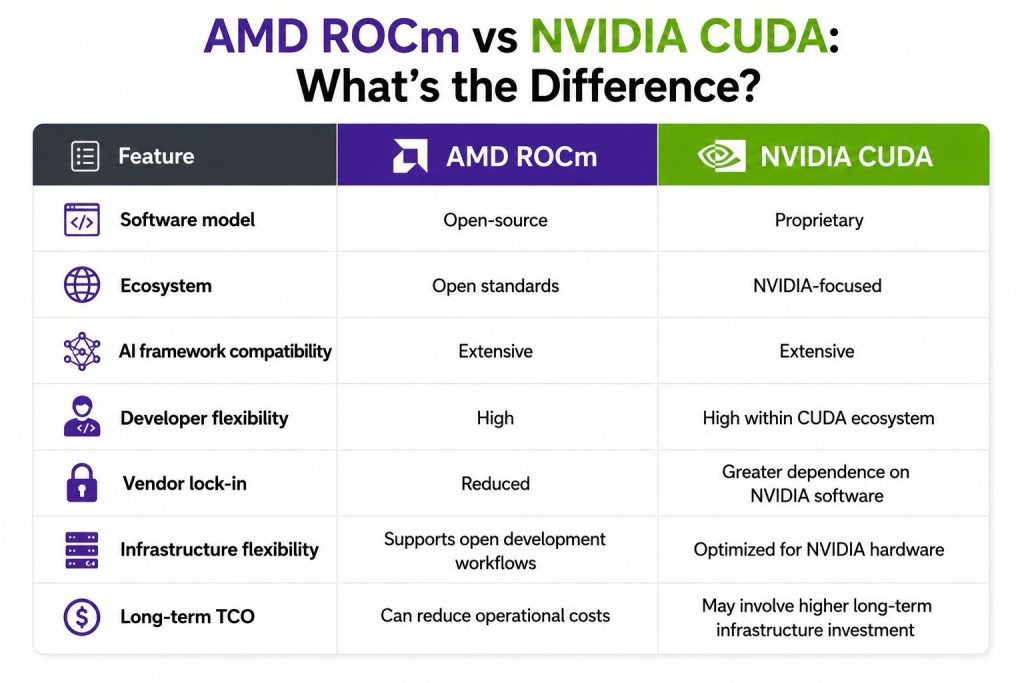
One of the most common questions organizations ask when evaluating AI infrastructure is how AMD ROCm compares with NVIDIA CUDA.
While both platforms enable GPU-accelerated computing, they take different approaches to software development and ecosystem design.
Feature | AMD ROCm | NVIDIA CUDA |
Software model | Open-source | Proprietary |
Ecosystem | Open standards | NVIDIA-focused |
AI framework compatibility | Extensive | Extensive |
Developer flexibility | High | High within CUDA ecosystem |
Vendor lock-in | Reduced | Greater dependence on NVIDIA software |
Infrastructure flexibility | Supports open development workflows | Optimized for NVIDIA hardware |
Long-term TCO | Can reduce operational costs | May involve higher long-term infrastructure investment |
How ROCm Can Improve Total Cost of Ownership (TCO)
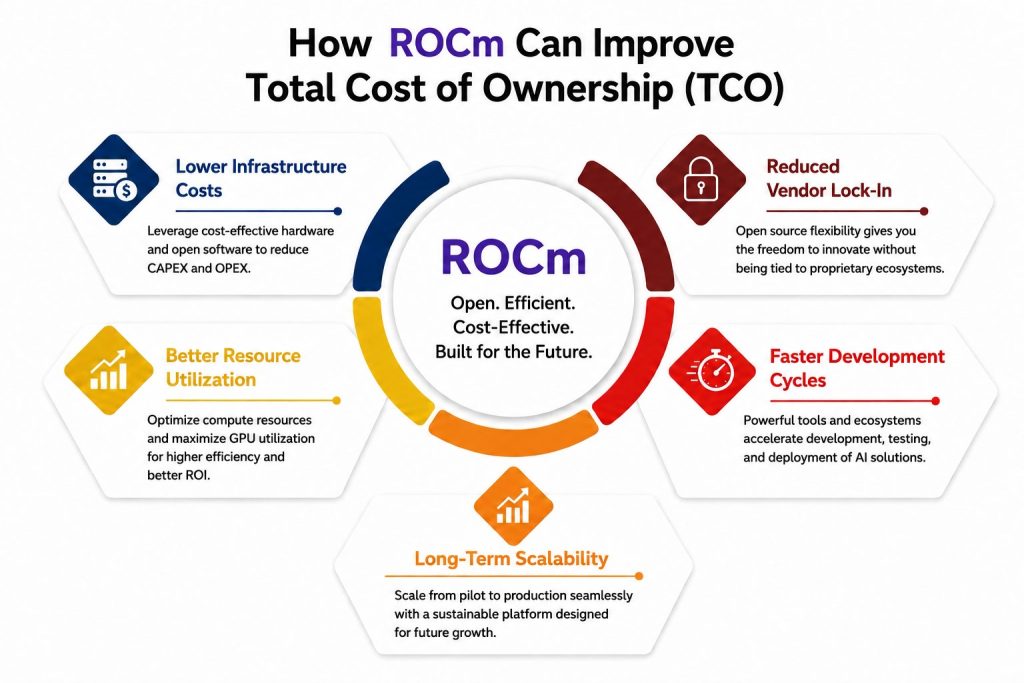
As AI projects grow, hardware acquisition costs are only one part of the overall investment. Organizations must also consider software flexibility, operational efficiency, infrastructure scalability, and future technology decisions.
AMD ROCm helps improve Total Cost of Ownership (TCO) by addressing several of these factors.
Lower Infrastructure Costs
Because ROCm is designed around open software principles, organizations can optimize their AI infrastructure without being tied to proprietary software ecosystems. This flexibility can simplify long-term planning and reduce barriers when expanding AI environments.
Reduced Vendor Lock-In
Vendor lock-in can increase migration complexity and limit future infrastructure choices. ROCm’s support for open frameworks and industry standards enables organizations to maintain greater flexibility as AI technologies continue evolving.
Better Resource Utilization
Optimized GPU libraries and runtime components help organizations make better use of available computing resources. Efficient utilization can improve productivity while supporting increasingly demanding AI workloads.
Faster Development Cycles
Developers spend less time adapting applications to proprietary software environments when they can continue using familiar frameworks and tools. Shorter development cycles allow organizations to:
- Build prototypes faster
- Deploy AI solutions sooner
- Iterate models more efficiently
- Respond quickly to changing business needs
- Long-Term Scalability
- AI infrastructure investments are expected to support years of growth. ROCm’s open ecosystem enables businesses to scale
AI workloads while maintaining compatibility with frameworks and emerging technologies.
AMD ROCm™ Case Studies
Microsoft Azure: Hyperscale Cloud Infrastructure
- The ROCm Solution: Azure deployed AMD Instinct MI300X instances tightly integrated with Azure Kubernetes Service (AKS). They leveraged the modular installation path of ROCm to deploy only runtime-critical packages into individual container nodes.
- The Outcome: Delivered over a 2x improvement in throughput and latency for large language models compared to alternative legacy accelerator configurations. Furthermore, the AMD EPYC platform paired with ROCm allowed Azure to yield a 26% reduction in cloud OPEX.
Hugging Face: Native Zero-Click Developer Workflows

- The Challenge: Providing frictionless model access to millions of developers without forcing them to manually compile software or write custom execution kernels for AMD hardware.
- The ROCm Solution: Hugging Face integrated AMD Developer Cloud into their primary model repository interface. This relies on upstreamed ROCm libraries that seamlessly convert standard PyTorch and TensorFlow inference calls into GPU-executable code.
- The Outcome: Developers can now launch massive foundational models such as the Qwen 3.6 collection on AMD platforms via a one-click Jupyter environment, avoiding manual hardware abstraction layers or driver workarounds.
vLLM Ecosystem: Upstream “First-Class Platform” Status
- The Challenge: Open-source AI serving frameworks historically required hardware-specific forks, leading to unpatched bugs and delayed feature updates for non-proprietary ecosystems.
- The ROCm Solution: The core vLLM development team integrated ROCm directly into the main repository branch. They introduced native FP8/FP4 quantization kernels, assembly-level page attention, and custom triton-scaled matrix multiplications specifically for RDNA and CDNA hardware.
- The Outcome: Test pass rates within the continuous integration (CI) pipeline scaled dramatically from 37% to 93%. The deep structural enhancements led to a 3x faster prefill and a 40% increase in decoding speeds for live transformer engines.
310 AI: Accelerated Molecular Design & Therapeutics

- The Challenge: A biological AI startup needed massive memory capacities to process complex structural matrices for text-to-protein generative sequences, which frequently stalled on standard 80GB VRAM limits.
- The ROCm Solution: 310 AI utilized ROCm 6 on AMD Instinct MI300 series GPUs. The open-source libraries allowed them to take full advantage of the hardware’s unified, ultra-dense 192 GB High-Bandwidth Memory (HBM3) architectures.
- The Outcome: Removed memory-swapping bottlenecks entirely during token generation, automating the creation of fully functional, novel protein sequences at a fraction of their previous multi-GPU cluster cost.
Lamini: Enterprise LLM Fine-Tuning & Quantization
- The Challenge: Enterprise clients require exclusive, air-gapped deployments and hyper-optimized model tuning without sharing data back to centralized proprietary APIs.
- The ROCm Solution: Lamini utilized the advanced graph optimizations inside the AMD ROCm 6 software stack to orchestrate cluster-wide post-training quantization. They deployed the stack’s native attention algorithms directly on enterprise-owned server hardware.
- The Outcome: Achieved an 8x performance increase for text generation latency relative to older hardware-and-software configurations, allowing enterprise clients to host completely private, fine-tuned models.
LeRobot (Edge-to-Cloud Robotics): Real-Time Inference

- The Challenge: Running low-latency physical AI tasks such as real-time computer vision and pick-and-place robotic arm telemetry on compact edge systems rather than the cloud.
- The ROCm Solution: Implemented a unified ROCm runtime on local AMD Ryzen AI PC environments running Ubuntu. ROCm’s shared memory fabric allowed a local PyTorch instance to map datasets directly between the CPU and NPU/iGPU engines without memory overhead.
- The Outcome: Enabled local vision-language models (VLMs) and robotic teleoperation loops to run efficiently at the edge, maintaining a steady 50 frames per second (FPS) on a highly constrained power envelope.
- The Challenge: Running low-latency physical AI tasks such as real-time computer vision and pick-and-place robotic arm telemetry on compact edge systems rather than the cloud.
The Future of Open AI Development with AMD
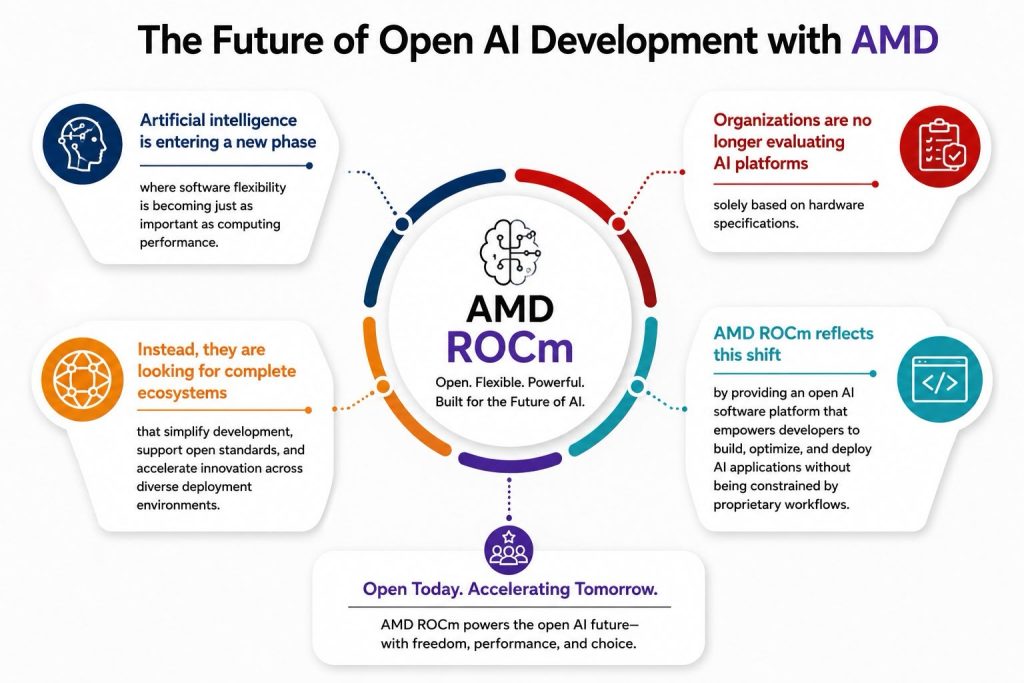
Artificial intelligence is entering a new phase where software flexibility is becoming just as important as computing performance.
- Organizations are no longer evaluating AI platforms solely based on hardware specifications.
- Instead, they are looking for complete ecosystems that simplify development, support open standards, and accelerate innovation across diverse deployment environments.
- AMD ROCm reflects this shift by providing an open AI software platform that empowers developers to build, optimize, and deploy AI applications without being constrained by proprietary workflows.
- As AI continues expanding into cloud computing, enterprise applications, edge devices, personal AI, robotics, and scientific computing, the demand for open and scalable software platforms will only increase.
- AMD continues investing in ROCm through ongoing performance improvements, broader framework compatibility, stronger ecosystem partnerships, and enhanced developer tools.

Deepak Wadhwani has over 20 years experience in software/wireless technologies. He has worked with Fortune 500 companies including Intuit, ESRI, Qualcomm, Sprint, Verizon, Vodafone, Nortel, Microsoft and Oracle in over 60 countries. Deepak has worked on Internet marketing projects in San Diego, Los Angeles, Orange Country, Denver, Nashville, Kansas City, New York, San Francisco and Huntsville. Deepak has been a founder of technology Startups for one of the first Cityguides, yellow pages online and web based enterprise solutions. He is an internet marketing and technology expert & co-founder for a San Diego Internet marketing company.