Introduction
Artificial intelligence is moving from simple chat-based assistance toward intelligent systems capable of managing complex workflows, analyzing business data, writing code, and supporting everyday decisions. The latest evolution in this direction is GPT-6 Sol and GPT-6 Luna, two models designed to bring advanced AI capabilities to different types of users and business needs.
While previous AI generations focused heavily on generating text and answering questions, newer models are designed around reasoning, automation, collaboration, and practical problem-solving. GPT-6 Sol focuses on advanced professional tasks requiring deeper reasoning, while GPT-6 Luna emphasizes speed, efficiency, and cost-effective AI adoption for high-volume workflows.
For businesses, this shift represents a major change. AI is no longer only a productivity tool. It is becoming a technology layer that can support marketing, customer service, operations, software development, research, and decision-making.
What Are GPT-6 Sol and Luna?
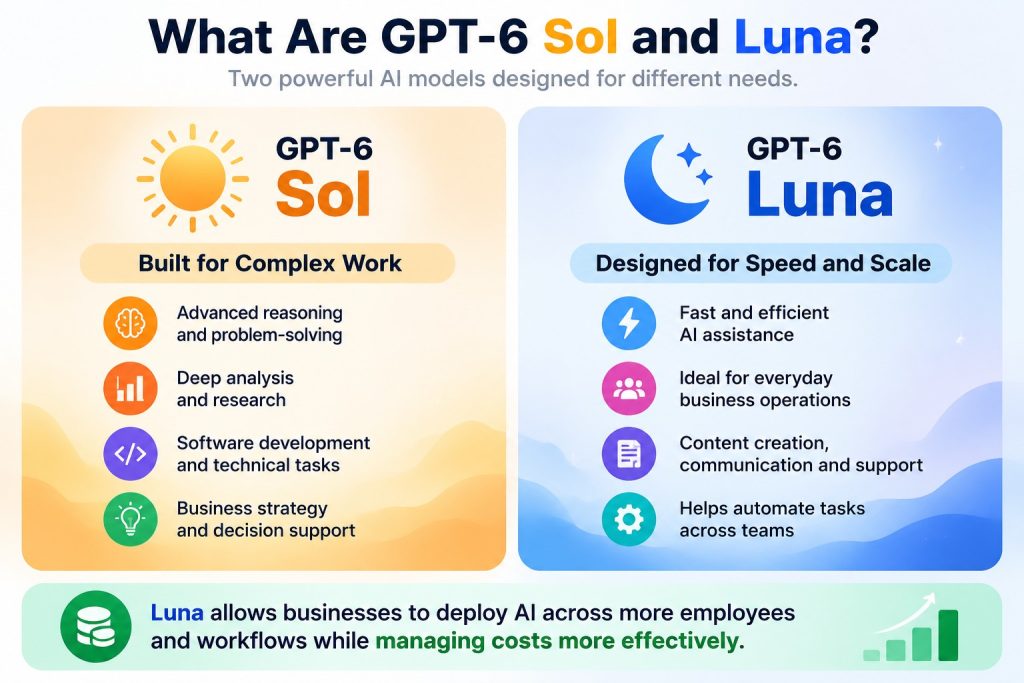
GPT-6 Sol and GPT-6 Luna are part of the GPT-6 model family developed to provide different levels of intelligence, speed, and cost efficiency depending on the user’s requirements.
Instead of using one AI model for every task, businesses can choose a model based on complexity.
GPT-6 Sol: Built for Complex Work
GPT-6 Sol is designed for tasks that require deeper reasoning, higher accuracy, and advanced problem-solving.
Common use cases include:
- Business strategy development
- Advanced research and analysis
- Software engineering
- Data interpretation
- Complex automation workflows
- Enterprise AI applications
For example, a company analyzing thousands of customer records, building internal AI agents, or developing software products may benefit from Sol’s stronger reasoning.
GPT-6 Luna: Designed for Speed and Scale
GPT-6 Luna focuses on fast, efficient AI assistance for everyday business operations.
Typical applications include:
- Customer support responses
- Content creation
- Email automation
- Document summaries
- Internal communication
- Marketing assistance
Luna allows businesses to deploy AI across more employees and workflows while managing costs more effectively.
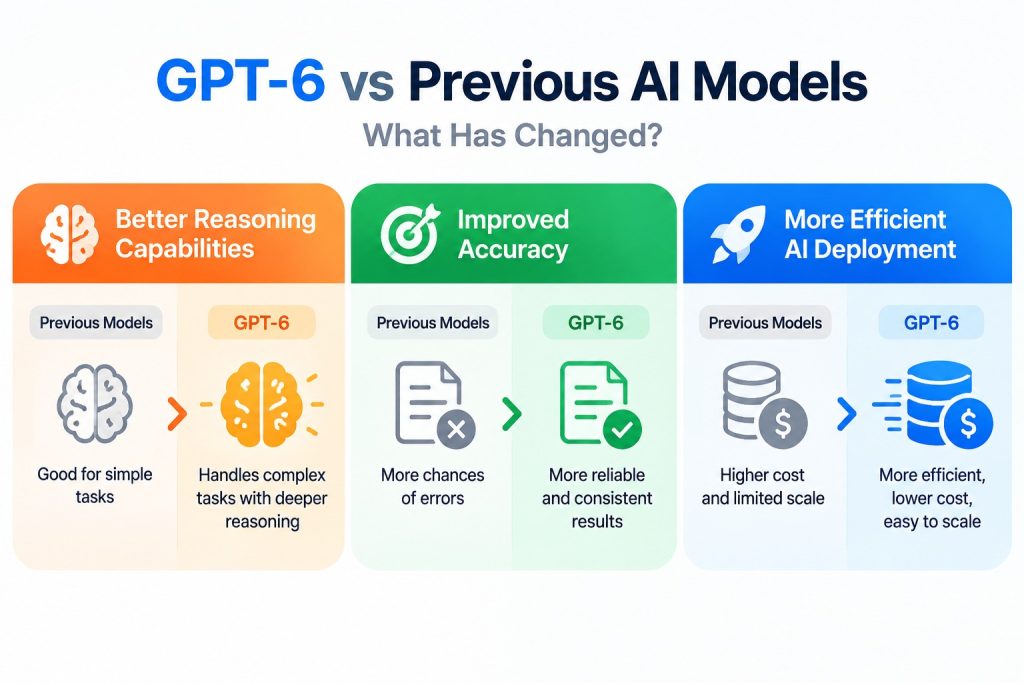
GPT-6 vs Previous AI Models: What Has Changed?
Each generation of AI models has improved in areas such as reasoning, reliability, coding ability, and understanding of user intent. GPT-6 continues this trend by focusing not only on intelligence but also on practical usability.
Key improvements include:
Better Reasoning Capabilities
Earlier AI models could generate useful responses but sometimes struggled with multi-step problems. GPT-6 models are designed to handle longer workflows that require planning, evaluation, and decision-making.
Examples:
- Creating business strategies
- Reviewing large documents
- Analyzing financial information
- Building technical solutions
Improved Accuracy
Businesses depend on reliable information. GPT-6 Sol and Luna focus on reducing factual errors and improving consistency during professional tasks. OpenAI has reported improvements in factual reliability compared with previous models.
More Efficient AI Deployment
One major challenge with advanced AI has been cost. GPT-6 Sol and Luna introduce improvements in efficiency, allowing organizations to use AI at a larger scale.
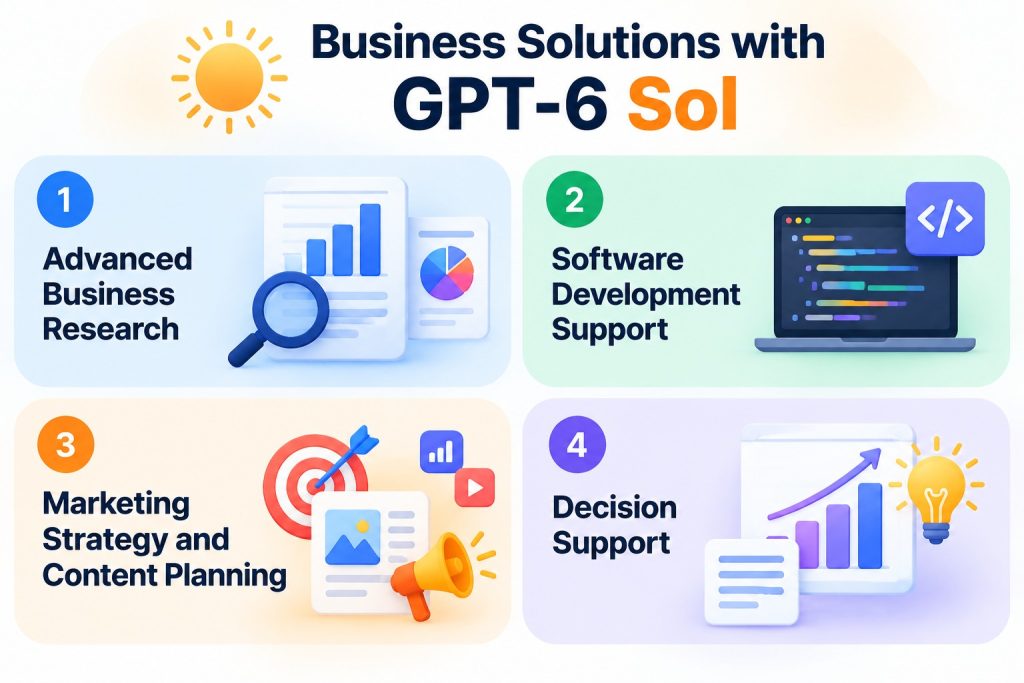
Business Solutions with GPT-6 Sol
GPT-6 Sol can help businesses solve problems that require analysis, creativity, and strategic thinking.
1. Advanced Business Research
Companies can use Sol to analyze:
- Market trends
- Competitor activity
- Customer behavior
- Industry reports
- Business opportunities
Instead of spending hours reviewing information manually, teams can use AI to organize insights and identify patterns.
2. Software Development Support
Development teams can use GPT-6 Sol for:
- Writing and reviewing code
- Debugging applications
- Creating documentation
- Understanding complex systems
- Improving development workflows
AI-assisted coding can help developers complete tasks faster while maintaining quality standards.
3. Marketing Strategy and Content Planning
Marketing teams can use GPT-6 Sol to:
- Analyze audience segments
- Develop campaign strategies
- Create content frameworks
- Improve SEO planning
- Generate customer insights
For agencies and brands, AI can become a strategic partner rather than only a writing assistant.
4. Decision Support
Executives can use AI models to review information and explore possible outcomes.
Examples:
- Evaluating business opportunities
- Comparing operational strategies
- Summarizing complex reports
- Preparing executive presentations
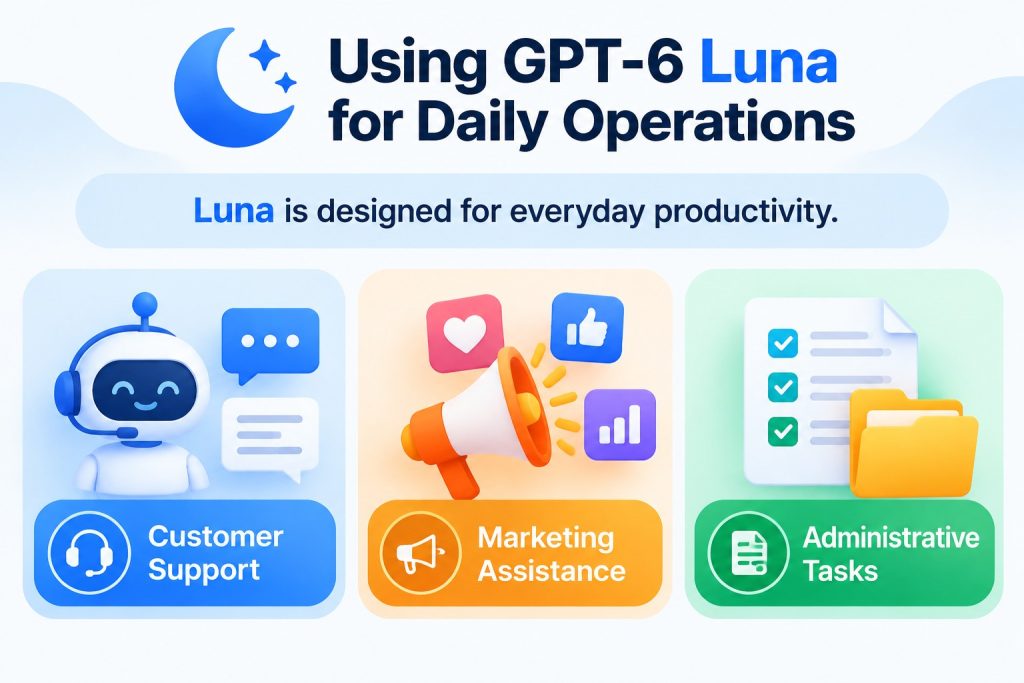
Using GPT-6 Luna for Daily Operations
While Sol focuses on complex tasks, Luna is designed for everyday productivity.
Businesses can integrate Luna into regular workflows.
Customer Support Automation
AI-powered support systems can:
- Answer common customer questions
- Provide product information
- Categorize requests
- Assist human support teams
This allows businesses to provide faster responses while maintaining human involvement for complex cases.
Marketing Assistance
Marketing teams can use Luna for:
- Social media drafts
- Email campaigns
- Blog outlines
- Product descriptions
- Customer communication
Administrative Tasks
Employees can use Luna to reduce repetitive work:
- Summarizing meetings
- Creating reports
- Organizing information
- Drafting documents
For small businesses, this creates access to AI-powered assistance without requiring large technical teams.
AI Automation with GPT-6 Sol and Luna
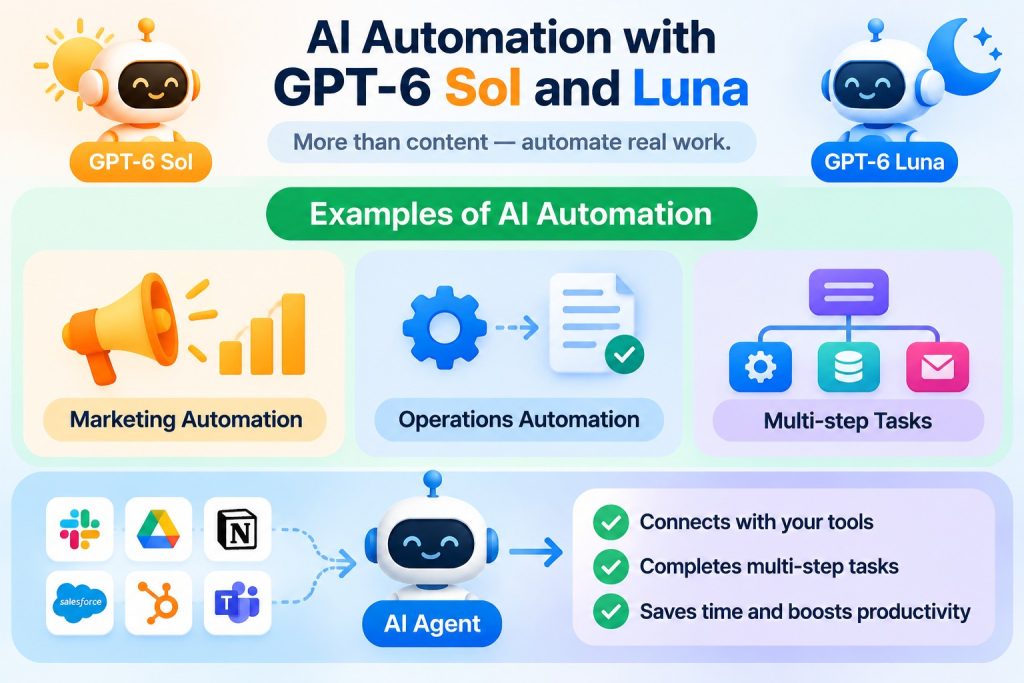
The biggest opportunity with GPT-6 is not simply generating content. It is connecting AI with business systems to automate workflows.
Examples of AI Automation
Sales Automation
AI can help:
- Qualify leads
- Analyze customer conversations
- Draft follow-up messages
- Update CRM records
Marketing Automation
Businesses can automate:
- Content planning
- Campaign analysis
- Customer segmentation
- Performance reporting
Operations Automation
AI systems can support:
- Document processing
- Internal knowledge management
- Workflow management
- Employee assistance
By combining GPT-6 models with business tools, companies can create AI agents capable of completing multi-step tasks.
GPT-6 for Enterprise AI Adoption
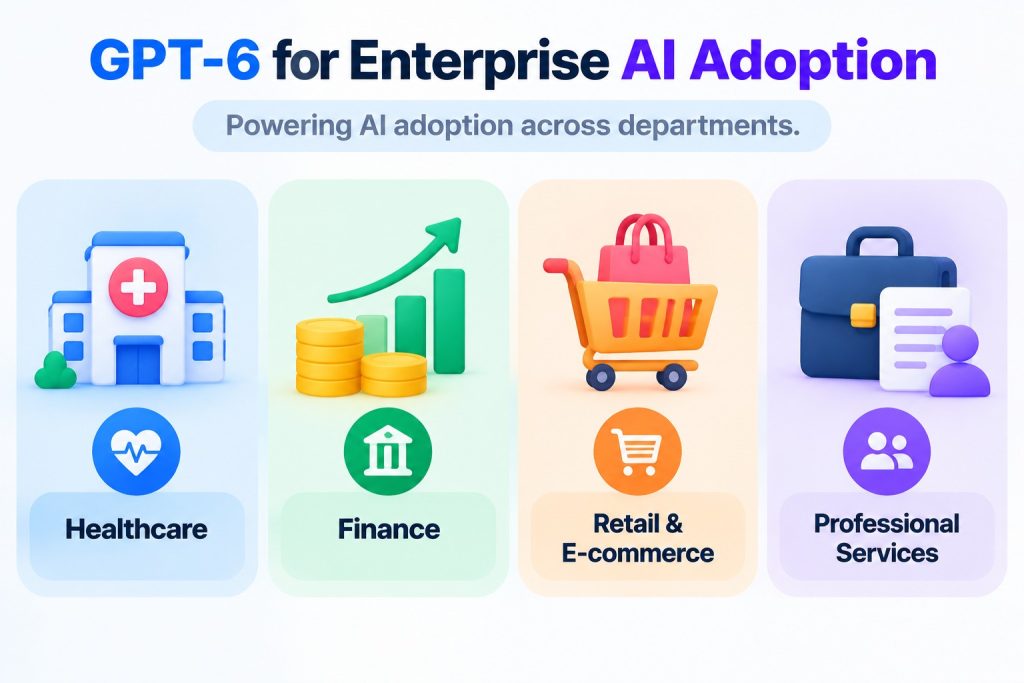
Large organizations are increasingly exploring AI adoption across departments. GPT-6 models provide businesses with different options based on their needs, from advanced enterprise applications to everyday employee assistance.
Enterprise adoption areas include:
Healthcare
Potential applications:
- Administrative automation
- Research assistance
- Patient communication support
- Documentation workflows
Finance
AI can support:
- Report analysis
- Risk assessment
- Customer service
- Financial research
Retail and E-commerce
Businesses can use AI for:
- Product recommendations
- Customer support
- Inventory insights
- Marketing personalization
Professional Services
Companies in consulting, legal, and technology sectors can use AI for:
- Research
- Document preparation
- Knowledge management
- Client communication
GPT-6 vs Traditional Software
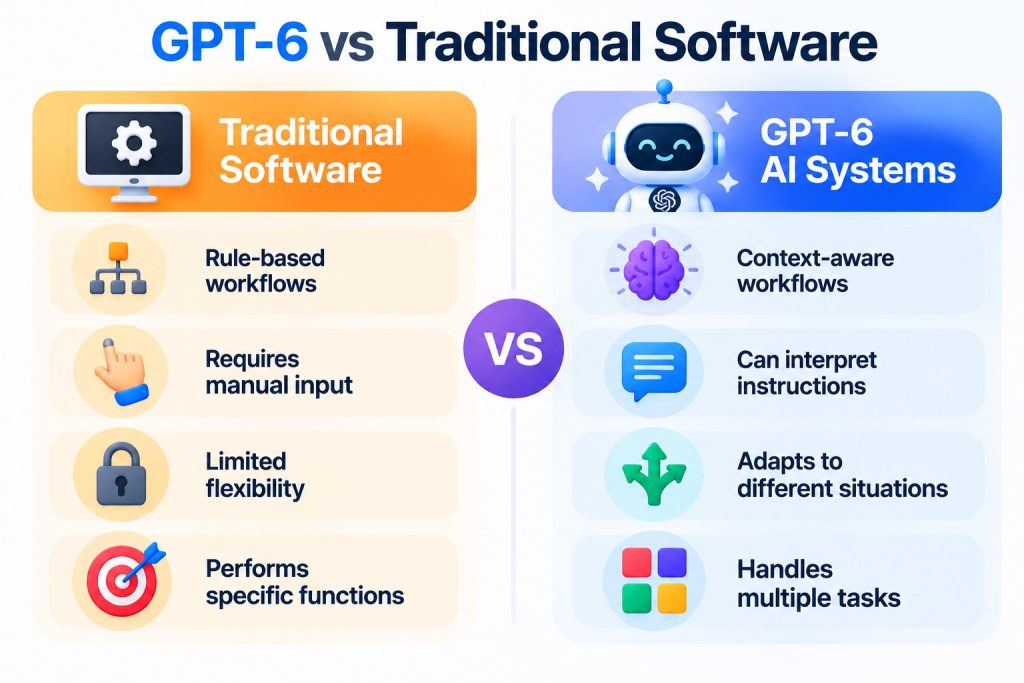
Traditional software follows predefined rules. AI-powered systems can understand context, adapt responses, and handle more flexible tasks.
Traditional Software | GPT-6 AI Systems |
Rule-based workflows | Context-aware workflows |
Requires manual input | Can interpret instructions |
Limited flexibility | Adapts to different situations |
Performs specific functions | Handles multiple tasks |
Things to Consider Before Implementing GPT-6
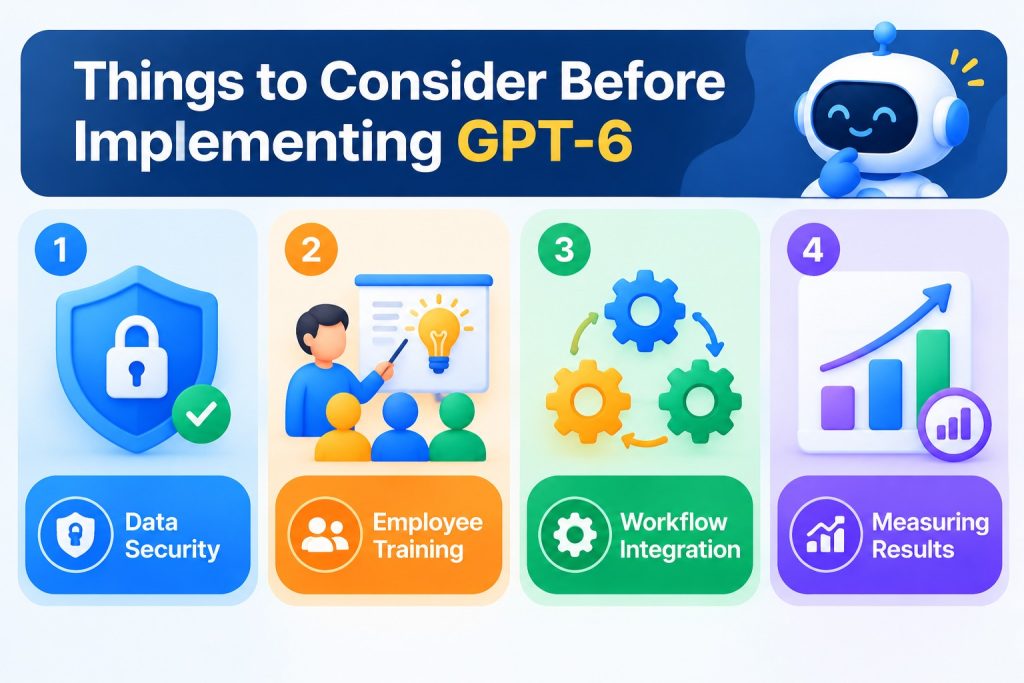
Although AI provides significant opportunities, businesses should consider several factors before adoption.
Data Security
Companies should evaluate:
- What information AI systems access
- How data is stored
- Who can use AI tools
Employee Training
Successful AI adoption requires employees to understand:
- How to write effective prompts
- How to verify AI outputs
- When human review is necessary
Workflow Integration
AI works best when connected to existing business processes rather than used as an isolated tool.
Measuring Results
Businesses should define success metrics such as:
- Time saved
- Increased productivity
- Customer satisfaction
- Reduced operational costs
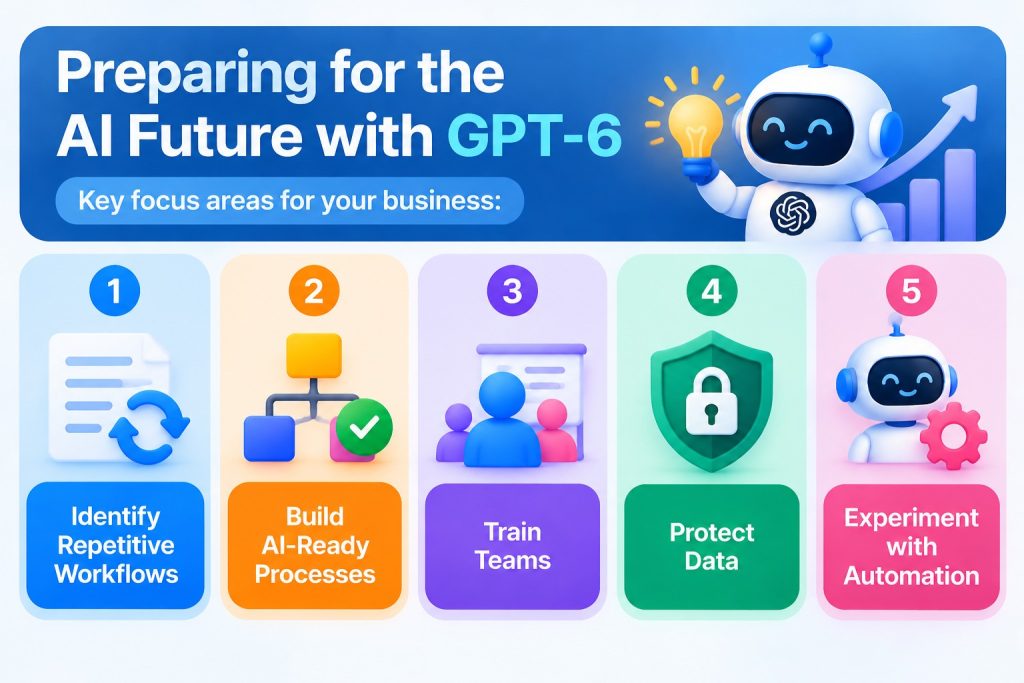
Preparing for the AI Future with GPT-6
The future of business will likely involve collaboration between humans and intelligent AI systems. GPT-6 Sol and Luna represent a move toward more accessible, practical, and scalable AI adoption.
Organizations that prepare early can explore how AI fits into their operations, customer experiences, and decision-making processes.
The next stage of AI will not only be about generating answers. It will be about creating systems that understand goals, complete tasks, and support people in meaningful ways.
Businesses preparing for this future should focus on:
- Identifying repetitive workflows
- Building AI-ready processes
- Training teams
- Protecting data
- Experimenting with automation
GPT-6 Sol and Luna show how artificial intelligence is evolving from a simple assistant into a powerful business capability. The companies that learn how to use AI effectively will be better positioned as technology continues to transform the way work is done.