Table of Contents
Introduction
Traditional RAG has been a game-changer for providing LLMs with context, but we’ve all hit that wall where the system retrieves the wrong document and confidently hallucinates an answer anyway. It’s a passive, one-shot process that often feels like a librarian who hands you the first book they see and walks away without checking if it actually helps.
To fix this, the industry has introduced Agentic Retrieval-Augmented Generation—affectionately known as Agentic RAG. The word “Agentic” stems from the concept of agency, meaning the system isn’t just a static pipeline but an autonomous agent capable of making its own choices, evaluating its own progress, and choosing the best tools for the job.
Enter Agentic RAG, the move from a static pipeline to a dynamic, reasoning loop where the AI acts more like a persistent researcher. Instead of just fetching and summarizing, it evaluates the quality of the data it finds, decides if it needs more information, and iterates until it actually solves the problem at hand.
This shift represents a massive leap in how we build AI applications, moving away from “hope-based” retrieval toward a system that can self-correct. By giving the model the agency to plan and critique its own search path, Agentic RAG ensures that the final output isn’t just fast, but genuinely accurate and reliable.

Core Architecture
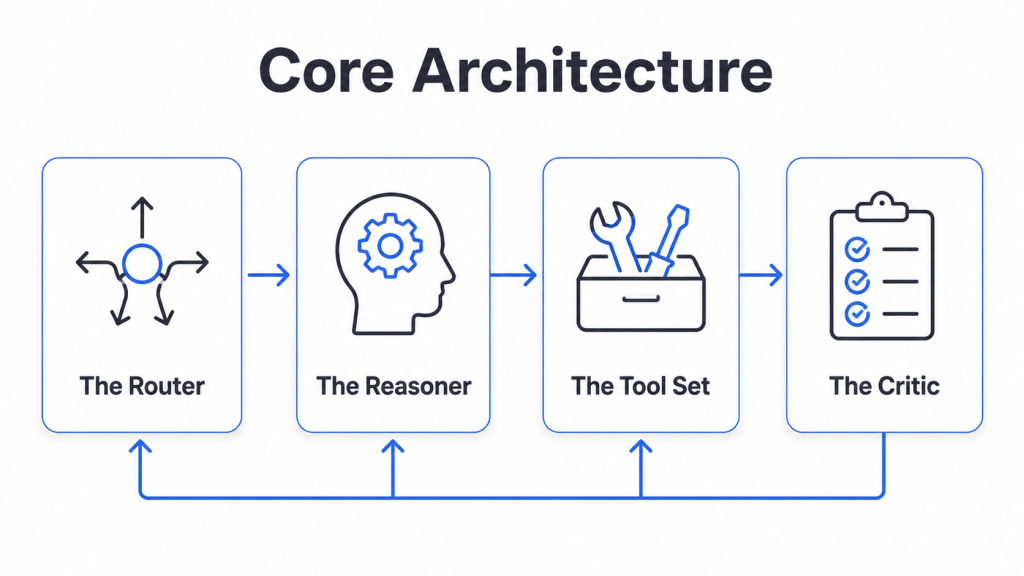
To understand how Agentic RAG works, you need to look under the hood of the orchestration layer.
- The Router: This is the air traffic controller, looking at the user’s intent to determine whether to search a local vector database, hit an external API, or answer from memory.
- The Reasoner: This is the ‘brain’ that takes complex, multi-part questions and breaks them down into smaller, logical steps, so that nothing is missed in the retrieval process.
- The Tool Set: Rather than relying on a single database, the agent has a “toolbox” of functions (such as web search or calculators) it can actively call upon when it does not have internal data.
- The Critic: This internal review step evaluates the relevance and correctness of the retrieved snippets, and if the information retrieved does not directly respond to the prompt, it will trigger a “re-try”.
This architecture is not a straight line from query to answer but a feedback loop where specialized components “talk” to each other for fact-checking and refining results.
Key Patterns & Strategies
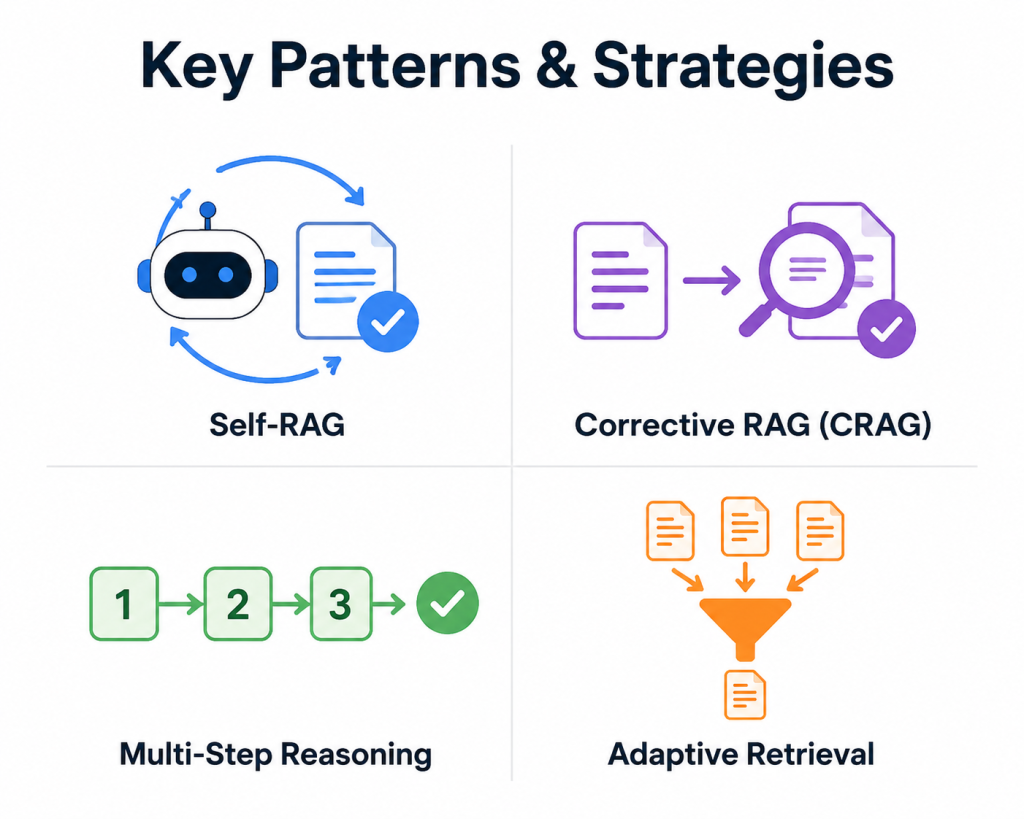
Agentic RAG’s strength lies in its ability to adapt its strategy based on the quality of information it encounters.
- Self-RAG: This pattern adds a self-reflection mechanism where the model grades its own retrieved context and generations for high factual alignment using specialized “critique tokens”.
- Corrective RAG (CRAG): a fallback; when the retriever returns low-quality or irrelevant documents, the agent calls an external search (such as a web search) for better sources.
- Multi-Step Reasoning: Well-suited for “needle in a haystack” questions. This method enables the agent to make a series of searches, where the result of one search helps inform the next search query.
- Adaptive Retrieval: The system dynamically determines the depth of retrieval, opting for a quick “vector search” for straightforward facts or a “long-context” read for complex, nuanced synthesis.
These patterns allow the system to “think” about its own search results and pivot when the data is lacking or misleading, rather than being chained to a specific path.
Tools of the Trade
Building an Agentic RAG system requires more than just a basic prompt; it demands a robust framework that can handle state management and complex logic loops.
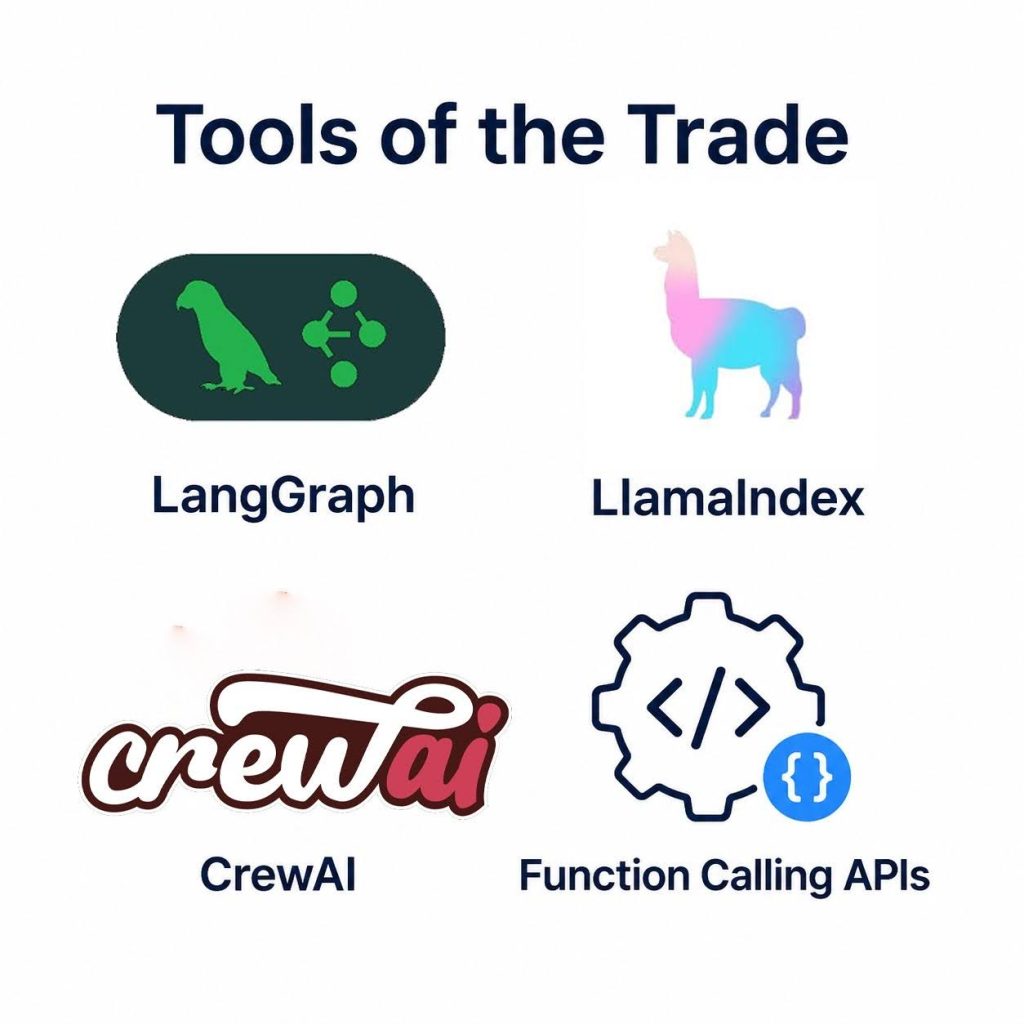
- LangGraph: A powerhouse for building cyclical graphs, it allows developers to define precise state machines where agents can loop back to previous steps if a retrieval fails.
- LlamaIndex: Known for its “Agentic Components,” this framework excels at data orchestration, offering pre-built tools for query decomposition and automated routing across diverse data indices.
- CrewAI: This framework focuses on “role-playing” collaborative agents, allowing you to assign one agent to be the “Researcher” and another to be the “Fact-Checker” for high-integrity outputs.
- Function Calling APIs: The foundational tech (from providers like OpenAI or Google) that enables the agent to interact with the real world, turning natural language into executable code for database queries.
These tools provide the “nervous system” that allows your AI agent to switch between searching, reasoning, and calling external functions seamlessly.
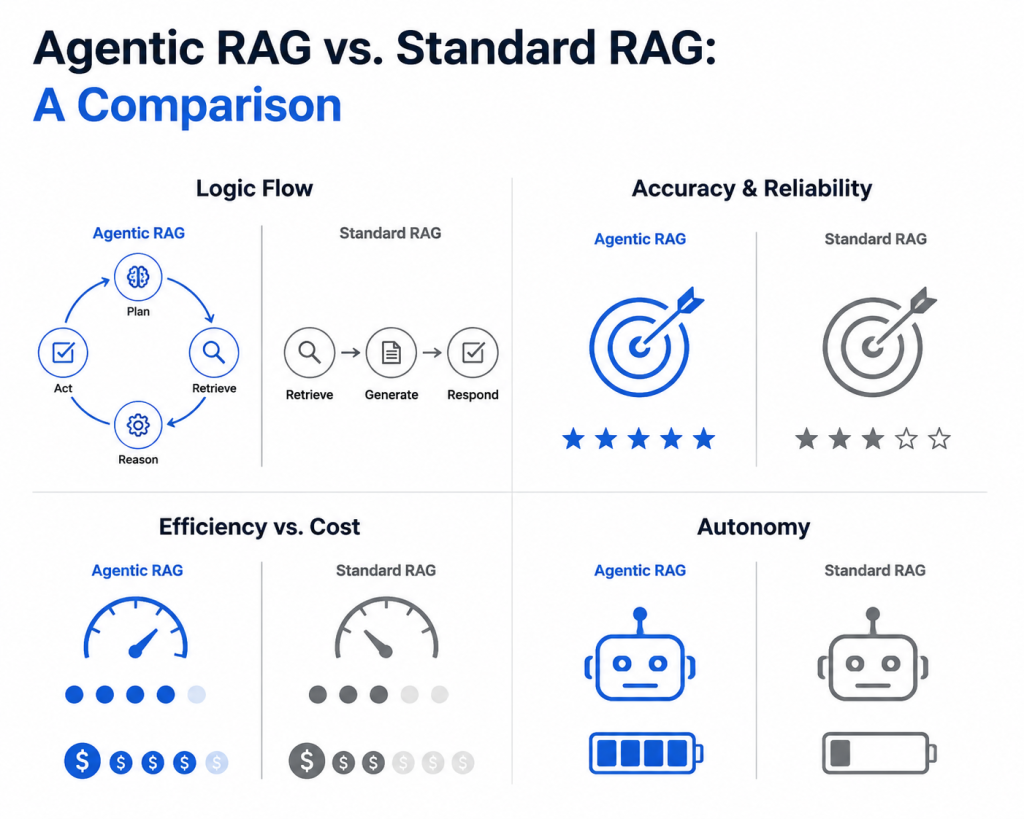
Agentic RAG vs. Standard RAG: A Comparison
Choosing between a standard pipeline and an Agentic RAG setup usually comes down to a trade-off between speed and sophistication.
- Logic Flow: Standard RAG follows a “one-and-done” linear path (Query → Retrieve → Answer), whereas Agentic RAG uses iterative loops to verify and refine information.
- Accuracy & Reliability: By using “The Critic” to self-evaluate, Agentic systems significantly reduce hallucinations compared to standard setups that trust whatever the retriever finds.
- Efficiency vs. Cost: Standard RAG is faster and cheaper; Agentic RAG requires more LLM calls and processing time, making it an investment in quality over quantity.
- Autonomy: Standard systems are passive recipients of data, while Agentic systems can proactively decide to search the web or query a different database if the first attempt fails.
While a standard approach is great for simple lookups, the agentic model is designed to handle the messy, “gray area” questions where a single search just isn’t enough.
Feature | Standard RAG | Agentic RAG |
Workflow | Linear (Fixed) | Iterative (Dynamic) |
Query Handling | Single-shot retrieval | Multi-step decomposition |
Error Correction | None (outputs what it finds) | Self-corrects based on relevance |
Complexity | Low / Straightforward | High / Requires orchestration |
Real-World Use Cases
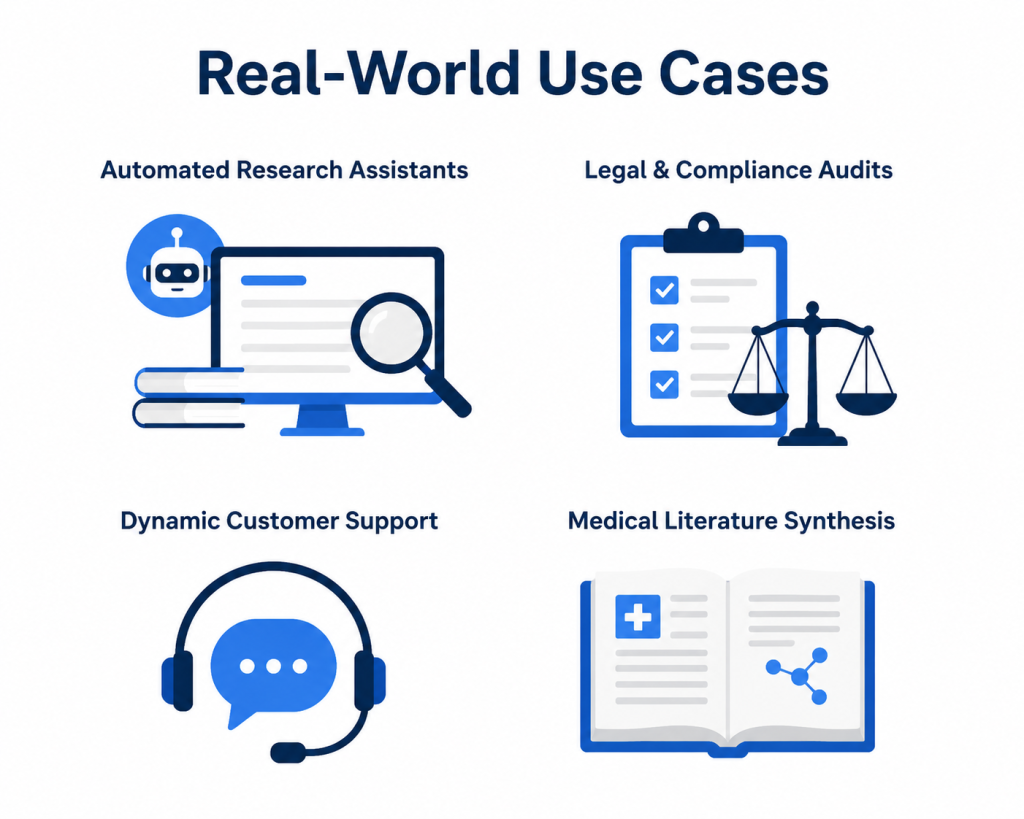
The true value of Agentic RAG shines when it is applied to high-stakes environments where “close enough” isn’t good enough.
- Automated Research Assistants: Agents can scan thousands of market reports, synthesize conflicting data points, and proactively perform web searches to fill in gaps for a comprehensive final analysis.
- Legal & Compliance Audits: Instead of a simple keyword search, an agent can “read” through contracts to identify missing clauses and verify they align with the latest regulatory updates.
- Dynamic Customer Support: Beyond scripted FAQs, agentic bots can query user history, technical manuals, and real-time shipping APIs simultaneously to resolve nuanced, multi-layered customer issues.
- Medical Literature Synthesis: For clinicians, an agent can cross-reference patient symptoms with the latest peer-reviewed studies, flagging potential drug interactions by reasoning through disparate data sources.
By automating the verification and cross-referencing process, these systems are transforming how professionals interact with vast, complex knowledge bases.
Future Outlook
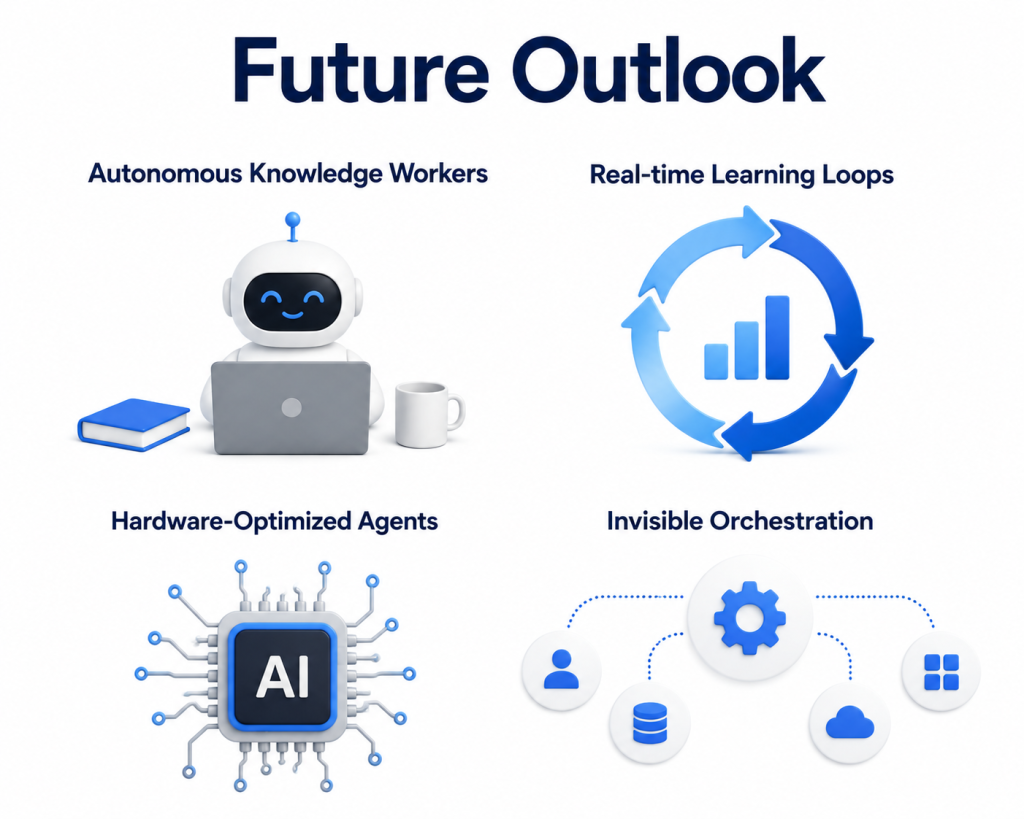
The trajectory of Agentic RAG points toward a future where AI doesn’t just assist with research but operates as a fully autonomous knowledge partner.
- Autonomous Knowledge Workers: We are heading toward “Agentic Swarms” where specialized RAG agents collaborate independently to complete entire projects, from data gathering to final document drafting.
- Real-time Learning Loops: Future systems will likely feature “on-the-fly” indexing, where the agent learns and updates its own knowledge base in real-time as it discovers new information during a search.
- Hardware-Optimized Agents: As small language models (SLMs) become more capable, we’ll see Agentic RAG running locally on devices, providing private and incredibly fast reasoning without needing constant cloud access.
- Invisible Orchestration: Eventually, the “agentic” nature of these systems will become the standard, with reasoning and self-correction happening so seamlessly that users won’t even realize a multi-step loop occurred.
As these systems become more efficient, we are moving toward a world where the friction between asking a complex question and receiving a verified, multi-source answer completely disappears.
Conclusion
Wrapping up the move toward Agentic RAG isn’t just about adopting a new technical stack; it’s about embracing a mindset shift in how we trust and deploy AI. We are moving away from simple “keyword matching” and entering an era where our systems can finally handle the nuance, ambiguity, and complexity of real-world data.
If you’re currently running a standard RAG pipeline, the best way to start is by adding a simple “evaluator” layer to your existing workflow. You don’t need to rebuild everything overnight—start by giving your model the ability to critique its own search results, and you’ll immediately see a jump in the quality and reliability of your outputs.
Ultimately, Agentic RAG represents the bridge between static information retrieval and true digital intelligence. By giving our models the agency to think, search, and self-correct, we are creating tools that don’t just give us data but provide us with the verified insights we need to make better decisions in an increasingly information-heavy world.

Deepak Wadhwani has over 20 years of experience in software/wireless technologies. He has worked with Fortune 500 companies, including Intuit, ESRI, Qualcomm, Sprint, Verizon, Vodafone, Nortel, Microsoft, and Oracle, in over 60 countries. Deepak has worked on Internet marketing projects in San Diego, Los Angeles, Orange County, Denver, Nashville, Kansas City, New York, San Francisco, and Huntsville. Deepak has been a founder of technology Startups for one of the first Cityguides, yellow pages online, and web-based enterprise solutions. He is an internet marketing and technology expert & co-founder of a San Diego Internet marketing company.