
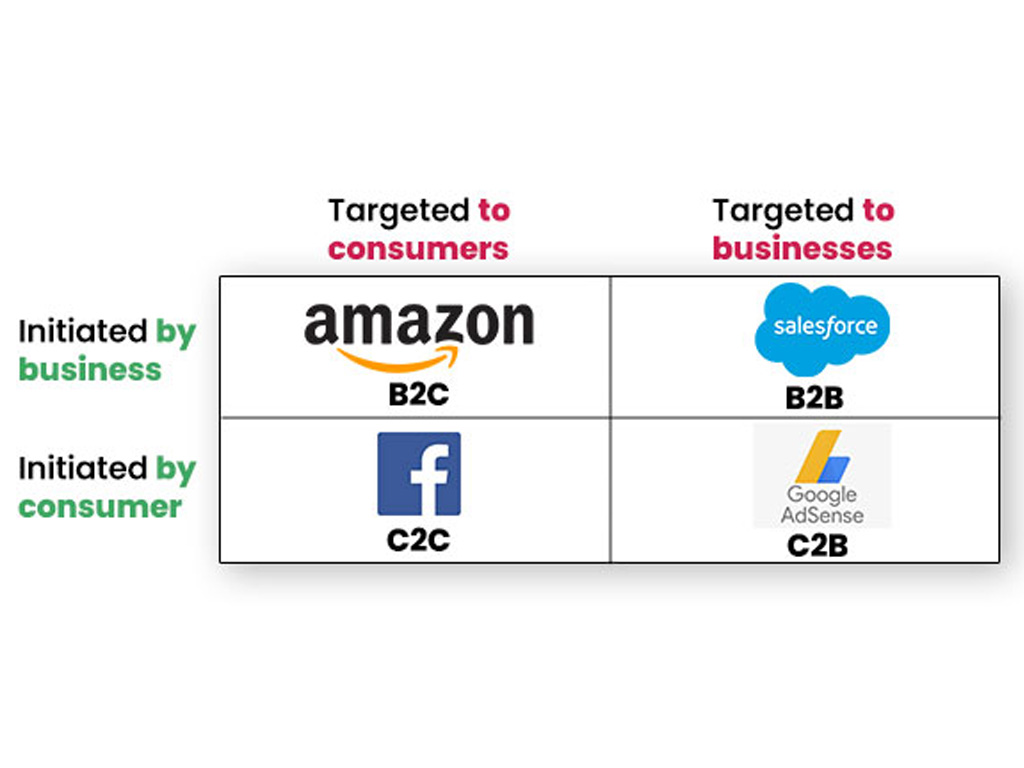

Table of Contents
Introduction
Starting an e-commerce business can be both exciting and overwhelming. One of the first steps is understanding the different e-commerce business models and determining which one aligns best with your products, audience, and long-term strategy. Choosing the right model impacts your revenue streams, marketing approach, and operational efficiency.
In this guide, we’ll explore the most popular types of e-commerce business models, provide actionable insights, highlight real-world examples, and discuss how to start an e-commerce business successfully. Whether you are a first-time entrepreneur or an established business looking to expand online, this guide provides a roadmap to make informed decisions.
What Are E-commerce Business Models?
An e-commerce business model defines the way a company delivers products or services to customers and generates revenue. It establishes the relationship between the business, consumers, and other stakeholders.
With the growth of online shopping, businesses now have multiple options, each tailored to different industries, customer types, and sales channels. Understanding the nuances of each model helps you select the most suitable approach and capitalize on emerging trends in the e-commerce space.
Key Statistics
- Global e-commerce sales are expected to reach $6.3 trillion by 2026, up from $4.28 trillion in 2020.
- The B2B e-commerce market in the US is approaching $8 trillion.
Online marketplaces are expected to grow annually by 9–12% over the next five years.
These trends highlight the significant potential for businesses across all types of e-commerce business models.
Common Types of E-commerce Business Models
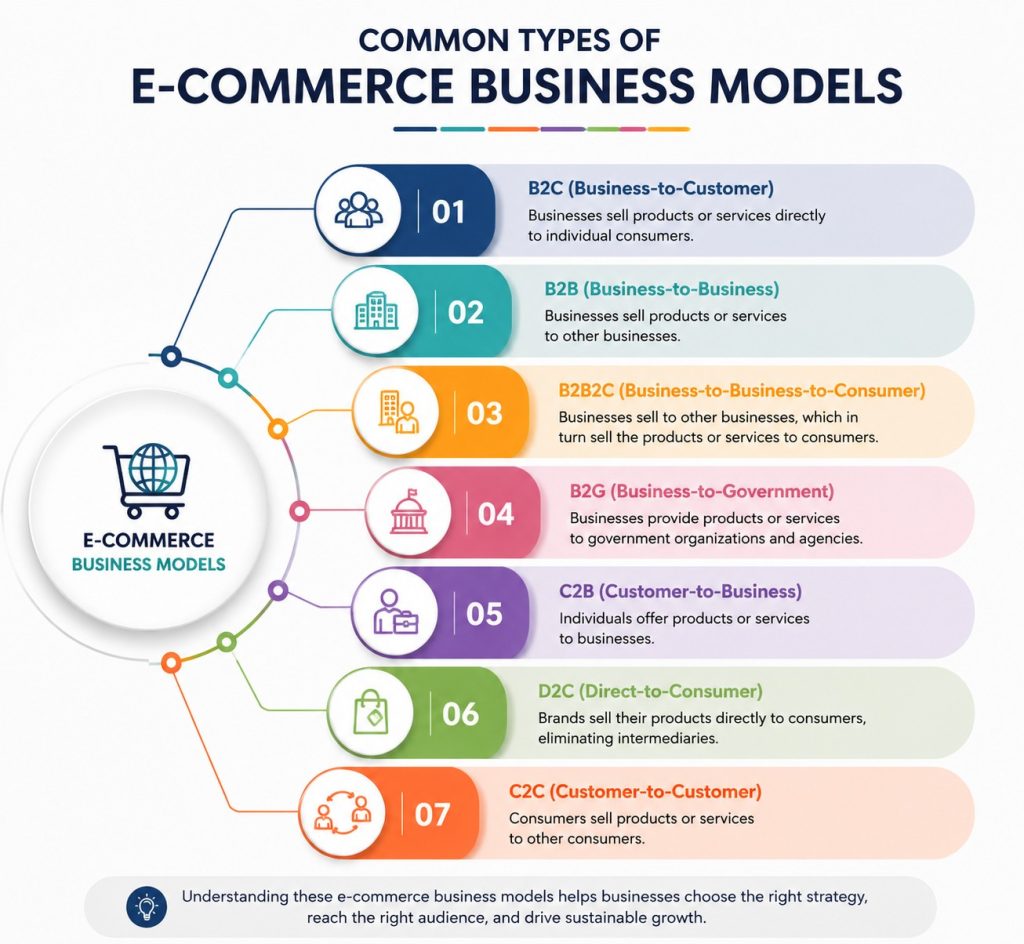
Understanding the different e-commerce business models is essential before launching your online store. Each model serves a specific type of customer, follows distinct operational processes, and comes with unique challenges and benefits.
1. B2C (Business-to-Customer)
Definition: In a B2C model, businesses sell directly to individual consumers.
Examples: Amazon, Walmart, Zappos.
Key Features:
- Shorter sales cycles compared to B2B.
- Lower average order value but higher transaction frequency.
- Marketing relies heavily on digital channels: social media, email marketing, retargeting, and mobile apps.
- Covers both physical products (clothing, electronics) and services (digital subscriptions, online courses).
Benefits:
- Direct engagement with customers.
- Greater control over branding and customer experience.
- Easier to collect data on buyer behavior and preferences.
2. B2B (Business-to-Business)
Definition: Businesses sell products or services to other businesses rather than individual consumers.
Examples: Shopify, AWS, Salesforce, Microsoft.
Key Features:
- Longer sales cycles but larger average order values.
- Often involves recurring purchases and subscription models.
- Requires specialized portals, catalogs, or integrated platforms for ordering.
- Growing significance as younger B2B buyers (millennials) embrace digital-first purchasing.
Benefits:
- Larger contracts with repeat business.
- Opportunity for niche specialization.
- Increased customer lifetime value compared to B2C.
3. B2B2C (Business-to-Business-to-Consumer)
Definition: In a B2B2C model, a business collaborates with another business to reach the end consumer.
Examples: Amazon Marketplace, Alibaba, Etsy, eBay.
Key Features:
- Combines the advantages of B2B partnerships with consumer sales.
- The end customer knows the original provider of the product.
- Useful for expanding market reach without creating your own direct-to-consumer platform.
Benefits:
- Access to larger customer bases via partners.
- Lower cost of customer acquisition compared to direct marketing.
- Can leverage partner credibility to build trust.
4. B2G (Business-to-Government)
Definition: Companies sell products or services directly to government agencies or public institutions.
Examples: SAP Ariba, Skycatch, ProtectBox.
Key Features:
- Revenue depends on government contract bidding (RFPs).
Often slower but secure transactions. - Businesses must comply with regulations and bidding requirements.
Benefits:
- Stable and large-scale contracts.
- Opportunities for long-term partnerships.
5. C2B (Customer-to-Business)
Definition: Individuals sell products or services to businesses.
Examples: Google Adsense, affiliate marketing platforms, freelance marketplaces.
Key Features:
- Consumers have pricing power.
- Can include freelance services, social media marketing, and influencer promotions.
Benefits:
- Consumers can monetize skills, content, or products.
- Businesses benefit from competitive offers and niche services.
6. D2C (Direct-to-Consumer)
Definition: Brands sell directly to customers, bypassing intermediaries.
Examples: Warby Parker, Dollar Shave Club.
Key Features:
- Full control over marketing, fulfillment, and branding.
- Supports subscription services and recurring revenue models.
- Collects first-party customer data to enhance personalization.
Benefits:
- Complete control over customer experience.
- Higher margins by removing middlemen.
- Easier to test and innovate products.
7. C2C (Customer-to-Customer)
Definition: Platforms allow customers to sell directly to other customers.
Examples: Craigslist, Facebook Marketplace, eBay.
Key Features:
- Monetized via transaction fees or listing fees.
- Encourages self-propelled growth by users.
- Requires effective quality control and technology upkeep.
Benefits:
- Low operational costs for the platform owner.
- Rapid scalability through user adoption.
Selecting Your E-commerce Business Model
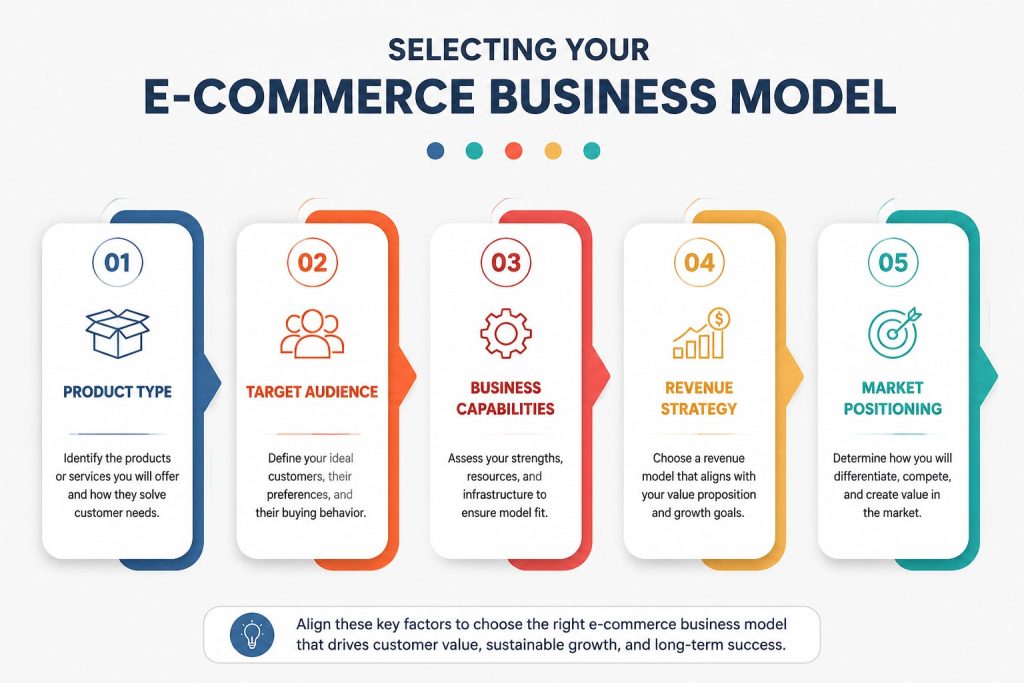
When choosing a type of e-commerce business model, consider the following factors:
Product Type
- Physical goods: high demand, scalable, requires inventory management.
- Digital products: flexible, low overhead, immediate delivery.
- Services: rely on expertise and reputation, often niche.
Target Audience
- Understand their preferences, purchasing habits, and expectations.
- Segment your audience for personalized marketing.
Business Capabilities
- Leverage internal strengths.
- Identify areas requiring outsourcing or technology support.
Revenue Strategy
- Evaluate margins, recurring revenue, and customer lifetime value.
- Consider subscription, freemium, or one-time purchase models.
Market Positioning
- Identify your unique value proposition.
- Differentiate through service, price, quality, or experience.
How to Start an E-commerce Business
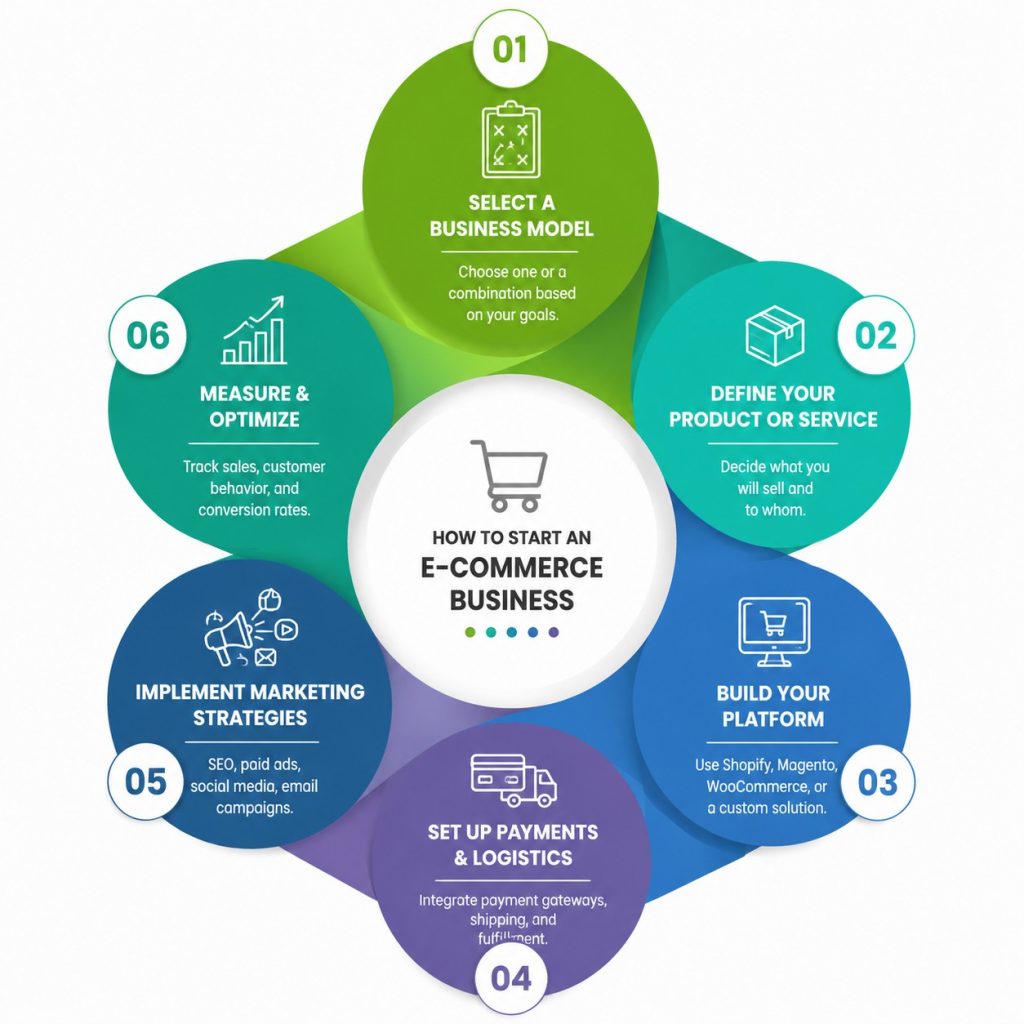
- Select a Business Model: Choose one or a combination based on your goals.
- Define Your Product or Service: Decide what you will sell and to whom.
- Build Your Platform: Use Shopify, Magento, WooCommerce, or a custom solution.
- Set Up Payments & Logistics: Integrate payment gateways, shipping, and fulfillment.
- Implement Marketing Strategies: SEO, paid ads, social media, email campaigns.
- Measure & Optimize: Track sales, customer behavior, and conversion rates.
Starting with the right e-commerce business model ensures scalable growth and a clear path to profitability.
Conclusion
Understanding types of e-commerce business models is crucial for building a successful online business. Whether you are exploring e-commerce business ideas or figuring out how to start an e-commerce business, choosing the right model ensures efficient operations, better marketing, and sustainable growth.
By leveraging these models and aligning them with your unique value proposition, your business can thrive in the competitive e-commerce landscape.