


Table of Contents
Introduction
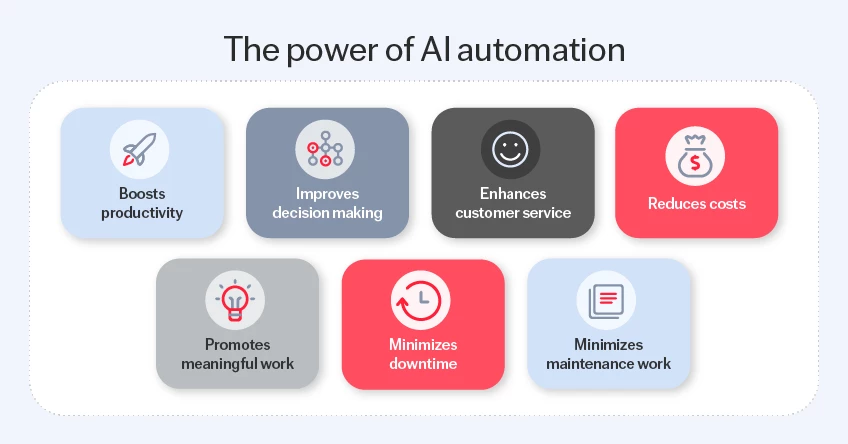
AI automation combines artificial intelligence with automation technology to complete tasks, analyze information, make recommendations, and improve workflows with less manual intervention. Unlike traditional automation, which follows fixed instructions, AI-powered systems can interpret data, recognize patterns, and adapt their responses.
Businesses use AI automation to answer customer questions, qualify leads, detect fraud, predict demand, process documents, personalize marketing, and monitor equipment. These capabilities are part of a much broader group of artificial intelligence applications influencing healthcare, education, finance, ecommerce, entertainment, customer support, and search.
However, successful automation is not simply about adding an AI tool to an existing process. Organizations need suitable data, clearly defined goals, secure integrations, human oversight, and measurable performance standards. This guide explains how AI automation works, where it creates value, and how businesses can implement it responsibly.
What is AI Automation?
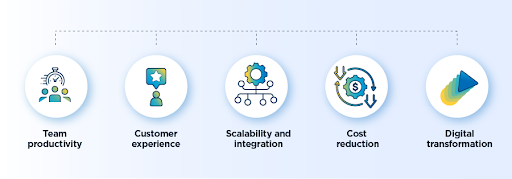
AI automation is the use of artificial intelligence technologies to automate tasks that normally require human judgment, interpretation, or decision-making.
Traditional automation completes actions according to predefined rules. For example, a conventional system might send the same confirmation email whenever someone submits a form. AI automation can examine the form’s content, classify the request, determine its urgency, personalize the response, and direct it to the appropriate department.
AI automation commonly uses:
- Machine learning to recognize patterns and make predictions
- Natural language processing to understand written or spoken language
- Computer vision to interpret images and video
- Generative AI to create or summarize content
- Predictive analytics to forecast likely outcomes
- Robotic process automation to perform structured digital tasks
- AI agents to plan and execute multi-step activities
The intelligence layer interprets information or recommends an action. The automation layer carries out the action within a business system.
How AI Automation Works
Most AI automation systems follow a connected process.
1. Data enters the system
The system receives information from customer relationship management platforms, websites, emails, documents, sensors, transaction records, support tickets, or other business applications.
2. AI analyzes the information
A machine learning model, language model, computer vision system, or predictive model processes the input. It may classify a request, identify a pattern, estimate an outcome, or generate a response.
3. The system applies business rules
The AI output is evaluated against defined conditions. These rules may specify which actions are permitted, when approval is required, and which situations must be escalated to a person.
4. An automated action occurs
The system may update a customer record, send a message, create a task, flag a transaction, adjust inventory, or trigger another workflow.
5. Results are measured
Teams track accuracy, completion time, exceptions, customer outcomes, and other performance indicators. Feedback can then be used to improve the workflow.
For example, an AI customer-support system can interpret a message, identify the customer’s intent, retrieve approved information, provide an answer, record the interaction, and send complicated cases to a human representative.
Types of AI Automation
AI automation is not limited to a single approach. Below are some key types:
Cognitive automation
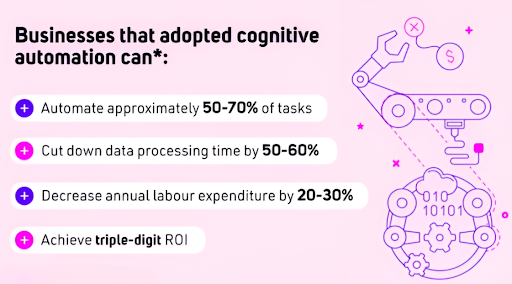
Cognitive automation processes information that previously required human interpretation. It can read documents, understand language, identify images, or extract details from unstructured data.
Common uses include invoice processing, email classification, document review, and virtual assistance.
Predictive automation
Predictive automation uses historical and real-time information to estimate what may happen next.
Businesses use it to forecast sales, anticipate customer churn, detect unusual transactions, schedule maintenance, and predict inventory requirements.
Generative automation
Generative automation creates new content or responses based on instructions and available information. It can draft emails, summarize meetings, generate product descriptions, prepare reports, or produce personalized customer communications.
Human review remains important when generated content affects customers, compliance, finances, or a company’s reputation.
Robotic process automation with AI
Robotic AI process automation, or RPA, handles repetitive actions such as copying data, updating systems, or generating records. Adding AI enables these systems to work with documents, messages, and other less-structured inputs.
Agentic automation
Agentic automation uses AI agents that can interpret a goal, plan several steps, use approved tools, and take actions within established boundaries.
An agent might research an account, update a CRM record, prepare a follow-up email, and schedule the next task. These systems require strong access controls, monitoring, and approval requirements.
Hyperautomation
Hyperautomation connects AI, RPA, analytics, process-mining tools, APIs, and workflow platforms to improve an entire business process rather than one isolated task.
It may be used to automate customer onboarding, order management, employee support, or claims processing across several departments.
Benefits of AI Automation
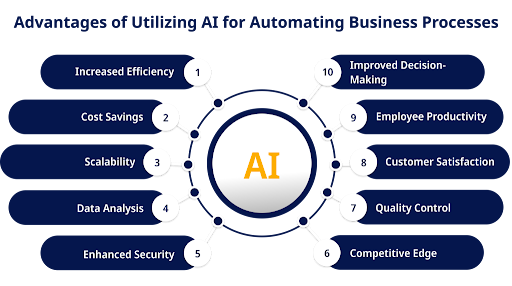
The rise of AI automation brings numerous advantages across industries. Here are some of the most impactful benefits:
- Increased Efficiency and Productivity: AI-powered systems complete tasks faster and more precisely than humans. Automation reduces time spent on routine activities, allowing employees to focus on higher-value work.
- Cost Savings: By automating repetitive processes, businesses can cut labor costs and improve operational efficiency. AI automation also minimizes errors, which further reduces costs.
- Improved Decision-Making: AI tools can analyze massive amounts of data in seconds, uncovering patterns and trends that humans might miss. These insights enable better decision-making, from strategic planning to customer engagement.
- Enhanced Customer Experience: AI-powered chatbots and recommendation engines deliver personalized customer service around the clock. This ensures customers receive timely assistance and product suggestions tailored to their preferences.
- Scalability: AI systems can scale up operations to handle increased workloads without additional human resources. For instance, e-commerce platforms use automated systems to manage seasonal surges in orders.
Where Is AI Automation Used?
- Healthcare: AI automation has transformed healthcare through applications like predictive diagnosis, patient chatbots, and robotic surgery. It also supports remote monitoring of patients and assists in drug discovery through data analysis.
- Retail and E-commerce: Retailers use AI to predict demand, optimize inventory, and deliver personalized shopping experiences. For example, AI-based recommendation systems suggest products based on browsing history.
- Finance: AI tools in the financial sector enable fraud detection, automated trading, and robo-advisory services. Chatbots assist customers with account inquiries, while predictive models improve loan approval processes.
- Manufacturing: Predictive maintenance powered by AI ensures that machines are repaired before they fail, reducing downtime. In production lines, robotic automation speeds up assembly tasks while ensuring quality.
- Marketing: AI-driven platforms automate ad campaigns, optimize email marketing strategies, and analyze consumer behavior. Tools like Google Ads use machine learning to suggest optimized bidding strategies for advertisers.
How Can a Business Implement AI Automation?
Step 1: Identify a specific problem
Start with a measurable issue, such as slow support response times, repetitive data entry, inconsistent lead follow-up, or excessive document-processing time.
Step 2: Map the current workflow
Document every step, decision, system, handoff, and exception. This reveals where automation can create value and where human judgment remains necessary.
Step 3: Evaluate the data
Determine what information the system requires, where it is stored, who can access it, and whether it is accurate enough for the intended use.
Step 4: Choose a manageable pilot
Select a repetitive, high-volume process with limited risk. A focused pilot makes it easier to measure performance and identify problems.
Step 5: Define human oversight
Specify which actions AI may complete independently, which require approval, and which must always remain with a person.
Step 6: Establish performance metrics
Useful metrics may include:
- Processing time
- Error rate
- Resolution rate
- Escalation rate
- Cost per completed task
- Customer satisfaction
- Employee time saved
- Revenue influenced
The Future of AI Automation
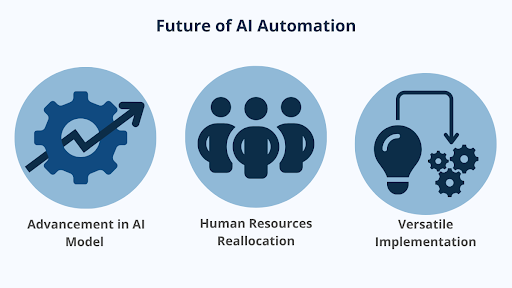
AI automation is moving from isolated tools toward connected systems that can manage larger portions of a workflow. Multimodal AI can process text, audio, images, and video together, while AI agents can coordinate tasks across several applications.
Future development is likely to focus on:
- More capable AI agents
- Real-time operational decision support
- Natural-language workflow creation
- Greater personalization
- Better monitoring and evaluation
- Stronger security and access controls
- Wider use of human approval checkpoints
- Closer integration between predictive and generative AI
The broader range of AI applications used in business and everyday life will continue to grow. However, the most successful organizations will not automate every possible activity. They will select processes where automation provides a clear, measurable benefit while preserving human accountability.