

Table of Contents
Introduction
Google AdSense rules require publishers to generate genuine traffic, avoid encouraging ad clicks, publish original and policy-compliant content, use ads without misleading users, and meet applicable privacy and consent requirements.
The most important 2026 compliance change is the transition to IAB Europe’s Transparency and Consent Framework version 2.3. Publishers serving ads to users in the European Economic Area, the United Kingdom, or Switzerland must ensure that new consent strings comply with TCF v2.3.
AdSense allows website owners, bloggers, publishers, and content creators to earn revenue by displaying Google-served advertisements. However, participation is conditional.
Google can restrict or disable ad serving when a website, page, traffic source, or advertising implementation does not comply with its program policies. Serious or repeated violations can also lead to account-level suspension or termination.
What Changed for AdSense Publishers in 2026?
TCF v2.3 Became Mandatory
As of March 1, 2026, publishers and consent management platforms must use TCF v2.3 for newly generated consent strings involving users in the EEA, UK, and Switzerland.
- Publishers using Google’s consent management platform do not need to update the implementation manually.
- Publishers using another platform should confirm that it is registered with the IAB and has migrated to TCF v2.3.
- An invalid or incomplete consent string may cause an ad request to use limited ads or be dropped, potentially reducing revenue.
AI Labels May Appear on Ad Creatives
On July 13, 2026, Google introduced tools that allow advertisers to identify and label AI-generated advertising creatives.
- Publishers may now see these sponsored labels on Google Ads or Display & Video 360.
- This update concerns the advertisements displayed on publisher properties. It is not a new rule prohibiting publishers from using AI to help create articles.
Additional US Privacy Requirements Took Effect
Privacy provisions in Indiana, Kentucky, and Rhode Island took effect on January 1, 2026.
- Google provides tools such as Restricted Data Processing to help publishers honor eligible opt-out requests and manage personalized advertising in applicable US states.
- Publishers remain responsible for determining which laws apply to their websites and visitors.
The 7 Core Google AdSense Rules Publishers Must Follow
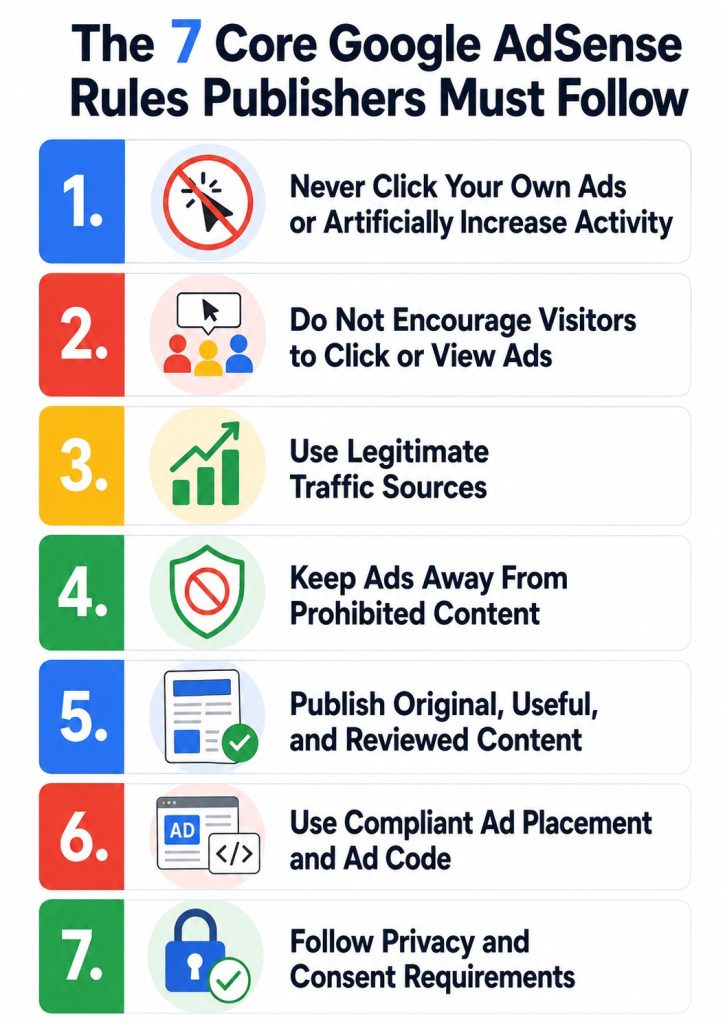
1. Never Click Your Own Ads or Artificially Increase Activity
Publishers must not click their own Google ads for any reason, including testing whether an advertisement works.
Google also prohibits any manual or automated method designed to increase clicks or impressions artificially. Examples include:
- Repeatedly refreshing pages to generate impressions
- Using bots, scripts, automated browsers, or deceptive software
- Asking employees or contractors to interact with advertisements
- Joining click-exchange or paid-to-click programs
- Purchasing traffic intended to generate advertising engagement
- Clicks must come from genuine user interest in the advertised product or service.
Publishers who want to inspect an advertisement should use the preview and testing tools provided by Google rather than interacting with a live ad.
2. Do Not Encourage Visitors to Click or View Ads
Publishers cannot directly or indirectly encourage visitors to click or view non-rewarded advertising.
Prohibited methods include:
- Writing “click the ads to support this website”
- Offering rewards, money, points, or downloads for interacting with an ad
- Asking friends, followers, or customers to click advertisements
- Placing arrows, animations, icons, or images that draw unnatural attention to an ad
- Labeling advertisements as “resources,” “recommended links,” or “special offers”
- Making ads look like navigation, download buttons, or editorial links
Google generally allows labels such as “Advertisements” or “Sponsored Links” when a label is needed. Ads and publisher content must remain visually distinguishable.
3. Use Legitimate Traffic Sources
A website displaying AdSense advertisements must not receive traffic through systems designed to create artificial impressions or clicks.
Prohibited sources include:
- Paid-to-click and paid-to-surf websites
- Autosurf and click-exchange networks
- Bots or automated traffic programs
- Unsolicited bulk email
- Software that automatically opens, redirects to, or loads a publisher’s pages
- Pop-ups or browser tools that interfere with navigation
Paid advertising itself is not automatically prohibited. Publishers may promote their websites through legitimate advertising platforms, but the landing page must deliver what the advertisement promised and provide a usable experience.
4. Keep Ads Away From Prohibited Content
Google Publisher Policies identify content on which Google-served advertisements are not allowed. Major categories of Google Ads include:
- Illegal content
- Copyright infringement
- Dangerous or derogatory content
- Misrepresentative content
- Content enabling dishonest behavior
- Sexually explicit content
- Child sexual abuse or exploitation
- Content promoting compensated sexual acts
- Adult themes presented as family content
Publishers are responsible for content they produce as well as guest posts, comments, forums, uploaded files, embedded media, and other user-generated material.
5. Publish Original, Useful, and Reviewed Content
Google-served advertisements should not appear on pages without meaningful publisher content or on pages containing low-value material.
Examples of risky pages include:
- Automatically generated pages are published without human review
- Copied or lightly rewritten articles
- Scraped search results or product feeds
- Pages that embed videos or posts without adding commentary
- Empty category, login, error, exit, or thank-you pages
- Pages created primarily to display advertisements
- Unfinished pages or placeholder content
Google also prohibits monetization of replicated content copied from another source without meaningful commentary, curation, analysis, or added value.
6. Use Compliant Ad Placement and Ad Code
Advertisements must not be placed where visitors are likely to mistake them for navigation, buttons, downloads, or regular website content.
Avoid placements that:
- Sit directly beside navigation or action buttons
- Cover text, images, forms, or interactive features
- Cause accidental taps on mobile devices
- Make it difficult for visitors to close an overlay
- Appear in pop-ups, pop-unders, or emails
- Load on non-content pages
- Looks like editorial recommendations
- Fully or partially obscure content
- Allow content to obscure the advertisement
Google permits certain modifications to AdSense code, but those changes must not artificially improve performance or harm advertisers.
7. Follow Privacy and Consent Requirements
Publishers must maintain a privacy policy that clearly explains data collection, data sharing, data usage, cookies, IP addresses, web beacons, and other identifiers connected to Google advertising services.
For users in the EEA, UK, and Switzerland, publishers serving personalized advertising must use a Google-certified consent management platform integrated with the applicable IAB Transparency and Consent Framework requirements.
Publishers should also:
- Keep their privacy policy accessible from the website footer
- Explain the use of Google and third-party advertising cookies
- Provide appropriate consent or opt-out controls
- Review regional privacy laws affecting their audiences
- Configure personalized, non-personalized, or limited ads correctly
- Confirm that their CMP supports TCF v2.3
- Test consent signals after website, tag, or CMP changes
Google’s Privacy & Messaging section in AdSense can help publishers create and manage certain consent messages, but using Google’s tool does not remove the publisher’s responsibility to comply with applicable law.
Google AdSense Compliance Checklist for 2026
Content
- Review high-traffic and recently published pages
- Remove copied, scraped, or minimally rewritten material
- Manually review automatically generated content
- Moderate comments, forums, and uploaded files
- Confirm that images, videos, and research are properly licensed
- Keep advertisements off empty or low-value pages
Traffic
- Monitor traffic sources in analytics
- Investigate sudden spikes and unknown referrals
- Avoid traffic exchanges and guaranteed-visitor packages
- Block known bots and abusive sources
- Review campaigns run by affiliates or third-party agencies
Ad Placement
- Test layouts on real mobile devices
- Keep ads away from menus, forms, and buttons
- Make advertisements distinguishable from content
- Prevent overlays from covering content or advertisements
- Make sure publisher content remains more prominent than ads
Privacy
- Review the privacy policy regularly
- Use a compliant consent management platform where required
- Confirm TCF v2.3 implementation
- Provide applicable privacy choices and opt-out mechanisms
- Check the AdSense Policy Center and regulatory messages
What Happens When You Violate AdSense Rules?
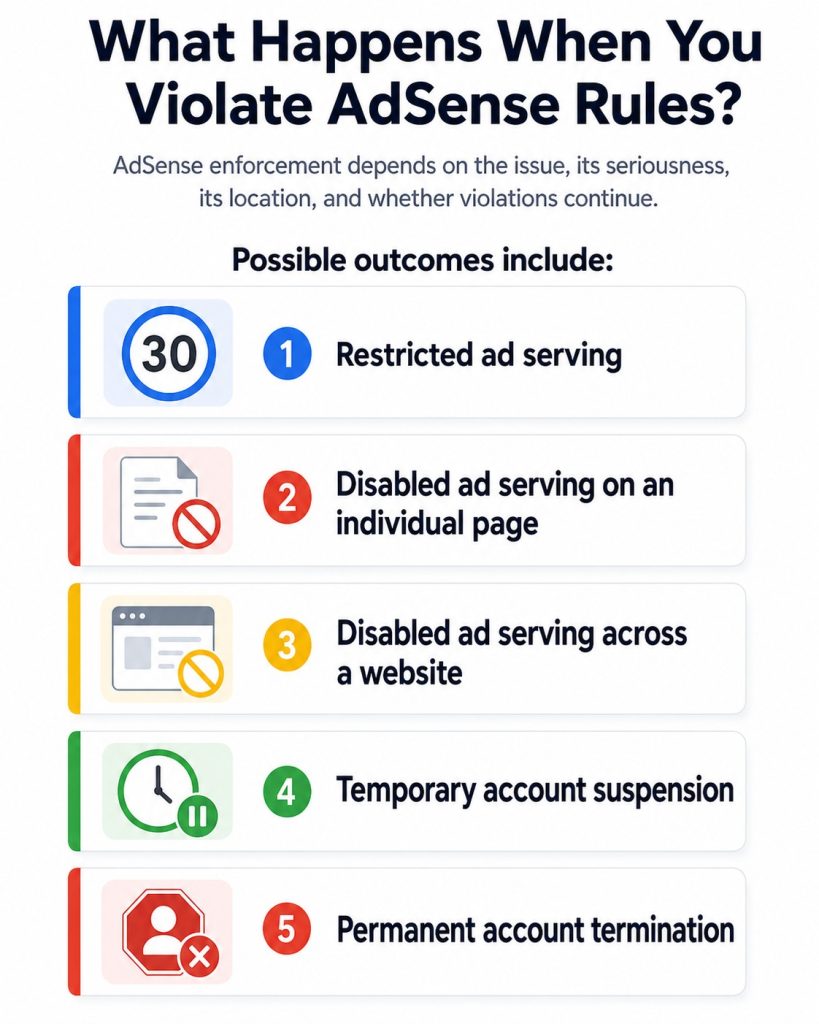
AdSense enforcement depends on the issue, its seriousness, its location, and whether violations continue.
Possible outcomes include:
- Restricted ad serving
- Disabled ad serving on an individual page
- Disabled ad serving across a website
- Temporary account suspension
- Permanent account termination
Publisher restrictions are not always policy violations. They may simply reduce the number of advertisers eligible to bid on the affected inventory. The Policy Center identifies whether an issue is a policy violation, a regulatory issue, or an advertiser preference.
What Are Google AdSense Rules? FAQ's
Publishers must not click their own ads, encourage visitors to interact with ads, generate artificial traffic, monetize prohibited content, publish replicated or low-value pages, use misleading ad placements, or ignore privacy and consent requirements.
No. Google prohibits publishers from clicking their own advertisements for any reason. Use Google’s approved preview or testing tools instead.
AI-assisted content is not automatically prohibited. However, automatically generated, copied, replicated, or low-value content without meaningful human review may violate publisher inventory policies. Mass-produced content intended to manipulate Search rankings may also violate Google Search spam policies.
Legitimate paid promotion is not automatically banned. However, publishers must not use paid-to-click systems, autosurf programs, bots, unwanted advertising, or services that artificially generate impressions and clicks. Paid landing pages must also deliver what the advertisement promised.
TCF v2.3 is the current version of IAB Europe’s Transparency and Consent Framework. Google requires new consent strings generated for applicable EEA, UK, and Swiss traffic to use TCF v2.3 from March 1, 2026.
Google does not provide one fixed limit that applies to every page. Publishers must ensure that advertisements and paid promotional material do not outnumber or overwhelm the page’s publisher-created content.
Open the AdSense Policy Center, review the affected page or site, follow the provided correction instructions, and fix the content, traffic, placement, or consent problem. When the option is available, submit a review request after completing the corrections.