


Google just upgraded AI Mode

Google Just Upgraded AI Mode

Table of Contents

Introduction

Google introduced a major update to its AI Mode in April 2026, transforming it from a simple search enhancement into a continuous browsing companion. The goal is to make search smooth and effortless, so you can find what you need without switching multiple tabs.

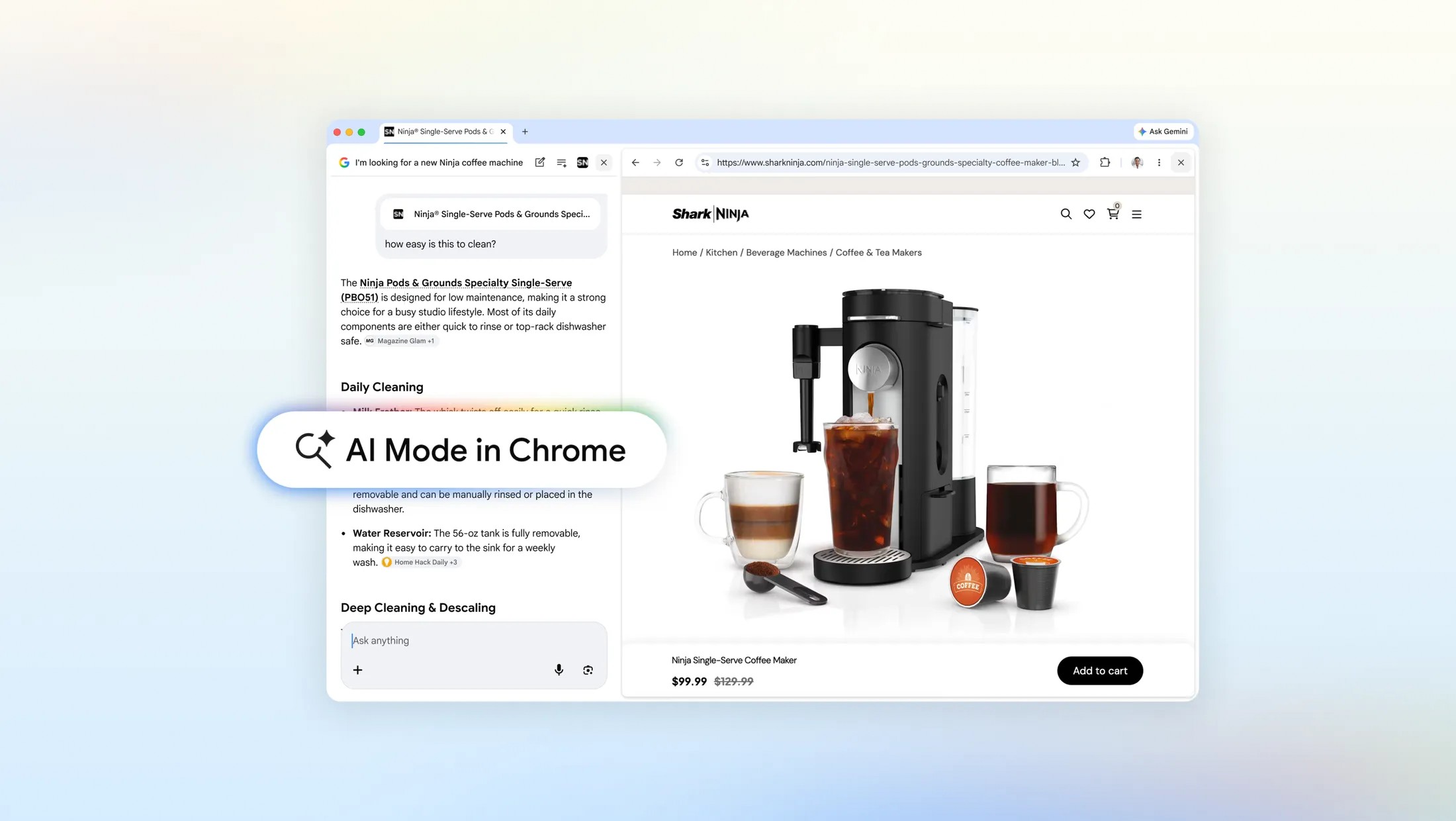
Google showed a coffee maker search to explain this better.

Instead of switching between multiple tabs, AI mode stays open next to the product page. While you are looking at a specific item, you can ask detailed questions like, “Will this fit under a 40cm cabinet?” or “Does this model have a self-cleaning feature?”

It works like a smart shopping assistant. It pulls information from reviews and product specs in real time, so you don’t have to search everything yourself.

Although currently live in the U.S., the rollout is expanding to countries like India, Canada, and Australia in the coming months, making this a global shift that businesses need to prepare for now.

The End of Tab Switching

One of the most immediate changes is the introduction of side-by-side browsing.

Instead of opening a new tab every time you click a result, pages now appear in a split view while AI Mode remains active alongside them. Users can:

  • Read an article
  • Ask follow-up questions instantly
  • Request summaries or comparisons

This eliminates the traditional “tab-hopping” behavior and keeps users inside a single, continuous experience. Your content is no longer consumed independently. It’s being interpreted in real time by AI, which decides what matters most to the user.

Multi-Tab Searching

Multi-Tab Searching
Multi-Tab Searching

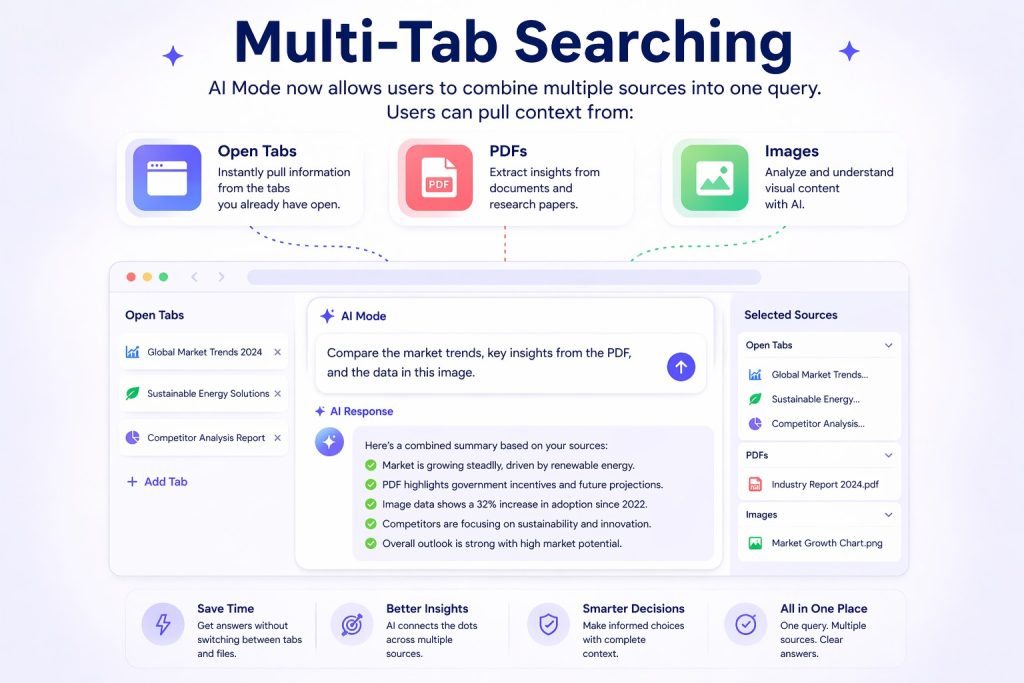
AI Mode now allows users to combine multiple sources into one query. Users can pull context from:

  • Open tabs
  • PDFs
  • Images

And ask questions like:
“Based on these sources, which option is best?”

This creates a layer of intelligence across content, where AI synthesizes insights instead of users manually comparing them.

Impact for websites:

  • Content competes directly with other sources in real time
  • Only the most clear, structured, and relevant information gets surfaced

How to Access AI Mode

Google has made AI Mode easily accessible across devices:

  • Desktop: Through the Chrome address bar or AI Mode button
  • Mobile: Via the Google app’s dedicated AI Mode tab

The feature is currently live in select regions and is gradually rolling out globally, including India.

Agentic & Personal Features Explained

This update introduces a new level of AI capability, moving from answering questions to taking action.

Personal Intelligence

With user consent, AI Mode can connect to tools like Gmail and Photos to provide:

  • Personalized recommendations
  • Context-aware suggestions

Deep Search

For complex queries, AI Mode can run multiple searches simultaneously and generate:

  • Detailed summaries
  • Cited, expert-level insights

Agentic Actions

AI can now assist with tasks such as:

  • Checking product availability
  • Comparing options
  • Helping with bookings or purchases

Search is evolving from information retrieval to task completion.

Creative Integration in Canvas & Image Generation

AI Mode is no longer just about finding answers; it’s about creating, refining, and collaborating in real time. With the integration of canvas-style workspaces and built-in image generation, Google is turning search into a production environment, not just a discovery tool.

Users can now:

  • Generate images instantly from prompts while researching (e.g., product mockups, travel visuals, design ideas)
  • Work inside a canvas-style interface to organize thoughts, notes, and outputs in one place
  • Edit, refine, and iterate content (text, visuals, ideas) without switching tools or tabs

This changes how people move from idea to execution.  Previously, a user might:

  • Search
  • open tools 
  • Create
  • Revise
  • compare

Now it becomes:

  • Search
  • Create
  • Refine
  • Decide (all in one flow)

The deeper implication is about AI as a collaborator. Inspired by modern AI system design principles (like those seen in advanced AI labs), tools are evolving to:

  • Understand user intent continuously
  • Provide suggestions proactively
  • Help shape outcomes, not just deliver answers

Why This Update Changes Search Behavior

This update represents a fundamental shift in user behavior, arguably the biggest since the rise of mobile search.

From Searching to Conversing

Search used to be transactional:

  • Type a query
  • Scan results
  • Click links

Now it’s conversational:

  • Ask a question
  • Refine it naturally
  • Build on previous context

Users don’t restart searches; they continue thinking out loud with AI.

From Browsing to  Interacting

Traditional browsing required effort:

  • Open multiple tabs
  • Compare information manually
  • Piece together conclusions

With AI Mode:

  • Information is interpreted instantly
  • Key points are extracted automatically
  • Comparisons happen in seconds

Users are no longer passive readers; they’re active participants in an AI-guided experience.

From Clicking to Deciding

Clicks used to be the goal of search. Now, decisions happen before clicks.

AI Mode:

  • Summarizes options
  • Highlights pros and cons
  • Recommends next steps

The End of Website-Centric Journeys

Users no longer need to visit 5-10 websites to:

  • Compare products
  • Research services
  • Validate information

AI does that instantly. Websites are no longer the primary interface for AI.

Real-Time Context-Aware Decisions

AI Mode understands:

  • What you’re currently viewing
  • What you’ve already asked
  • What you’re trying to achieve

This allows it to:

  • Deliver hyper-relevant answers
  • Adapt responses dynamically
  • Guide decisions more effectively

The New Standard of AEO (Answer Engine Optimization)

With AI Mode, traditional SEO is no longer enough. The focus is shifting to Answer Engine Optimization (AEO).

What matters now:

  • Content that directly answers questions
  • Clear structure and formatting
  • Strong signals of expertise and authority
  • Information that is easy for AI to extract and cite

Instead of optimizing for rankings, businesses must optimize for AI inclusion.

How Businesses Should Adapt to AI Mode

How Businesses Should Adapt to AI Mode

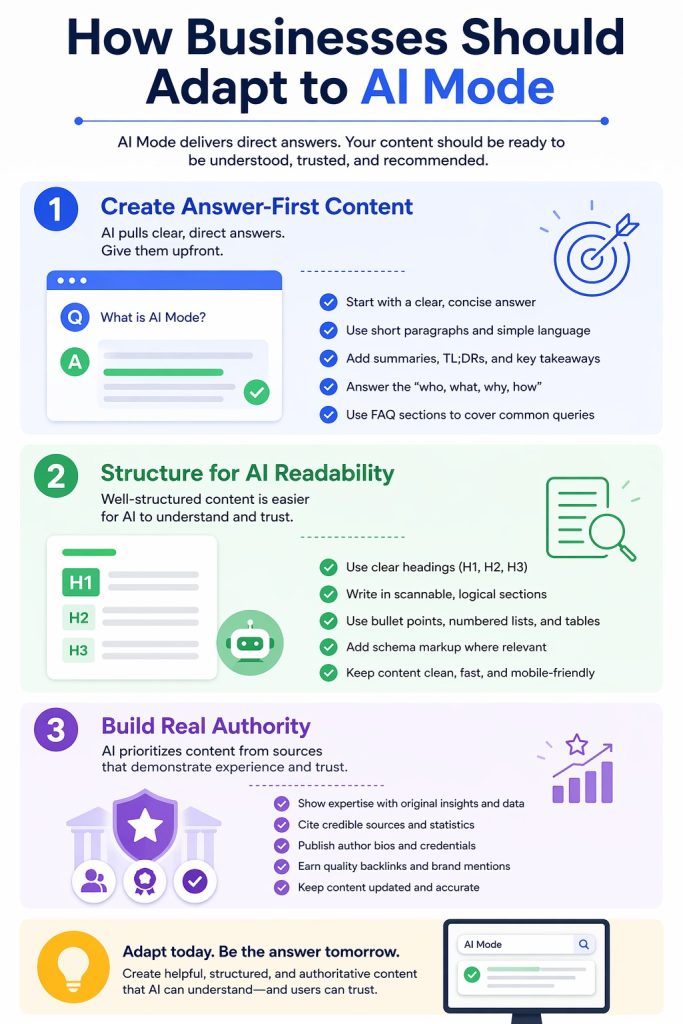
To stay visible in this new landscape, businesses need to rethink their content strategy.

Create Answer-First Content

Focus on solving user queries clearly and directly.

Structure for AI Readability

Use headings, bullet points, and summaries to make content easy to parse.

Build Real Authority

Demonstrate expertise through:

  • Data
  • Experience
  • Insights

Cover Topics in Depth

AI favors content that provides a complete, contextual understanding, not just surface-level answers.

Future of Search

Future of Search
Future of Search

Google’s AI Mode signals a clear shift in search from a tool that finds information to a system that helps users achieve outcomes. It combines context awareness, decision support, and task execution into a single, seamless experience.

Search is becoming a context-aware personal assistant. Instead of treating queries separately, AI understands user intent across a session and responds accordingly, making interactions continuous and more natural.

  • No need to repeat or refine queries
  • Understands intent beyond keywords
  • Improves responses with ongoing context

At the same time, it functions as a decision engine. Rather than just listing options, AI compares, summarizes, and guides users toward the best choice.

  • Compares options instantly
  • Highlights key insights and differences
  • Speeds up decision-making
  • Checks availability and pricing
  • Assists with bookings or purchases
  • Simplifies multi-step processes

This leads to a shift from information retrieval to outcome delivery. Users no longer need to visit multiple sites; AI aggregates and presents what matters most.

Scroll to Top