



Table of Contents
Introduction
“What if we could use a powerful AI model while keeping more control over how it runs?”
“Can a European AI company offer a competitive alternative to the models coming from China?”
“Would an open-weight model actually improve our website or business operations?”
Mistral’s latest announcement brings these questions into focus. On October 6, 2026, the French AI company introduced a public preview of Mistral Large 4, also known as Le Chonk.
Mistral says the model competes with the strongest open models globally, with particular strengths in enterprise tasks. These are the company’s launch claims, not proof of superiority in every application.
For businesses, the announcement raises a practical question: how should they choose an AI model when performance, data control, cost, and integration requirements all matter?
This article explains what Mistral Large 4 is, what its positioning means, and how businesses can evaluate its potential without relying entirely on launch headlines.
What Is Mistral Large 4?
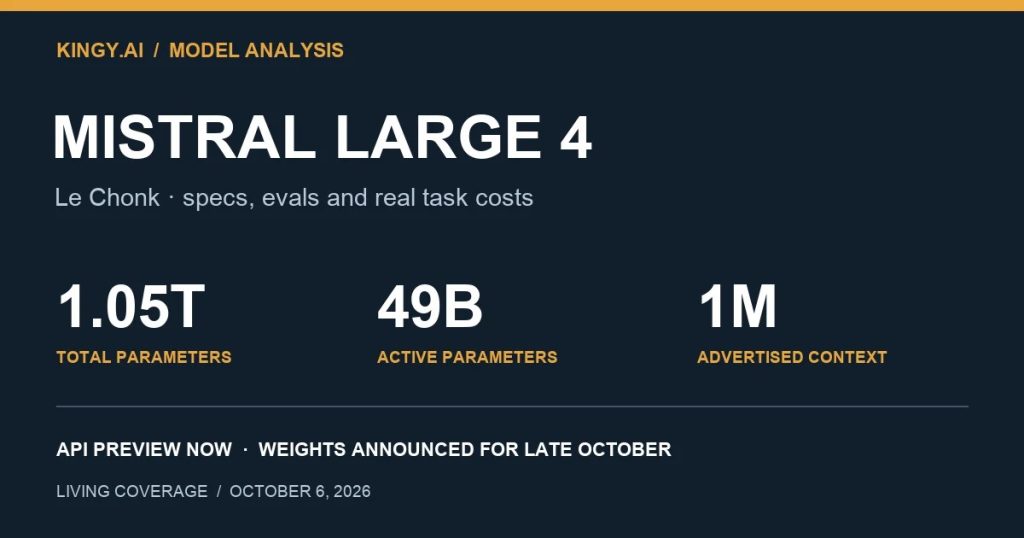
Mistral Large 4 (nicknamed “Le Chonk”) is a 1.05-trillion-parameter, open-weight, general-purpose multimodal AI model released by Mistral AI on October 6, 2026.
- Mistral Large 4 is a general-purpose, multimodal AI model. Mistral’s documentation describes it as using a Mixture-of-Experts architecture, which routes processing through selected parts of the model.
- Its intended role extends beyond basic conversation to more demanding business and technical tasks.
- A general-purpose model can serve as the foundation for different applications. One organization might use it to help employees search internal documents.
- Another might connect it to a customer support system or use it to assist developers.
- However, the model is only one part of a working application. Businesses still need to provide relevant information, define permissions, connect the necessary systems, and check response quality.
For example, a website assistant needs access to accurate product details and policies. An internal assistant needs a clear way to retrieve approved documents. A workflow assistant needs rules about which actions it can perform independently and which require staff approval.
Can Mistral Compete With China’s Leading AI Models?
Mistral says its latest model is competitive with leading AI models worldwide. The announcement places particular emphasis on coding, agentic workflows, multimodal understanding, and specialized enterprise tasks.
That makes Mistral Large 4 a model worth evaluating. It does not establish that it will outperform every Chinese competitor on every workload.
AI performance depends on what a model is asked to do. A system that performs well on software tasks may produce less useful marketing copy. A model that handles complex documents accurately may respond too slowly for a busy customer service application.
Businesses should therefore look beyond a single ranking and compare models using representative tasks.
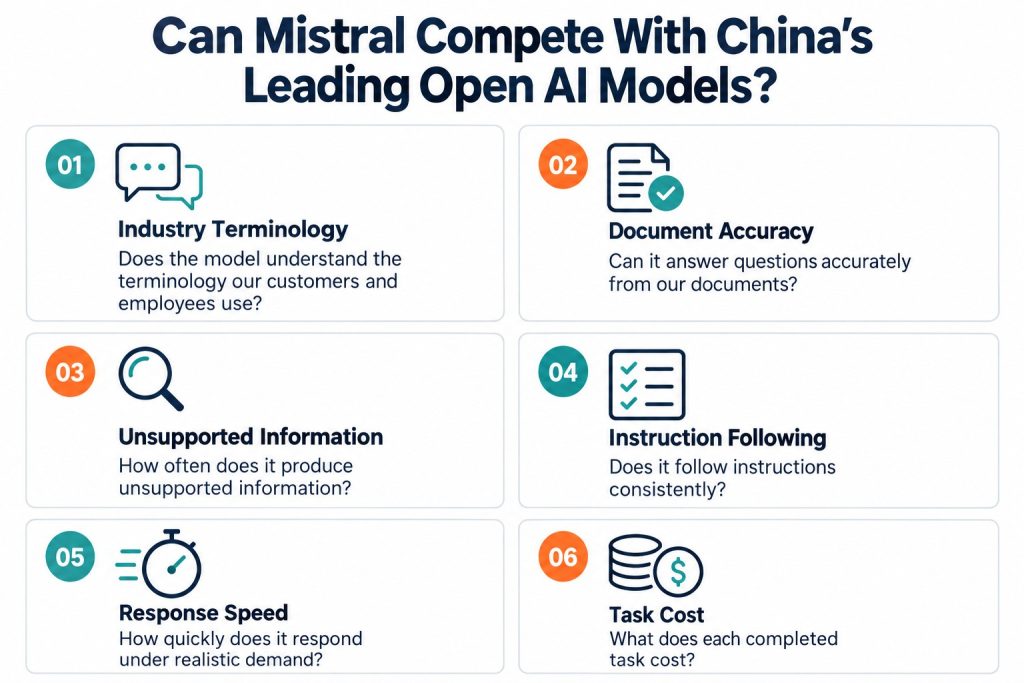
Useful questions include:
- Does the model understand the terminology our customers and employees use?
- Can it answer questions accurately from our documents?
- How often does it produce unsupported information?
- Does it follow instructions consistently?
- How quickly does it respond under realistic demand?
- What does each completed task cost?
A customer support team could test the same set of questions across several models and score accuracy, clarity, and escalation decisions. A development team could compare how well the models identify and fix problems in its own code.
This approach turns a broad competitive claim into evidence relevant to the business.
What Does “Open-Weight” Mean for Businesses?
An AI model’s weights are the learned numerical parameters that help determine how it processes inputs and generates outputs. Making those weights available can allow organizations to deploy or adapt a model, subject to its license and technical requirements.
Open-weight and fully open-source AI are different concepts. The Open Source Initiative’s definition includes requirements involving code, parameters, and training-data information.
Access to weights alone does not provide the same level of transparency or freedom. For businesses, an open-weight release can create several possibilities.
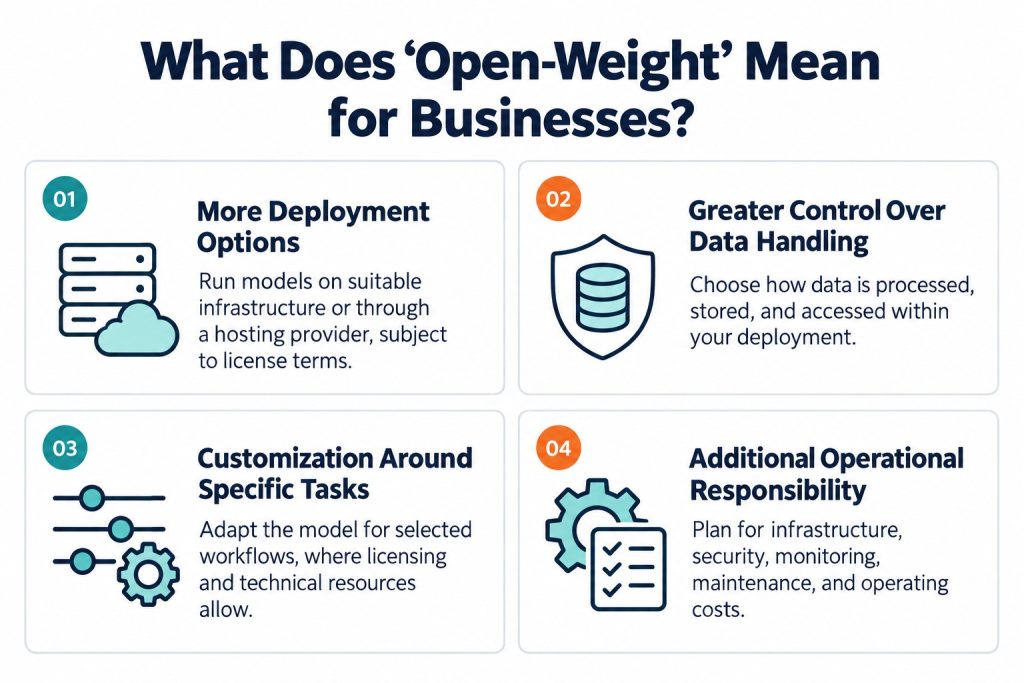
More deployment options
An organization may be able to run the model through a hosting partner or on infrastructure it controls. Whether that is practical depends on the model’s requirements and the organization’s resources.
Greater control over data handling
A carefully designed private deployment can give a business more control over where information is processed and who can access it. That control still depends on the surrounding infrastructure, logging settings, and access policies.
Customization around specific tasks
Depending on the license, technical support, and available resources, a business may adapt the model for particular workflows. It can also build applications that connect the model to approved company information.
Additional operational responsibility
Running a model involves infrastructure, monitoring, maintenance, and security. Downloadable weights do not eliminate those costs.
For many businesses, a managed service may be easier to operate. Others may find that private deployment better fits their requirements. The decision should follow the business need.
When Will Mistral Large 4 Be Available?
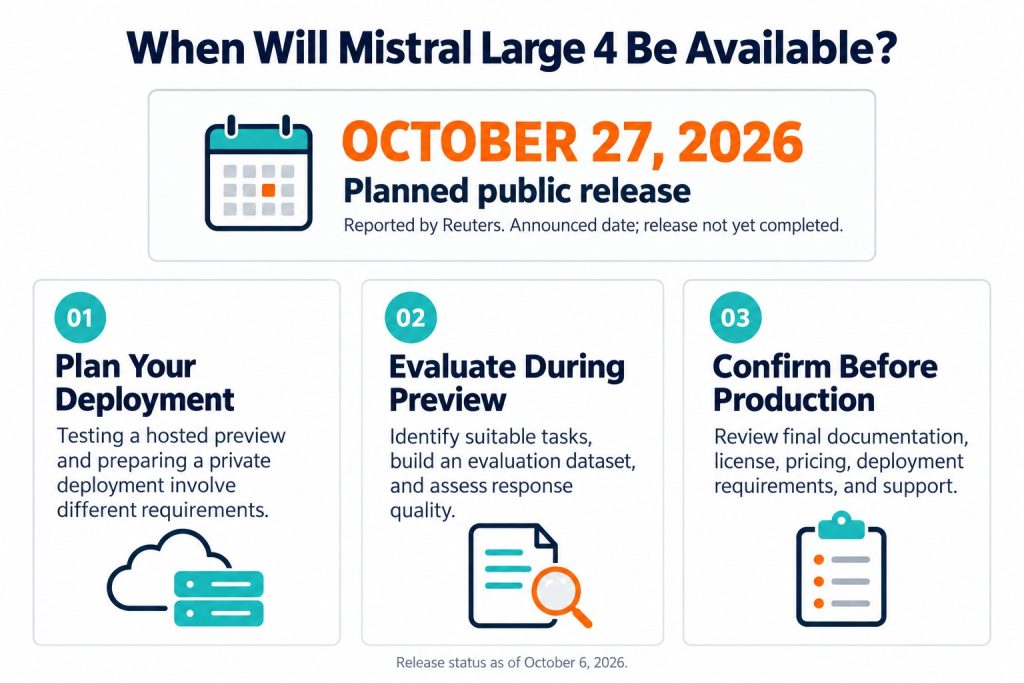
As of October 6, 2026, Mistral says a public preview API is available through Mistral Studio, with the model weights planned for release later in October. This means businesses can begin evaluating the hosted preview before the downloadable weights arrive.
- Reuters reported October 27 as the planned public release date. That remains an announced date, rather than a completed release.
- The distinction matters for planning. Testing a hosted preview and preparing a private deployment involve different requirements.
- During the preview period, teams can identify suitable tasks, build an evaluation dataset, and assess response quality.
- Before making a production commitment, they should confirm the final release documentation, license, pricing, deployment requirements, and support arrangements.
An early evaluation can provide useful evidence without requiring an immediate company-wide rollout.
Why the Announcement Matters for European AI
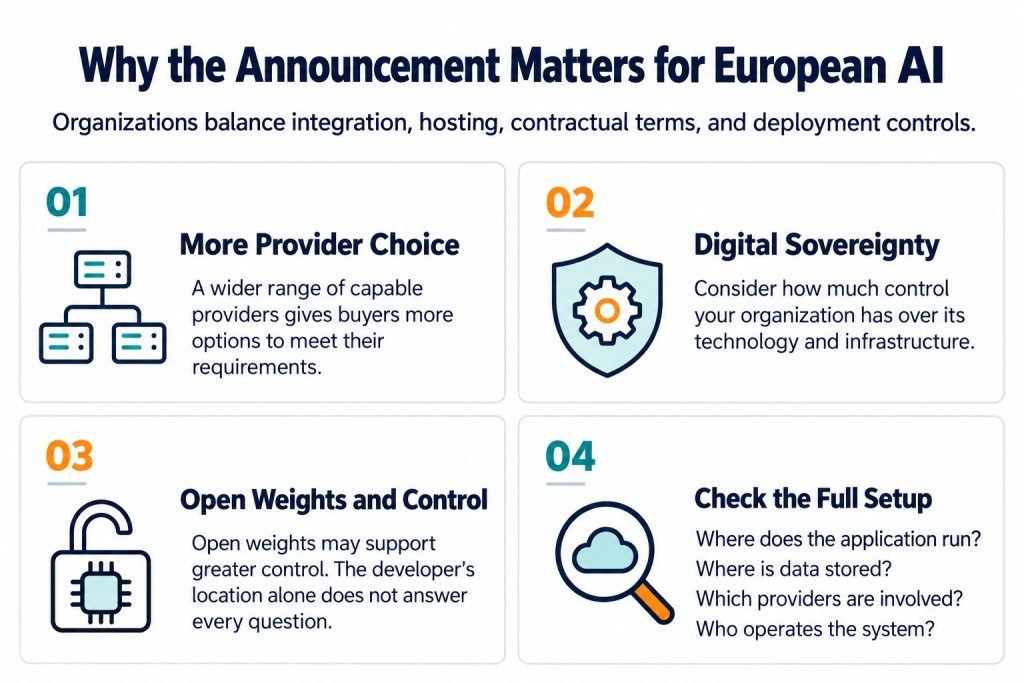
Mistral’s announcement adds another European contender to the discussion about high-performance AI. Its leadership has positioned the release as evidence that Europe can compete with American and Chinese developers. For businesses, the practical significance is greater choice.
- Organizations have different priorities. Some want the easiest possible integration. Others need particular hosting arrangements, contractual terms, or deployment controls.
- A wider range of capable providers gives buyers more options when balancing these requirements.
- The announcement also invites a closer look at digital sovereignty: how much control an organization has over the technology and infrastructure it depends on.
- An open-weight model may contribute to that control, but the developer’s location does not settle every question.
- Businesses still need to understand where their application runs, where data is stored, which providers are involved, and who is responsible for operating the system.
The potential benefit is a broader set of choices that businesses can assess against their actual needs.
Applications for Business Websites and Operations
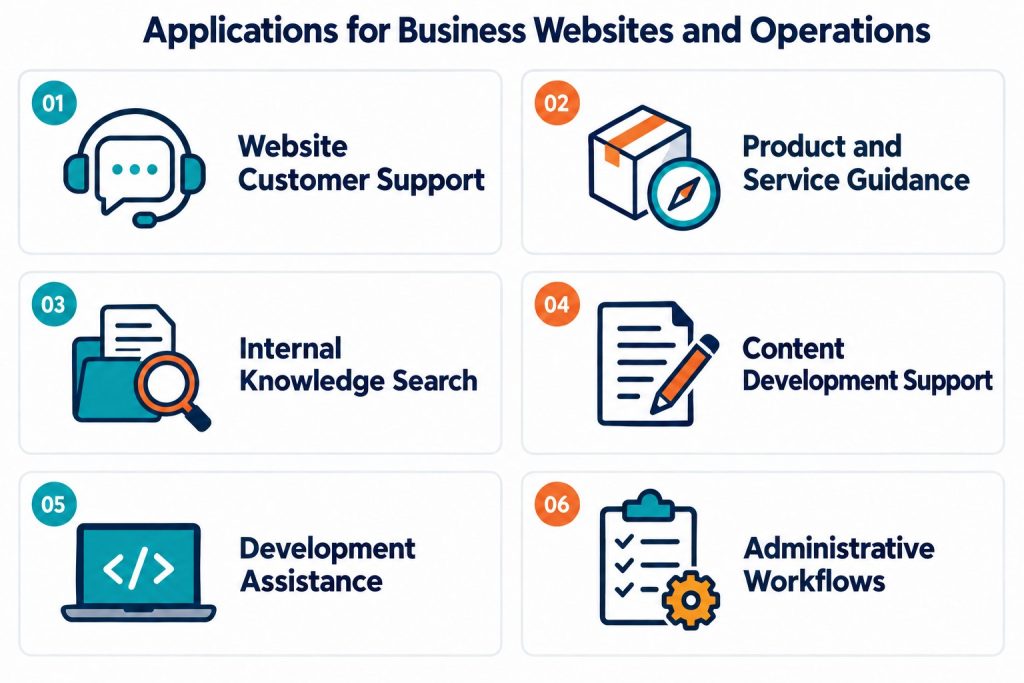
The following are potential implementation ideas, rather than claims that Mistral Large 4 includes ready-made business applications. Each would require integration and testing.
Website customer support
A business could connect an assistant to approved FAQs, product information, and service policies. Visitors could ask questions in everyday language and receive answers based on that material.
- For example, a customer might ask whether a product fits a particular use case. The assistant could explain relevant specifications and direct the customer to a staff member when the available information is insufficient.
- Success should be measured through answer accuracy, customer satisfaction, and appropriate escalation.
Product and service guidance
- Businesses with large catalogs or several service packages could use an assistant to help visitors compare options.
- The system would need accurate source information and clear limits. It should avoid inventing features, availability, or promises that the company has not approved.
Internal knowledge search
Employees could ask questions about procedures, onboarding materials, or internal documentation.
- A useful implementation would show the supporting source and respect existing access permissions.
- Employees should only receive information they are authorized to view.
Content development support
Marketing teams could use the model to draft outlines, summarize approved material, or adapt content for different audiences.
- Editors would still need to verify factual claims, refine the language, and ensure the content reflects the company’s expertise.
- A faster first draft is valuable when it also reduces the work needed to reach a publishable result.
Development assistance
Teams could evaluate the model for explaining unfamiliar code, suggesting changes, or helping investigate errors.
- Generated code should go through the same review and validation process as other contributions.
- The relevant measure is whether it helps developers complete reliable work more efficiently.
Administrative workflows
A connected application could summarize inquiries, categorize support requests, or prepare draft follow-up messages.
- A sensible starting point is a workflow where staff reviews the output before it triggers an external action.
- The business can then assess accuracy and decide whether further automation is justified.
What Businesses Should Evaluate Before Adoption
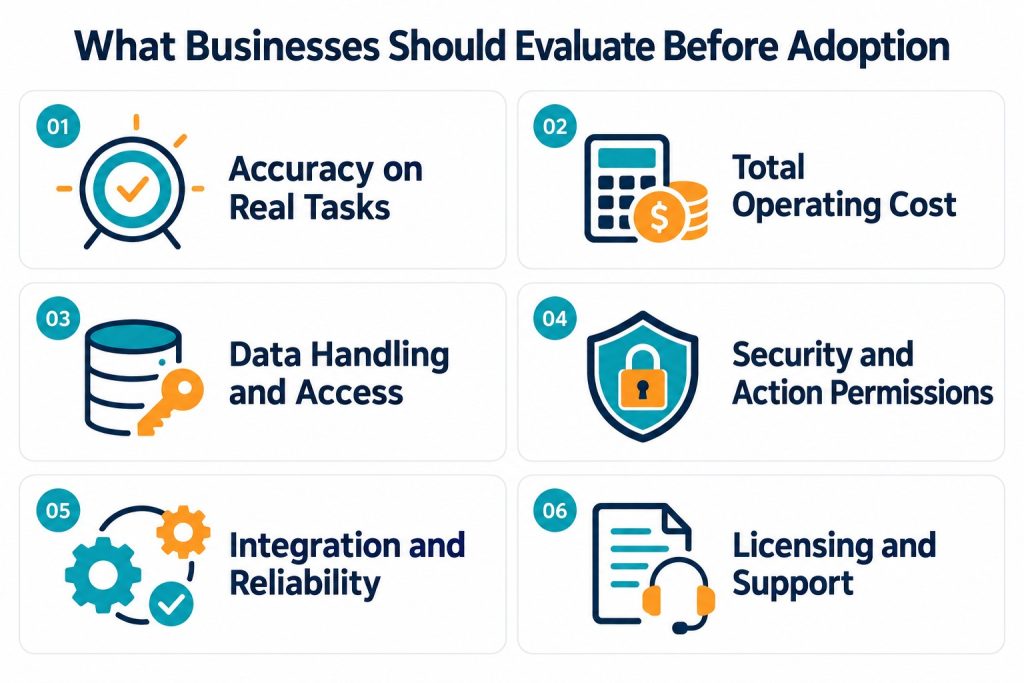
Before adopting Mistral Large 4, businesses should define the outcome they want and test whether the model helps achieve it.
Accuracy on real tasks
Use examples drawn from actual work. Include ambiguous questions, incomplete information, and cases where the correct response is to ask for clarification.
- Record how much human correction each output requires.
- A response that sounds polished may still contain serious mistakes.
Total operating cost
Compare API or hosting costs alongside integration, monitoring, maintenance, and staff review.
- A useful measure is cost per completed task.
- A cheaper response can become expensive if employees repeatedly need to correct it.
Data handling and access
Identify which information the application will receive, where it will be processed, and who can access it.
- For an internal assistant, document permissions need to remain intact.
- For a customer-facing system, confidential company information should stay outside the assistant’s accessible material.
Security and action permissions
Decide what the system can do beyond generating text.
- An assistant that drafts a reply needs different permissions from one that updates a customer record.
- Applications that perform actions should have clear authorization rules, activity records, and a way to stop or reverse incorrect actions.
Integration and reliability
Test how the model works with the systems the business already uses.
- Evaluate response time, error handling, and behavior when connected services are unavailable.
- A successful demonstration should lead to a small, measurable pilot before broader deployment.
Licensing and support
Review the terms governing commercial use, modification, hosting, and redistribution. Confirm what support is available and how model updates could affect the application.
- Mistral Large 4’s announcement gives businesses another model to consider.
- The adoption decision should come from a controlled evaluation: choose one useful task, establish a baseline, test the model, and measure whether it improves the result.

Deepak Wadhwani has over 20 years experience in software/wireless technologies. He has worked with Fortune 500 companies including Intuit, ESRI, Qualcomm, Sprint, Verizon, Vodafone, Nortel, Microsoft and Oracle in over 60 countries. Deepak has worked on Internet marketing projects in San Diego, Los Angeles, Orange Country, Denver, Nashville, Kansas City, New York, San Francisco and Huntsville. Deepak has been a founder of technology Startups for one of the first Cityguides, yellow pages online and web based enterprise solutions. He is an internet marketing and technology expert & co-founder for a San Diego Internet marketing company.