


Table of Contents
Introduction
Choosing between HubSpot vs. Klaviyo for ecommerce email comes down to one central question: Do you need a specialized ecommerce marketing platform or a broader CRM that manages the complete customer lifecycle?
Klaviyo is designed primarily for business-to-consumer brands that want to turn browsing, cart, purchase, and customer data into personalized email and SMS campaigns. HubSpot offers email marketing alongside CRM, sales, customer service, content management, lead generation, and broader marketing automation tools.
Both platforms can support ecommerce growth, but they approach it from different directions. Klaviyo begins with the online purchase journey. HubSpot begins with the customer relationship.
This comparison examines automation, segmentation, integrations, analytics, usability, pricing, and scalability to help you choose the right platform for your ecommerce business.
What Is HubSpot?
HubSpot is a customer relationship management platform that connects marketing, sales, content, commerce, customer service, and operations.
Its Marketing Hub includes tools for:
- Email campaigns
- Marketing automation
- Forms and landing pages
- Contact management
- Lead scoring
- Website tracking
- Advertising
- Social media
- Reporting
- Customer journey management
HubSpot can connect with ecommerce platforms such as Shopify to synchronize customer, product, cart, and order information. Shopify order data can then be associated with customer records and used in marketing workflows, reports, and audience segments.
What Is Klaviyo?
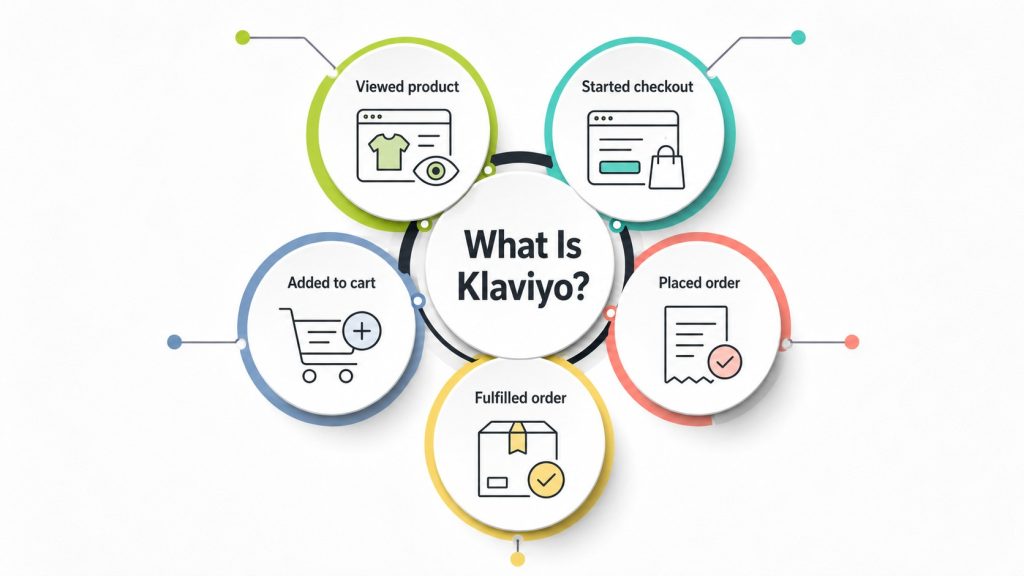
Klaviyo is a B2C customer relationship and marketing automation platform built around customer behavior and commerce data. Ecommerce brands widely use it for email, SMS, mobile messaging, segmentation, automated flows, and customer analytics.
Klaviyo can use events such as:
- Viewed product
- Started checkout
- Added to cart
- Placed order
- Fulfilled order
- Purchased a specific product
- Joined a list
- Became inactive
- Reached a customer-value threshold
These events can trigger automated messages without requiring the marketing team to build complex custom integrations.
Which Platform Offers Better Ecommerce Automation?
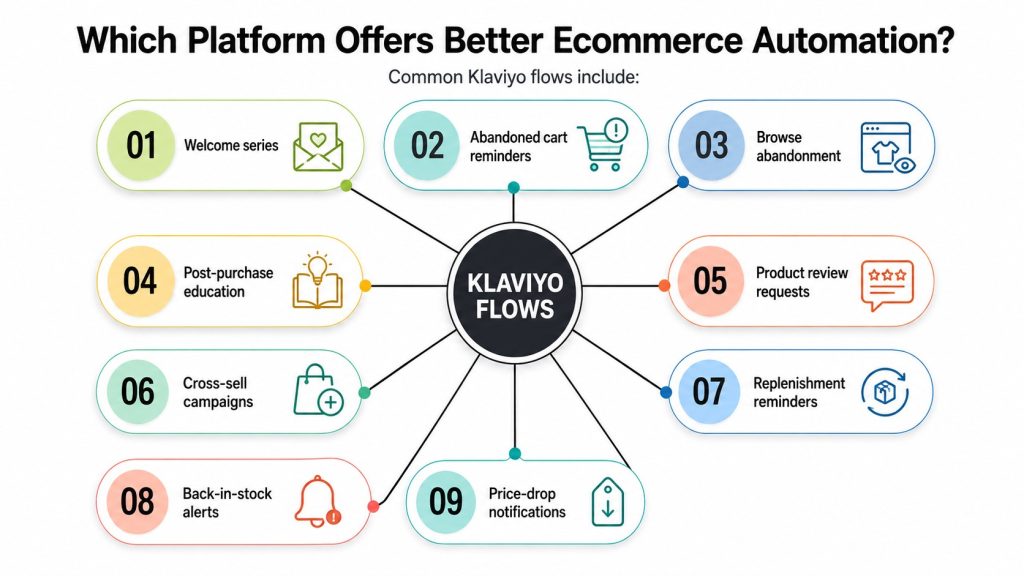
For pure ecommerce email automation, Klaviyo is generally the stronger choice.
Klaviyo Flows can trigger email, SMS, and other actions based on real-time customer behavior. Its workflows are designed around events that are familiar to ecommerce teams rather than only traditional CRM properties.
Common Klaviyo flows include:
- Welcome series
- Abandoned cart reminders
- Browse abandonment
- Post-purchase education
- Product review requests
- Cross-sell campaigns
- Replenishment reminders
- Back-in-stock alerts
- Price-drop notifications
- Customer win-back
- VIP recognition
- Birthday or anniversary campaigns
- Sunset flows for inactive subscribers
Which Platform Has Better Segmentation?
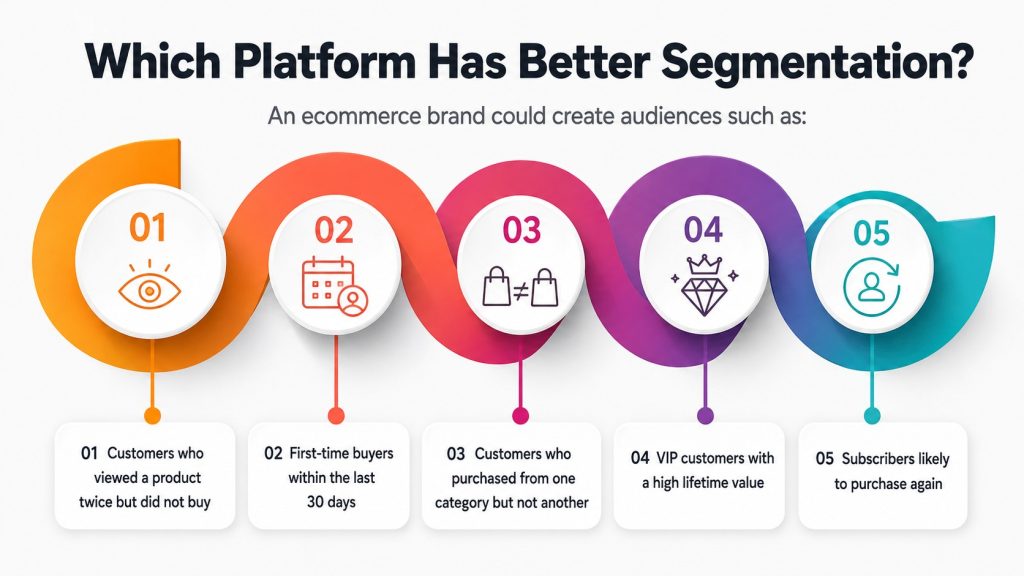
Klaviyo offers stronger out-of-the-box segmentation for most ecommerce brands.
Segments can update automatically based on profile properties, engagement, purchasing behavior, predictive information, Shopify tags, and other synchronized events.
An ecommerce brand could create audiences such as:
- Customers who viewed a product twice but did not buy
- First-time buyers within the last 30 days
- Customers who purchased from one category but not another
- VIP customers with a high lifetime value
- Subscribers likely to purchase again
- Customers who have not purchased within their usual buying cycle
- Buyers who used a discount on every recent order
- Customers in a particular Shopify
- Market
- Custom objects
- Order information
This makes HubSpot especially valuable for businesses that have both ecommerce and consultative sales journeys. For example, a company selling products online and handling wholesale accounts through sales representatives may benefit from keeping both audiences inside one CRM.
Which Is Better for Shopify Stores?
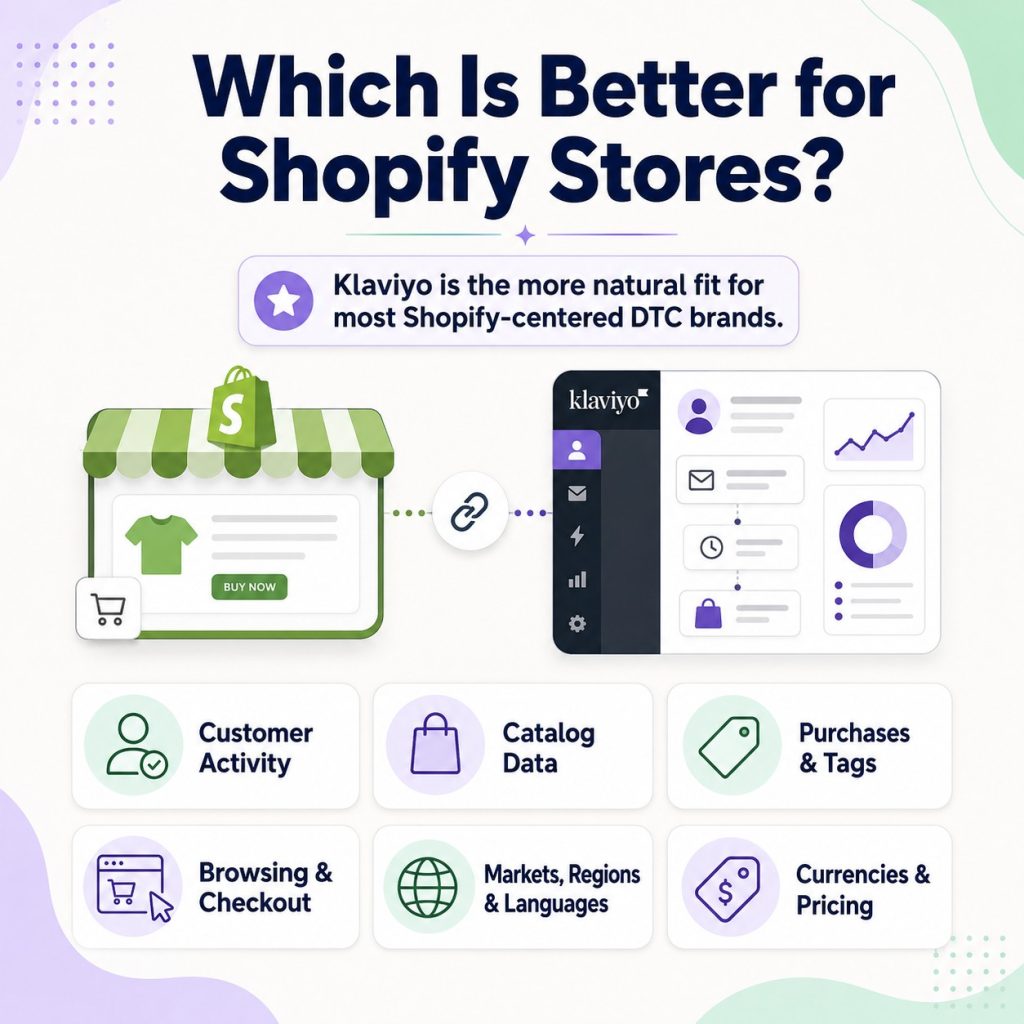
For most Shopify-centered direct-to-consumer brands, Klaviyo offers the more natural fit.
Its Shopify integration is designed to bring customer activity into Klaviyo profiles and flows. Marketers can work with catalog data, purchases, customer tags, browsing events, checkout behavior, and regional information.
Klaviyo can also synchronize information from Shopify Markets, including region- and language-specific customer and product data, currencies, and pricing.
HubSpot’s Shopify Data Sync integration can connect commerce activities with marketing and CRM records. Businesses can analyze synchronized data, access ecommerce reporting, and associate activity with customer records.
HubSpot also supports product modules within eligible automated emails. With a connected Shopify account, marketers can use recently viewed and most-viewed product recommendations under applicable conditions.
The difference is strategic:
- Choose Klaviyo when Shopify is the center of your customer and marketing operations.
- Choose HubSpot when Shopify is one part of a larger sales, service, or lead-generation system.
Which Platform Provides Better CRM Capabilities?
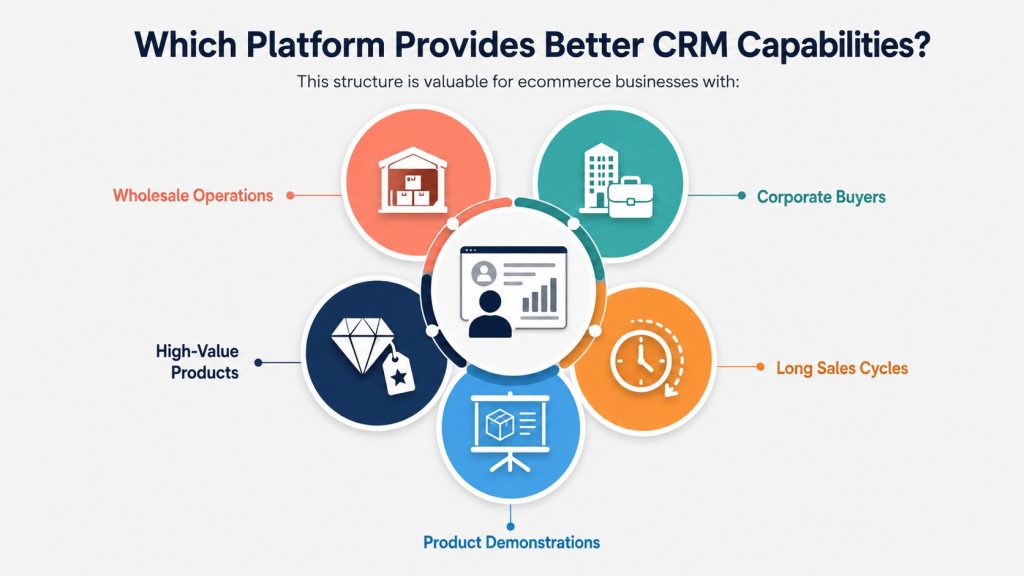
HubSpot is the clear winner for traditional CRM functionality.
It provides detailed records for contacts, companies, deals, tickets, activities, products, orders, and other objects. Sales teams can manage pipelines, tasks, meetings, conversations, and follow-ups while marketing teams work from the same customer database.
This structure is valuable for ecommerce businesses with:
- Wholesale operations
- Corporate buyers
- High-value products
- Long sales cycles
- Product demonstrations
- Account management
- Dealer or distributor networks
- Customer service teams
- Subscription consultations
- Both online and offline revenue
- Klaviyo provides unified customer profiles built around marketing engagement and purchasing behavior.
These profiles are highly valuable to ecommerce marketers, but Klaviyo is not intended to replace a full sales CRM in every use case.
Which Platform Is Easier to Use?
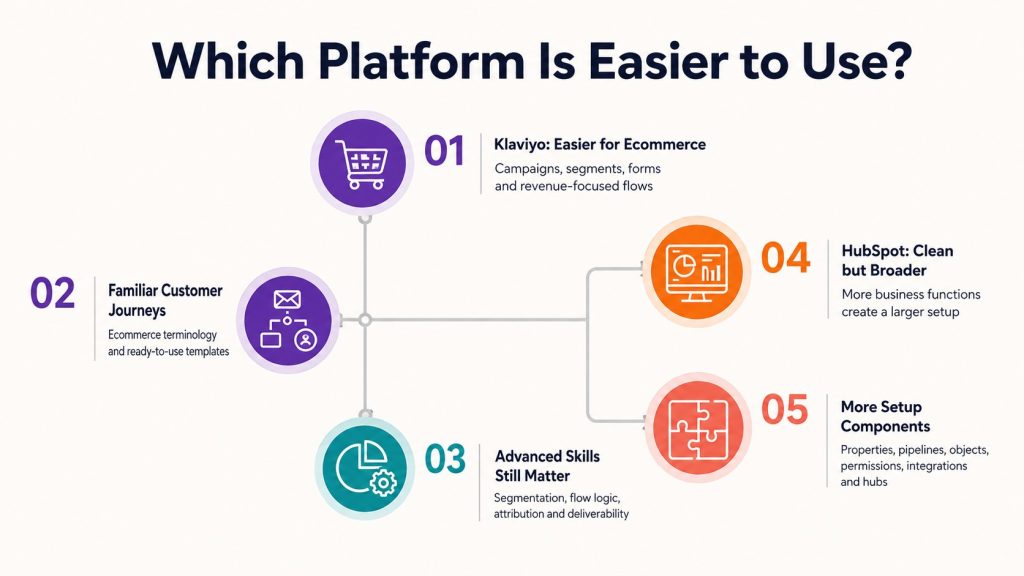
Klaviyo is usually easier for an ecommerce marketer who mainly wants to create campaigns, segments, forms, and revenue-focused automation flows.
Its terminology and templates reflect familiar ecommerce journeys. However, advanced segmentation, flow logic, attribution settings, and deliverability management still require experience.
HubSpot has a clean interface, but the platform covers more business functions. Setup may involve lifecycle stages, contact properties, pipelines, objects, user permissions, integrations, and multiple hubs.
This additional complexity is worthwhile when several departments need one connected system. It can feel unnecessary for a smaller ecommerce team focused almost entirely on email and SMS.
When Should an Ecommerce Brand Choose Klaviyo?
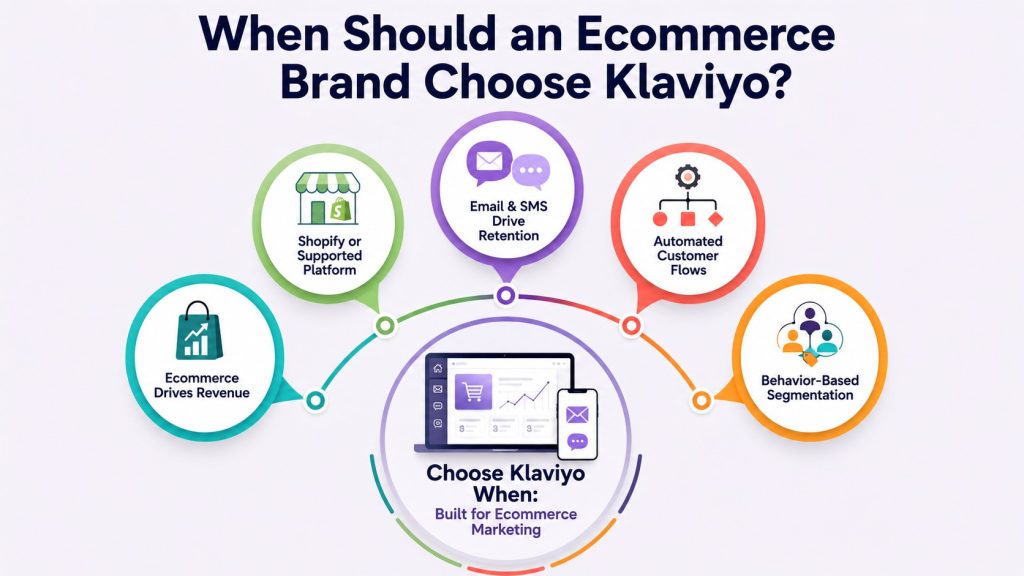
Klaviyo is usually the better choice when:
- Ecommerce generates most of the company’s revenue.
- The store operates on Shopify or another supported commerce platform.
- Email and SMS are major retention channels.
- The team needs browse, cart, post-purchase, and win-back flows.
- Purchase behavior should drive segmentation.
- Product recommendations are central to personalization.
- The business wants revenue-focused email reporting.
- There is no need for a complex sales CRM.
A growing direct-to-consumer brand will generally receive value from Klaviyo’s commerce-specific features more quickly.
When Should an Ecommerce Brand Choose HubSpot?
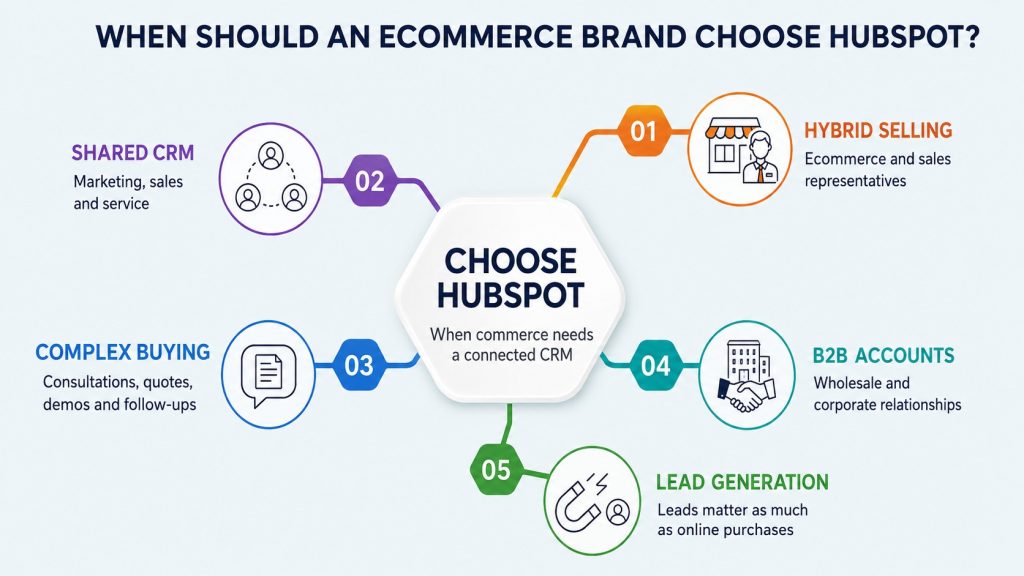
HubSpot is generally the better choice when:
- The business sells through both ecommerce and sales representatives.
- Marketing, sales, and service need a shared CRM.
- The buying process includes consultations, quotes, demos, or follow-ups.
- The company manages wholesale or corporate accounts.
- Lead generation is as important as online purchases.
- The team needs pipelines, tickets, content, and campaigns in one system.
- Customer journeys extend beyond product browsing and checkout.
- Management needs broader revenue and lifecycle reporting.
HubSpot can be particularly suitable for manufacturers, software companies, professional services firms, and hybrid B2B/B2C brands that also operate an ecommerce store.
Can You Use HubSpot and Klaviyo Together?
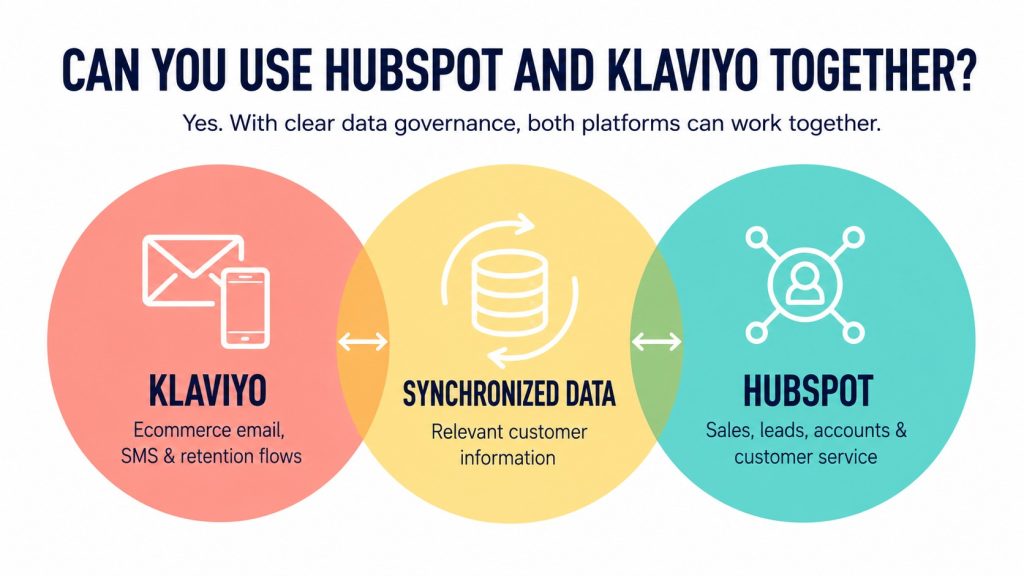
Yes, some businesses use both platforms, but doing so requires clear data governance.
In a combined setup:
- Klaviyo manages ecommerce email, SMS, and retention flows.
- HubSpot manages sales, lead generation, account relationships, and customer service.
- Relevant customer information is synchronized between the two systems.
This arrangement can be useful for a brand with strong direct-to-consumer sales and a separate wholesale or corporate sales operation.
Define which platform owns subscriptions, customer profiles, lifecycle stages, campaign suppression, and sales communication before activating overlapping workflows.
HubSpot vs. Klaviyo: Which Is Better?
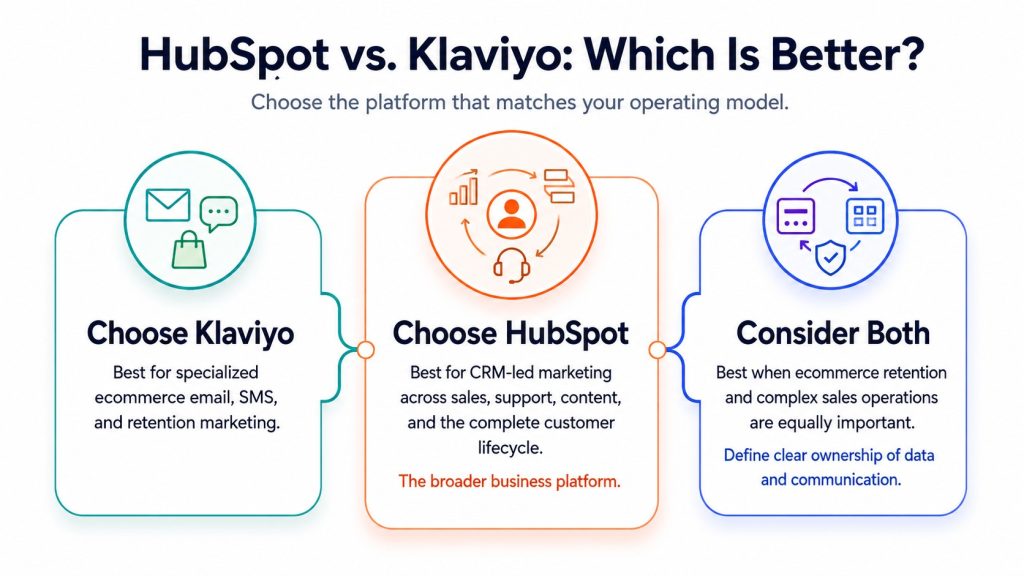
For most ecommerce-first and direct-to-consumer brands, Klaviyo is the better email marketing platform. Its behavioral segmentation, automated flows, Shopify integration, product personalization, predictive metrics, and revenue reporting are designed around ecommerce growth.
For businesses that need to connect ecommerce with sales pipelines, lead management, account relationships, customer support, content, and broader lifecycle marketing, HubSpot is the better business platform.
The final decision should follow your operating model:
- Choose Klaviyo for specialized ecommerce email and SMS marketing.
- Choose HubSpot for CRM-led marketing across the complete customer lifecycle.
Consider both when ecommerce retention and complex sales operations are equally important, provided you establish clear ownership of data and communication.
The best platform is not simply the one with the longest feature list. It is the one that matches how your customers buy, how your teams work, and how your business plans to grow.