


Table of Contents
Introduction
Artificial Intelligence (AI) has evolved from a promising technology into a core driver of innovation across nearly every industry. In 2026, AI is no longer limited to automating repetitive tasks or powering virtual assistants.
The rapid advancement of large language models (LLMs), multimodal AI, autonomous AI agents, and high-performance computing has significantly expanded what businesses can accomplish with AI.
At the same time, AI adoption has become more accessible. Cloud-based AI platforms, open-source frameworks, and enterprise-ready AI solutions allow businesses of all sizes to integrate intelligent automation into their daily operations without building complex infrastructure from scratch.
Whether you’re a business leader exploring digital transformation, a developer building AI-powered applications, or simply curious about where artificial intelligence is heading, understanding the major applications of AI in 2026 is essential.
In this guide, we’ll explore the most impactful AI use cases, emerging trends, and how organizations across industries are leveraging AI to stay competitive in an increasingly digital world.
What Makes AI More Powerful in 2026?
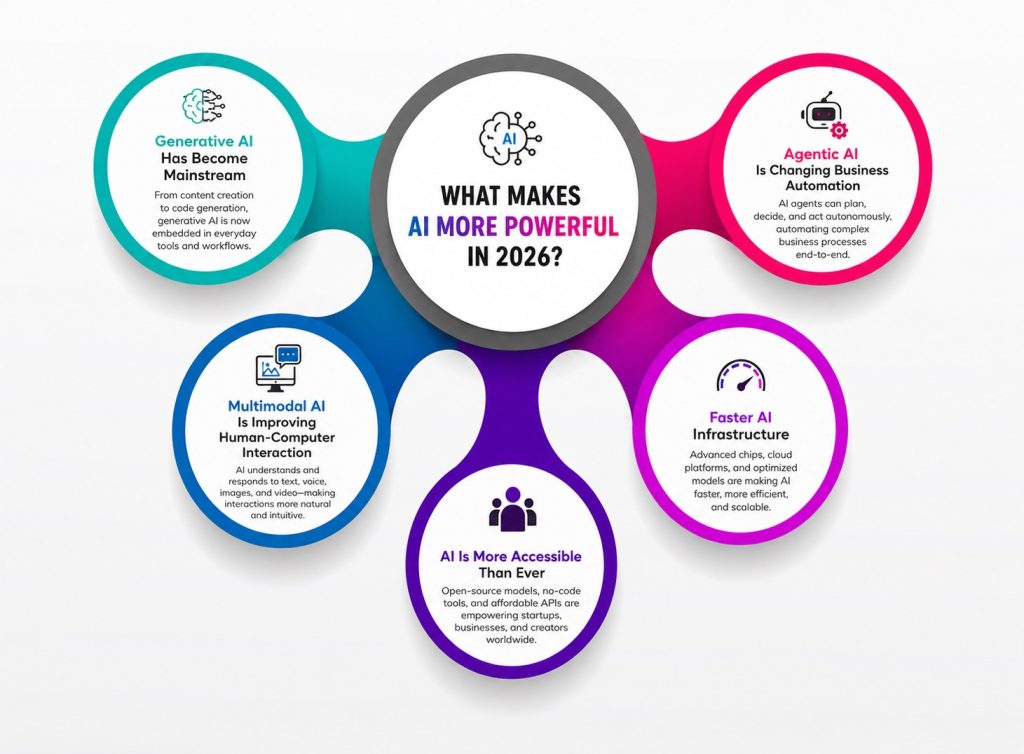
AI has progressed far beyond simple machine learning models. Several technological breakthroughs have made modern AI faster, more intelligent, and significantly more useful for real-world business applications.
Generative AI Has Become Mainstream
Generative AI has transformed the way organizations create content, write code, design products, and interact with customers. Instead of merely analyzing information, AI systems can now generate high-quality text, images, videos, software code, and even business reports in seconds.
Companies are integrating generative AI into customer support, marketing, software development, legal research, and product design to improve productivity while reducing manual effort.
Agentic AI Is Changing Business Automation
One of the biggest advancements in 2026 is the rise of Agentic AI.
Unlike traditional AI tools that wait for user instructions, AI agents can plan, reason, make decisions, and complete multi-step tasks with minimal human involvement.
For example, an AI agent can:
- Analyze sales data
- Identify declining products
- Generate recommendations
- Create a report
- Email department managers
- Schedule follow-up meetings
- All within a single automated workflow.
This capability is redefining business automation across industries.
Multimodal AI Is Improving Human-Computer Interaction
Modern AI systems no longer process only text. Today’s models can simultaneously understand:
- Images
- Audio
- Video
- Documents
- Voice commands
- Structured business data
This allows businesses to build richer applications such as AI-powered medical diagnostics, intelligent document processing, advanced customer support, and visual inspection systems for manufacturing.
Faster AI Infrastructure
Behind every AI breakthrough is powerful computing infrastructure. Modern AI workloads require:
- High-performance GPUs
- AI accelerators
- Advanced CPUs
- High-speed networking
- Optimized software platforms
- Companies like AMD, NVIDIA, Intel, Microsoft, and Google continue investing heavily in AI infrastructure to make large-scale AI deployments faster, more energy-efficient, and easier to manage.
AI Is More Accessible Than Ever
Only a few years ago, implementing AI required specialized teams and significant infrastructure investments. Today, businesses can access AI through:
- Cloud AI platforms
- AI APIs
- Low-code automation tools
- AI copilots
- Open-source frameworks
- This accessibility enables startups, small businesses, and enterprises alike to adopt AI solutions that fit their specific needs.
Major Applications of AI in 2026
AI is no longer confined to research laboratories or technology companies. It is actively solving business challenges across nearly every sector. Let’s explore the most significant applications driving AI adoption in 2026.
1. AI-Powered Customer Service and Virtual Assistants
AI-powered customer service platforms are helping businesses meet these expectations through intelligent virtual assistants and conversational AI. Unlike earlier chatbots that relied on scripted responses, modern AI assistants understand context, remember previous interactions, and provide human-like conversations.
Common applications include:
- 24/7 customer support
- Order tracking
- Product recommendations
- Appointment scheduling
- Technical troubleshooting
- Multilingual customer assistance
AI also assists human support agents by suggesting responses, summarizing conversations, and retrieving relevant knowledge base articles, reducing response times while improving customer satisfaction.
2. AI in Software Development
AI can help:
- Generate code snippets
- Detect bugs
- Recommend optimizations
- Create unit tests
- Explain complex code
- Generate technical documentation
Instead of replacing developers, AI acts as an intelligent collaborator that accelerates routine tasks while allowing engineers to focus on solving complex problems.
Development teams also use AI to review pull requests, identify security vulnerabilities, and improve overall code quality.
3. AI for Business Process Automation
Examples include:
- Invoice processing
- Purchase order approvals
- Employee onboarding
- Insurance claims processing
- Document classification
- Expense management
- Compliance reporting
Instead of employees spending hours performing repetitive administrative work, AI automates routine processes while maintaining high accuracy.
This allows organizations to focus more on innovation and customer value rather than manual operations.
4. AI in Healthcare
Key applications include:
- Medical image analysis
- Disease detection
- Drug discovery
- Personalized treatment planning
- Clinical documentation
- Remote patient monitoring
AI also assists hospitals by optimizing patient scheduling, predicting resource requirements, and improving operational efficiency.
Rather than replacing healthcare professionals, AI enhances their ability to make informed decisions while reducing administrative burden.
5. AI in Marketing and Content Creation
Modern AI platforms assist marketers by:
- Generating blog posts
- Writing ad copy
- Creating social media content
- Personalizing email campaigns
- Conducting keyword research
- Optimizing SEO strategies
- Predicting customer behavior
- Analyzing campaign performance
Instead of relying solely on historical reports, marketing teams now use AI to make real-time decisions that improve campaign performance and customer engagement.
6. AI in Cybersecurity
Unlike conventional security tools that depend on predefined rules, AI continuously analyzes network activity, user behavior, and system logs to detect unusual patterns that may indicate a cyberattack. This enables organizations to identify threats much earlier and respond before significant damage occurs.
- Common Applications
- Real-time threat detection
- AI-powered fraud prevention
- Email phishing detection
- Identity and access management
- Automated incident response
- Malware analysis
- Insider threat monitoring
Financial institutions, healthcare providers, and government agencies are among the biggest adopters of AI-driven cybersecurity because they manage highly sensitive information and face constant cyber risks.
7. AI in Finance and Banking
Banks process millions of transactions every day. AI enables them to analyze this data in real time, identify suspicious activities, automate customer service, and generate financial insights that would be impossible to achieve manually.
- Major Applications
- Fraud Detection
- AI analyzes transaction behavior and flags unusual spending patterns that may indicate fraud.
- Instead of relying solely on traditional credit scores, AI evaluates multiple data sources to assess an applicant’s financial risk more accurately.
8. AI in Manufacturing
Rather than reacting to problems after they occur, manufacturers now use AI to predict equipment failures, optimize production schedules, and improve product quality before defects reach customers.
- AI analyzes sensor data from machines to predict when maintenance is needed, reducing costly downtime.
- Computer vision systems inspect products for defects with greater speed and accuracy than manual inspections.
- AI identifies bottlenecks and recommends workflow improvements that increase efficiency.
- Intelligent robots perform repetitive or hazardous tasks while working alongside human employees.
- AI forecasts demand, manages inventory, and identifies the most efficient sourcing and shipping strategies.
9. AI in Retail and E-commerce
Retailers are using AI to create personalized shopping experiences while improving operational efficiency behind the scenes.
Whether customers shop online or in physical stores, AI helps businesses understand buying behavior, recommend products, and optimize inventory levels.
Popular examples include:
- Personalized product recommendations
- Customized homepages
- AI-powered search
- Virtual shopping assistants
- Inventory Management
- AI predicts demand based on purchasing trends, seasonal patterns, and market conditions, helping retailers maintain optimal inventory levels while minimizing waste.
10. AI in Education
Education has become increasingly personalized thanks to AI-powered learning platforms.
- Instead of delivering identical content to every student, AI adapts learning experiences based on individual progress, strengths, and learning styles.
- AI identifies knowledge gaps and recommends customized lessons, practice exercises, and study materials.
- Virtual tutors provide instant explanations, answer questions, and guide students through complex topics.
- Teachers save valuable time by using AI to evaluate quizzes, assignments, and written responses while generating performance reports.
- Educational institutions analyze student engagement and academic performance to identify learners who may need additional support.
- AI also assists schools by automating scheduling, enrollment management, and communication with students and parents.
Benefits of AI Adoption for Businesses
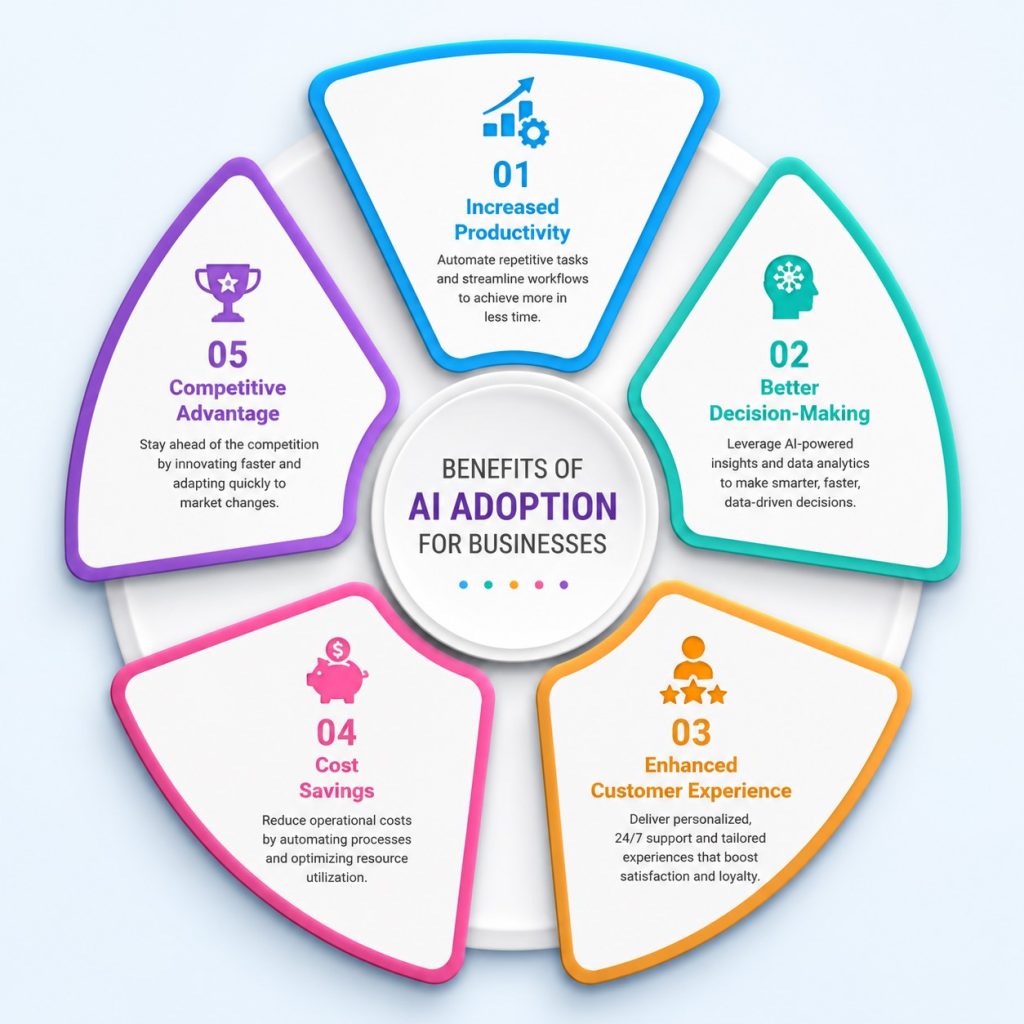
Artificial intelligence has evolved from a competitive advantage into a business necessity. Organizations across industries are leveraging AI to improve productivity, enhance customer experiences, reduce operational costs, and make more informed decisions. While the applications of AI vary by industry, the underlying benefits remain consistent.
Increased Productivity
One of the most immediate advantages of AI is its ability to automate repetitive and time-consuming tasks. Instead of spending hours on manual data entry, report generation, scheduling, or document processing, employees can focus on strategic work that requires creativity and critical thinking.
AI-powered assistants also help teams complete tasks faster by generating summaries, analyzing large datasets, and providing actionable recommendations in real time.
Better Decision-Making
Modern businesses generate enormous volumes of data every day. AI transforms this data into meaningful insights by identifying trends, predicting outcomes, and highlighting opportunities that might otherwise go unnoticed.
Executives use AI dashboards to:
- Forecast sales performance
- Monitor customer behavior
- Optimize pricing strategies
- Predict inventory requirements
- Evaluate financial risks
With data-driven insights readily available, organizations can make faster and more confident decisions.
Enhanced Customer Experience
Customer expectations continue to rise, and AI helps businesses deliver faster, more personalized interactions.
AI improves customer experience through:
- Personalized recommendations
- Intelligent virtual assistants
- Faster issue resolution
- Predictive customer support
- Multilingual communication
These capabilities increase customer satisfaction while building long-term loyalty.
Cost Savings
Automation reduces operational expenses by minimizing manual work, improving resource utilization, and reducing errors.
Organizations often see savings through:
- Automated workflows
- Lower support costs
- Improved energy efficiency
- Reduced downtime
- Optimized inventory management
Instead of replacing employees, AI enables teams to accomplish more with existing resources.
Competitive Advantage
Businesses that successfully integrate AI often gain an edge over competitors by responding more quickly to market changes, delivering innovative products, and improving operational efficiency.
Future of AI Beyond 2026
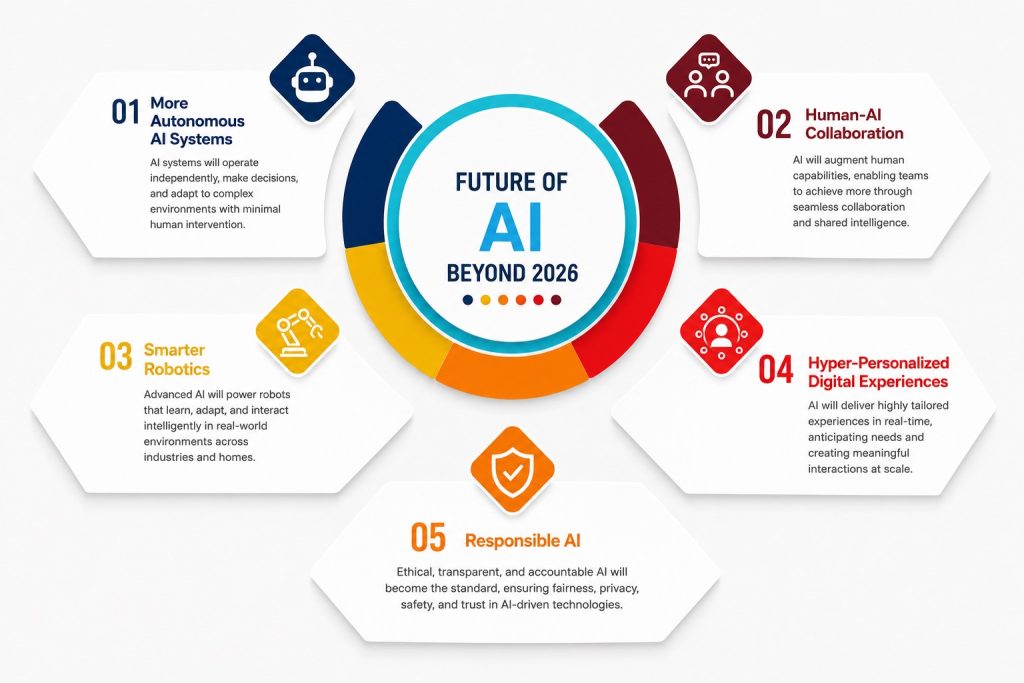
Although AI has already transformed many industries, its evolution is far from complete.
Several developments are expected to shape the next generation of intelligent technologies.
More Autonomous AI Systems
Future AI agents will manage increasingly complex workflows independently, coordinating tasks across multiple applications while requiring minimal human supervision.
Human-AI Collaboration
Rather than replacing professionals, AI will become an intelligent partner that enhances creativity, productivity, and decision-making across every industry.
Smarter Robotics
AI-powered robots will become more capable of working safely alongside humans in manufacturing, healthcare, logistics, and construction.
Hyper-Personalized Digital Experiences
Businesses will use AI to deliver highly personalized customer interactions based on real-time behavior, preferences, and contextual information.
Responsible AI
As AI adoption expands, organizations will place greater emphasis on ethical AI development, transparency, explainability, and regulatory compliance.
Responsible AI practices will become a key differentiator for organizations seeking long-term customer trust.

Deepak Wadhwani has over 20 years experience in software/wireless technologies. He has worked with Fortune 500 companies including Intuit, ESRI, Qualcomm, Sprint, Verizon, Vodafone, Nortel, Microsoft and Oracle in over 60 countries. Deepak has worked on Internet marketing projects in San Diego, Los Angeles, Orange Country, Denver, Nashville, Kansas City, New York, San Francisco and Huntsville. Deepak has been a founder of technology Startups for one of the first Cityguides, yellow pages online and web based enterprise solutions. He is an internet marketing and technology expert & co-founder for a San Diego Internet marketing company.