



Table of Contents
Introduction
In 2021, a group of AI researchers began asking an important question: as artificial intelligence becomes more powerful, how can it remain safe, reliable, and trustworthy for real-world use?
That question became the starting point for a new approach to building articial intelligence.
It led to the founding of Anthropic, created by researchers including siblings Dario Amodei and Daniela Amodei. Their goal was clear: to develop AI systems that businesses could rely on, focusing not only on performance but also on transparency, safety, and responsible design.
The result was Claude AI, an AI assistant built to support real work. Claude Sonnet (currently in its 4.6 iteration) is Anthropic’s flagship model for building and running AI agents. It is specifically optimized for “agentic” tasks workflows where the AI runs in a loop, uses tools, and interacts with software or computers to achieve complex goals.
Claude is rapidly transforming how modern SaaS platforms operate. With the rise of agent-driven automation, organizations are beginning to rethink how work gets done across their digital tools and internal systems.
Using Claude’s agentic capabilities through the Sonnet model, businesses can automate complex workflows across industries such as legal, finance, software, healthcare etc.. Instead of relying on manual processes or fragmented integrations, teams can deploy AI agents that analyze data, coordinate tasks, generate content, and execute multi-step workflows.
This shift is enabling companies to streamline operations, improve productivity, and unlock new levels of efficiency across their entire organization.
What Is Anthropic?
Anthropic is an American artificial intelligence company founded by former OpenAI researchers Dario Amodei and Daniela Amodei, who believed advanced AI must be developed responsibly.
From the beginning, the company focused on alignment. Alignment means ensuring that AI systems behave in ways that are helpful, honest, and harmless.
In regulated industries such as healthcare, finance, legal services, insurance, and enterprise technology, alignment is not optional. It determines whether AI can be deployed at all.
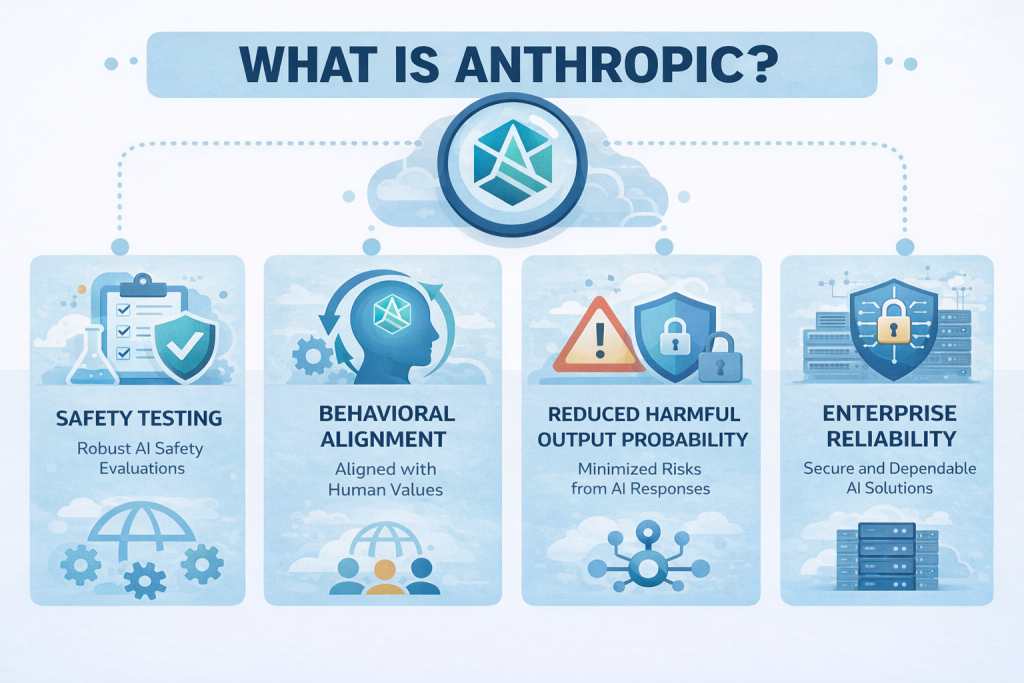
Anthropic’s research foundation informs every layer of Claude’s development. Instead of only optimizing for speed or creativity, the company invests in:
- Safety testing
- Behavioral alignment
- Reduced harmful output probability
- Enterprise reliability
This approach positions Anthropic differently from companies chasing novelty. It appeals directly to CIOs, CTOs, CISOs, and legal counsels who must evaluate operational risk before approving AI adoption.
Understanding Claude AI & How it Works

Claude is the practical product layer of Anthropic’s research. It functions as a large language model trained to process, generate, analyze, and reason over text at scale. But its design emphasizes predictability and steerability.
Claude AI can:
- Summarize complex documents
- Conduct a semantic search across large text bodies
- Generate creative and collaborative writing
- Answer technical and business questions
- Produce and review code
- Draft structured business reports
- Assist in compliance analysis
Because it is accessible via both a chat interface and API integration, Claude fits multiple enterprise use cases. For developers and product teams, the API (Application Programming Interface) allows deeper integration into software systems, internal tools, and customer-facing applications.
Claude’s code generation capabilities rely on large-scale transformer architectures trained on extensive programming datasets. These models learn patterns across multiple languages, including Python, JavaScript, TypeScript, Go, Java, and C++.
In practice, Claude assists developers in several ways.
Code Generation
Developers can describe functionality in natural language, and Claude translates that into executable code. For example, engineers can request:
API integrations
- Database schema creation
- Backend service logic
- Frontend UI components
Claude analyzes the request and constructs syntactically valid code aligned with the target programming language.
Code Refactoring
Large enterprise codebases require continuous optimization. Claude can:
- Simplify complex functions
- Identify redundant logic
- Improve performance
- Restructure modules
This reduces technical debt and accelerates modernization efforts.
Debugging and Error Detection
Claude can review logs or error outputs to identify potential issues. It can also suggest fixes, rewrite problematic sections, or propose improved architecture.
Documentation Generation
Enterprise engineering teams frequently struggle with outdated documentation. Claude can automatically generate:
- API documentation
- Online comments
- Developer guides
- Architecture summaries
This significantly improves onboarding speed for engineering teams. As organizations adopt AI-augmented development, tools like Claude become integrated into IDEs, CI/CD pipelines, and internal developer platforms.
Claude Platform Overview: Model Lineup, Sonnet, Chat, and Cowork
The Claude platform consists of multiple models optimized for different workloads. Think of the model stack as a set of engines with varying levels of power and efficiency.
Claude Haiku prioritizes:
- Speed
- Cost efficiency
- Lightweight text generation
Claude Sonnet prioritizes:
- Enterprise reasoning tasks
- Document analysis
- Regulatory summaries
- Multi-step problem solving
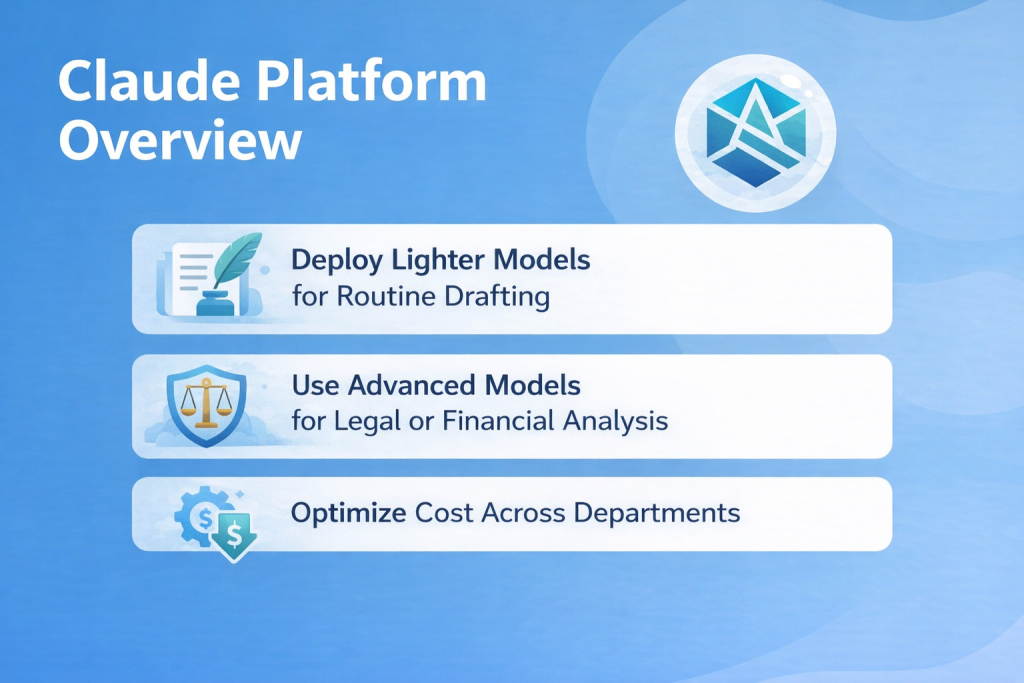
This layered approach allows U.S. enterprises to align usage with budget and performance needs. Instead of using maximum power for every request, organizations can:
- Deploy lighter models for routine drafting
- Use advanced models for legal or financial analysis
- Optimize cost across departments
Claude is not one single model. It is a family of models. Each one is built for a different level of speed, cost, and thinking power.
Claude Models Lineups:
- Claude 3 Opus: High-level intelligence for deep reasoning, long documents, and complex business analysis. Best for serious, accuracy-focused tasks.
- Claude 3.5 Haiku: Fast and cost-efficient. Ideal for chat support, quick coding help, and high-volume real-time tasks.
- Claude 3.7 Sonnet: Balanced model with hybrid reasoning. Good for structured business workflows and technical problem-solving.
- Claude Opus 4: Strong in coding and long-form thinking. Built for advanced projects and enterprise-level work.
- Claude Sonnet 4.6 (Feb 2026): Most advanced Sonnet version. Features a 1M token context window (beta), improved agentic coding, stronger long-context reasoning, and serves as the default model for Free and Pro users with API pricing at $3 per million input tokens and $15 per million output tokens.
What Sonnet Does in Real Business Use
Sonnet models are the balanced, business-ready options in the Claude family. They give strong reasoning, good speed, and controlled costs without being as expensive as the highest Opus tier.
- Long Document Review
- Multi-Document Comparison
- Financial Analysis Support
- Regulatory & Risk Review
Organizations evaluating AI platforms often begin with conversational interfaces. While many AI systems provide chat-based interactions, the distinction between Claude Chat and Claude Cowork highlights a shift from simple prompting to structured collaboration.
Claude Chat functions as the traditional conversational interface where users interact with the model through prompts and responses. It works well for individual productivity tasks such as:
- Summarizing documents
- Drafting emails or reports
- Performing quick research
- Generating ideas or outlines
Claude Cowork introduces a project-based working environment where the AI maintains context over extended interactions. Instead of restarting with each prompt, teams can:
- Maintain ongoing project memory
- Build iterative workflows across tasks
- Refine outputs over multiple sessions
- Coordinate work across different departments
Chat interfaces mainly increase individual productivity, while collaborative environments like Claude Cowork help transform team workflows, allowing AI to function as an active collaborator within operational processes.
Industry Disruption: Legal Sector, Finance & Software Development
Highly regulated industries such as legal services and finance are experiencing significant disruption from AI systems capable of analyzing complex documents and regulations.
Claude models are particularly effective in environments requiring long-context reasoning and precise interpretation of text-heavy materials.
Legal Sector Transformation
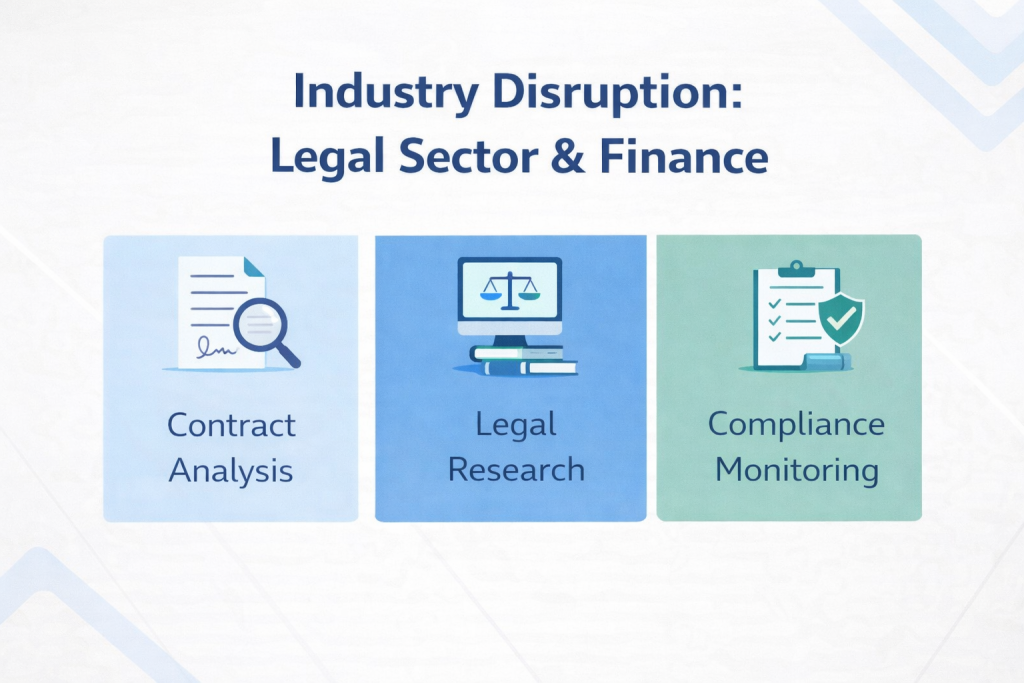
Law firms handle vast volumes of contracts, litigation filings, and regulatory documentation. Claude enables automation across several core activities:
- Contract Analysis: Claude can review contracts, extract clauses, identify obligations, and highlight risk exposure.
- Legal Research: AI models can summarize case law, analyze precedents, and generate structured research memos.
- Compliance Monitoring: Organizations can automate the review of regulatory updates and identify policy implications. While AI does not replace legal professionals, it significantly reduces research and analysis time, allowing attorneys to focus on strategic work.
Financial Services Transformation
Financial institutions deal with complex documents such as earnings reports, investment disclosures, and regulatory filings.
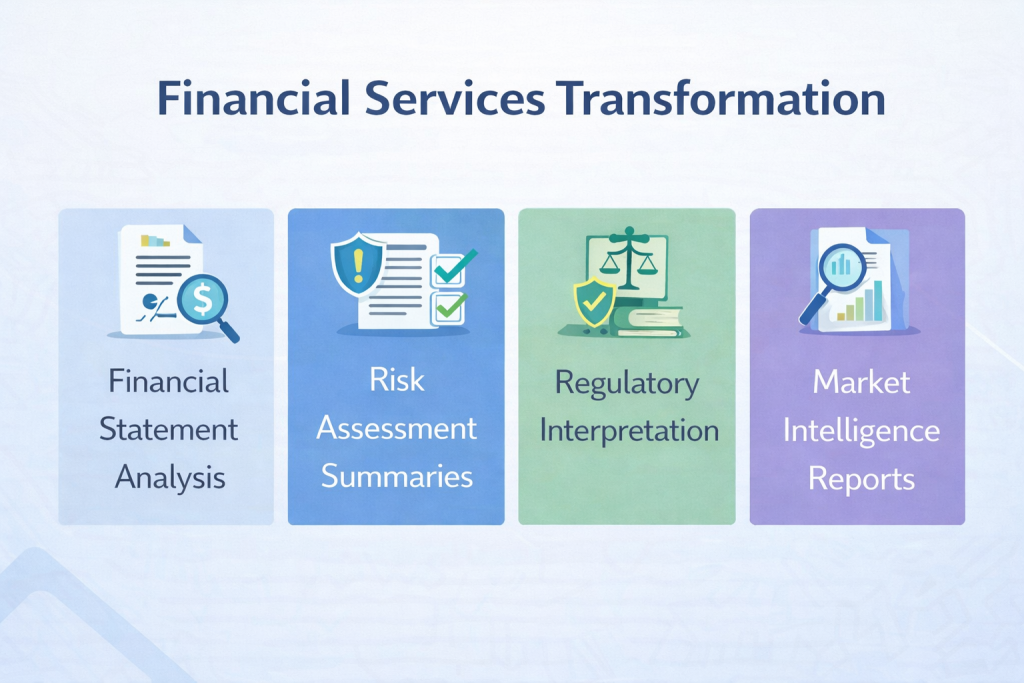
Claude supports financial teams through:
- Financial statement analysis
- Risk assessment summaries
- Regulatory interpretation
- Market intelligence reports
Software engineering may be the industry most rapidly transformed by AI.
Claude’s ability to understand programming languages and architectural patterns allows it to function as a development co-pilot.
Accelerated Development Cycles
Traditional development workflows require significant time for planning, coding, testing, and documentation. AI tools reduce this cycle by assisting developers at every stage.
Claude can:
- Generate prototype applications
- Design system architectures
- Produce database schemas
- Write test cases
This dramatically reduces development timelines.
DevOps and Infrastructure Support
Claude can assist DevOps teams with:
- CI/CD pipeline configuration
- Cloud infrastructure scripts
- Container orchestration setups
- Deployment troubleshooting
This allows infrastructure teams to automate repetitive operational tasks.
Legacy System Modernization
Many enterprises still operate legacy applications written in outdated languages. Claude can analyze legacy code and help convert it into modern frameworks.
This capability is particularly valuable for large organizations undergoing digital transformation initiatives.
Case Studies of Anthropic
1. Cognizant: Scaling AI Adoption Across a Global Workforce

Global IT services company Cognizant integrated Anthropic’s Claude models to accelerate enterprise AI adoption and internal transformation. The company deployed Claude across its engineering platforms and made it available to up to 350,000 employees working in corporate functions, development, and delivery teams.
- Automated coding, documentation, and testing tasks
- Improved DevOps and engineering workflows
- Faster transition from AI pilot projects to production deployments
- Increased productivity across large technical teams
By embedding Claude into its internal platforms, Cognizant demonstrated how AI can move beyond experimentation and become a core productivity layer across an enterprise workforce.
2. Novo Nordisk: Accelerating Regulatory Documentation

Pharmaceutical giant Novo Nordisk used Claude as the intelligence layer for an internal platform called NovoScribe, designed to assist with regulatory documentation for new medicines.
- Reduced document preparation from 10+ weeks to about 10 minutes
- Approximately 95% reduction in resources spent on verification checks
- Faster preparation of regulatory reports for drug approvals
For life sciences organizations, regulatory documentation is one of the most resource-intensive tasks. Claude helped automate large portions of the process while maintaining structured analysis of complex data.
3. ServiceNow: AI-Native Enterprise Workflows
Enterprise workflow platform ServiceNow signed a multi-year agreement with Anthropic to integrate Claude models into its products and internal systems.
- AI integrated into enterprise workflow automation
- Deployment to 29,000 employees internally
- Improved service management and internal productivity
- Faster decision-making through AI-driven insights
ServiceNow’s adoption highlights how large enterprise platforms are embedding Claude to transform workflows rather than simply adding chat interfaces.
4. Financial Sector Engineering Transformation

Technology leaders such as the New York Stock Exchange (NYSE) have explored using Claude to reshape engineering processes and build internal AI agents that automate development tasks.
- AI agents that translate Jira tickets into production code
- Faster development cycles
- Reduced manual engineering overhead
- Improved developer productivity
This demonstrates how Claude can serve as an AI development partner, helping engineering teams automate parts of the software lifecycle.
5. Enterprise Productivity and Research Automation

Across industries such as finance, marketing, and product development, companies are deploying Claude for high-value knowledge work tasks. Typical enterprise use cases include:
- Research analysis and summarization
- Strategy document creation
- Marketing content generation
- Software development assistance
- Internal knowledge base search
These workflows reflect Claude’s strength in reasoning, document processing, and long-context analysis, making it useful for complex business tasks
Future of the Anthropic AI Ecosystem

The AI ecosystem surrounding Anthropic and Claude is evolving rapidly. Several trends are shaping the future of this technology.
Larger Context Windows
Future Claude models are expected to process significantly larger documents and datasets. This will enable AI to analyze entire research archives, legal case libraries, or enterprise data repositories.
AI Collaboration Platforms
The shift from chat interfaces to collaborative environments like Cowork suggests a broader transition toward AI-native work platforms. These platforms will allow teams to:
- Manage projects with AI assistance
automate - Knowledge workflow
- Integrate AI reasoning into decision-making
AI Governance and Safety
Anthropic has positioned itself as a leader in AI safety and alignment research. Future models will likely incorporate stronger safeguards, ensuring that AI outputs remain reliable, transparent, and compliant with regulatory standards.
Enterprise AI Infrastructure
AI systems are increasingly integrated into enterprise technology stacks alongside cloud infrastructure, data platforms, and analytics systems.
In the coming years, organizations may treat AI models as core enterprise infrastructure, similar to databases or operating systems.

Deepak Wadhwani has over 20 years experience in software/wireless technologies. He has worked with Fortune 500 companies including Intuit, ESRI, Qualcomm, Sprint, Verizon, Vodafone, Nortel, Microsoft and Oracle in over 60 countries. Deepak has worked on Internet marketing projects in San Diego, Los Angeles, Orange Country, Denver, Nashville, Kansas City, New York, San Francisco and Huntsville. Deepak has been a founder of technology Startups for one of the first Cityguides, yellow pages online and web based enterprise solutions. He is an internet marketing and technology expert & co-founder for a San Diego Internet marketing company.