

Table of Contents
Introduction
Programmatic advertising has completely transformed the landscape of digital advertising, shifting from manual buying to a quick, data-driven approach. Nowadays, brands depend on automation to connect with the right audience at just the right time—eliminating the guesswork.
As technology continues to evolve, programmatic advertising has become sharper, smarter, and significantly more efficient. It combines real-time bidding, audience insights, and machine learning to create ads that feel almost instinctive.
What began as a straightforward automation tool has now become the foundation of contemporary media buying. By grasping its evolution, marketers can stay ahead of the curve, optimise their budgets, and unlock more effective advertising strategies.
What Is Programmatic Advertising
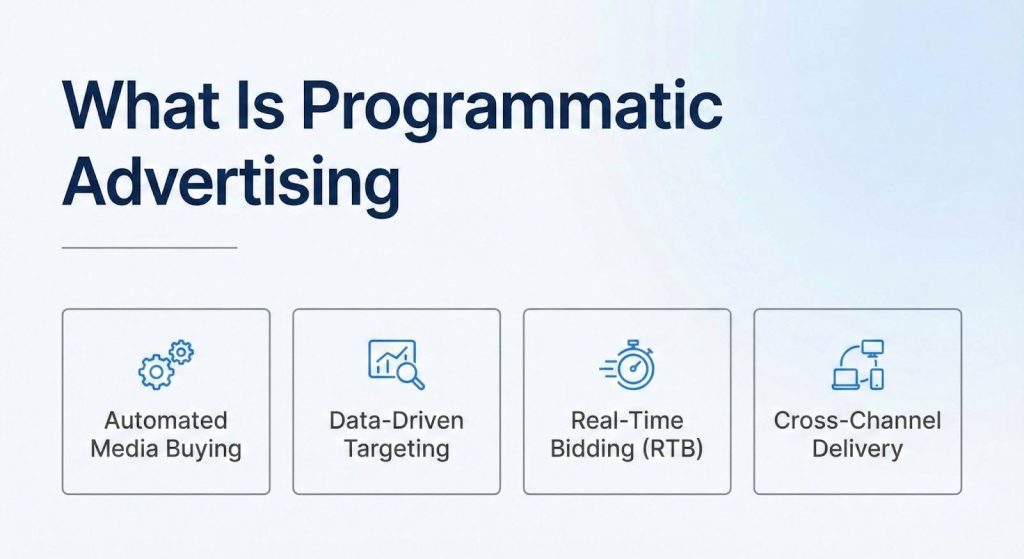
Programmatic advertising automates the buying and selling of digital ad space using data and technology.Â
- Automated Media Buying: This system snags ad placements in real time, eliminating slow manual processes. As a result, campaigns become quicker, more adaptable, and much easier to scale.
- Data-Driven Targeting: Insights about the audience steer every ad decision, making sure that messages hit the right users. It’s all about personalisation without the heavy lifting.
- Real-Time Bidding (RTB): Ads go head-to-head in live auctions that take place in the blink of an eye as a page loads. You only pay for the impressions that truly count.
- Cross-Channel Delivery: Programmatic advertising covers display, video, mobile, audio, and more. This approach gives brands a seamless way to engage with audiences across various platforms.
Instead of relying on human negotiations, algorithms take the reins, determining where ads show up—quickly, efficiently, and with remarkable accuracy.
Components of the Programmatic Ecosystem
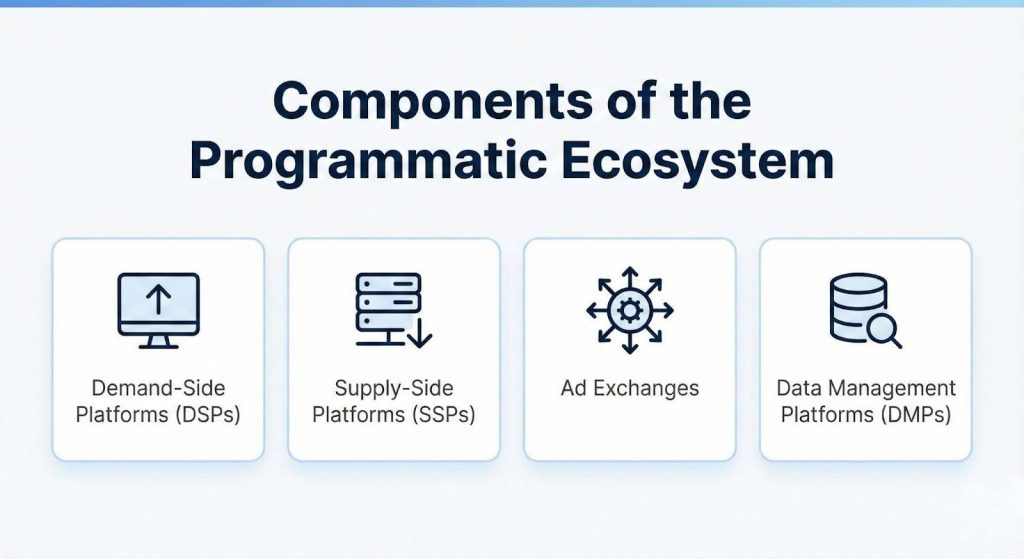
Programmatic advertising operates within a connected network of platforms that exchange information in the blink of an eye.
- Demand-Side Platforms (DSPs): Advertisers turn to DSPs to automatically buy ad space. These platforms use targeting rules, set budgets, and employ bidding strategies to connect with the right audiences.
- Supply-Side Platforms (SSPs): Publishers depend on SSPs to sell their available ad space. These platforms help boost revenue by allowing multiple buyers to bid on inventory simultaneously.
- Ad Exchanges: Picture ad exchanges as the bustling marketplace where buying and selling collide. They facilitate real-time auctions, linking DSPs and SSPs to trade impressions in the blink of an eye.
- Data Management Platforms (DMPs): DMPs gather and organise audience data from various sources. This information enhances targeting, ensuring ads reach users who are more likely to engage and find them relevant.
 Each part has its own unique function, working together to target, bid, and deliver ads smoothly across the internet.
Types of Programmatic Buying
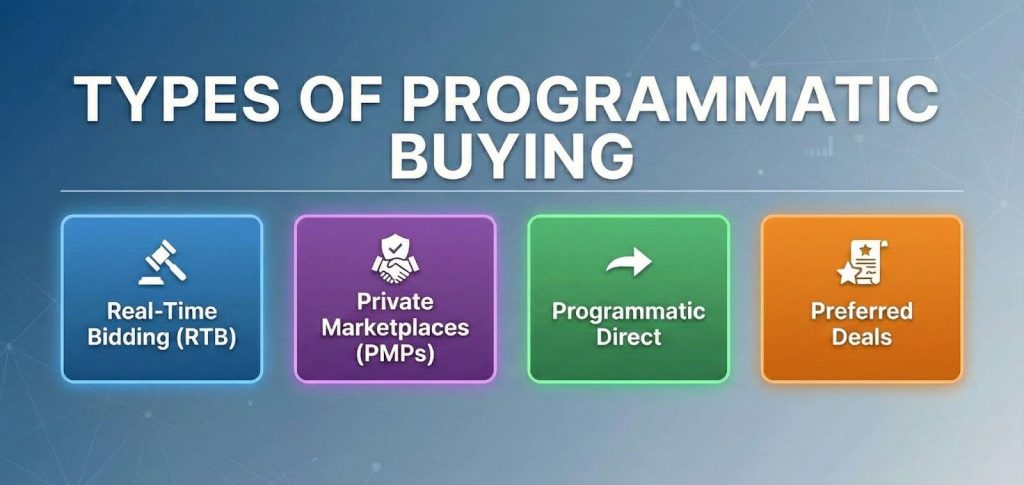
Programmatic buying comes in various formats, each providing different levels of control, transparency, and pricing.Â
- Real-Time Bidding (RTB): Think of it as open auctions where advertisers can bid for ad impressions on the spot. It’s super flexible, scalable, and perfect for efficiently reaching a wide audience.
- Private Marketplaces (PMPs): These are exclusive, invitation-only auctions where top-tier publishers provide premium inventory. This means brands can enjoy better placement quality along with more controlled pricing.
- Programmatic Direct: This is a straightforward deal between the advertiser and the publisher with set pricing. It guarantees predictable reach without the hassle of an auction.
- Preferred Deals: Here, advertisers can snag premium inventory at pre-negotiated rates before it hits the auction block. It’s a nice mix of exclusivity and competitive pricing.
By understanding these options, brands can select the best strategy that aligns with their goals and budgets.
Benefits of Programmatic Advertising
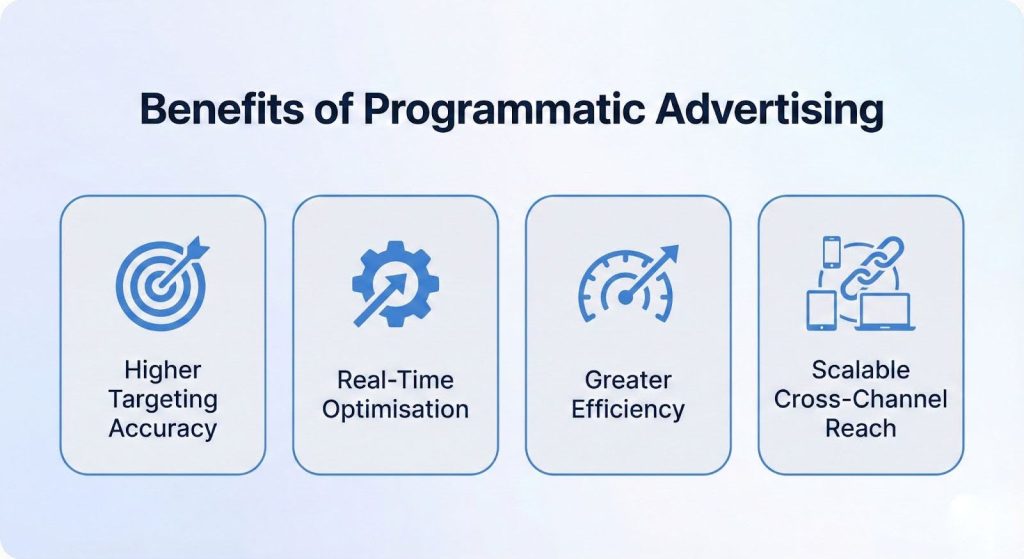
Programmatic advertising gives brands speed, precision, and scale that traditional buying just can’t match.
- Higher Targeting Accuracy: Programmatic advertising taps into detailed audience data, allowing you to connect with users who are truly interested. This results in smarter impressions and enhanced engagement.
- Real-Time Optimisation: Your campaigns can automatically adjust based on performance signals. This means you can save time and boost results without the need for constant manual adjustments.
- Greater Efficiency: With automated bidding, you can cut down on unnecessary spending and focus on high-value inventory. You only pay for impressions that have real potential.
- Scalable Cross-Channel Reach: Whether it’s mobile, audio, or connected TV, programmatic advertising spans all major digital channels. It ensures that brands maintain a consistent presence wherever their audiences are.
Leveraging data makes sure that each impression is more effective and that every dollar in the budget is maximised.
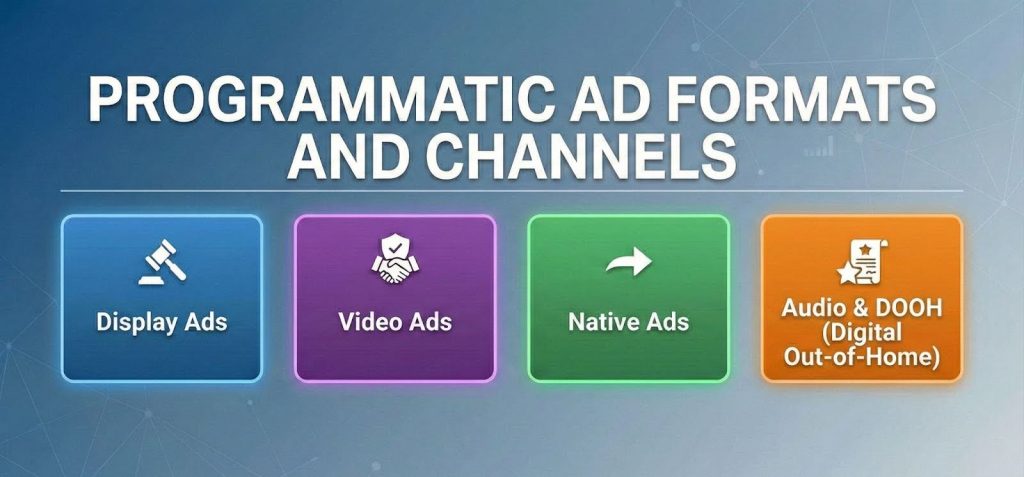
Programmatic Ad Formats and Channels
Programmatic advertising has come a long way from just simple banner ads. These days, brands have the chance to connect with their audiences through a wide variety of formats and channels, each offering its own special opportunities to shine and engage.
- Display Ads: These are the classic visual ads you see popping up on various websites and apps. They’re perfect for building brand awareness, retargeting potential customers, and ensuring your brand stays visible consistently.
- Video Ads: Think of short, engaging videos that you come across on the web, in apps, or even on connected TVs. They grab attention fast and create a deeper emotional connection with viewers.
- Native Ads: These ads are designed to blend in with the content around them, providing a smooth, non-intrusive experience. They enhance credibility and often lead to higher engagement rates.
- Audio & DOOH (Digital Out-of-Home): Thanks to programmatic technology, audio ads are now making their way onto music and podcast platforms, as well as digital billboards.Â
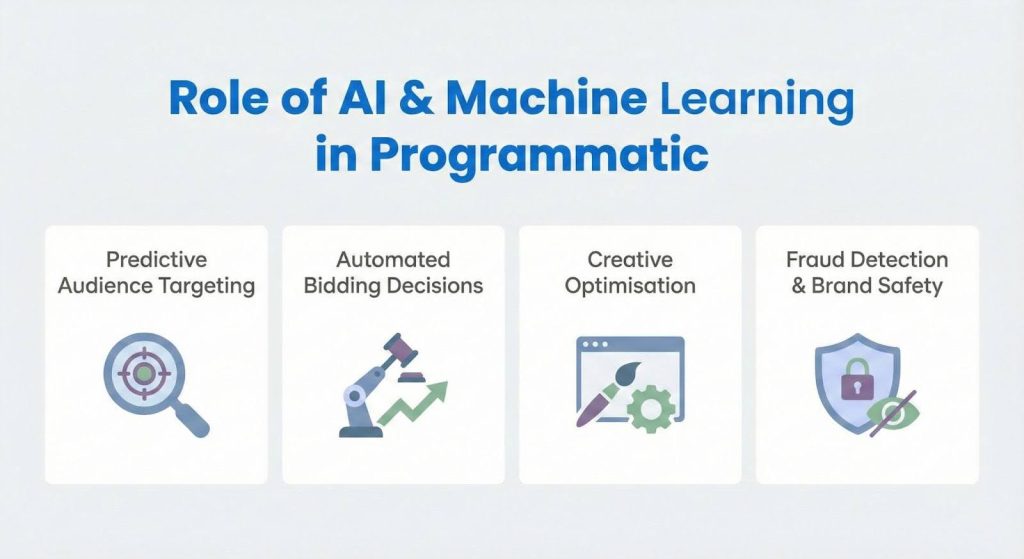
Role of AI & Machine Learning in Programmatic
AI and machine learning are the driving forces behind today’s programmatic advertising. They sift through data to spot trends, anticipate user behaviour, and streamline decision-making, ensuring that each impression is more intelligent than the one before.
- Predictive Audience Targeting: AI analyses user behaviour to predict who’s most likely to make a purchase. This means your ads can reach those high-intent audiences with pinpoint accuracy.
- Automated Bidding Decisions: Machine learning tweaks bids in the blink of an eye based on performance data. You’ll enjoy better results at lower costs, all without the hassle of manual adjustments.
- Creative Optimisation: AI experiments with different visuals, headlines, and formats to discover the best combinations. It keeps fine-tuning your creatives for maximum engagement.
- Fraud Detection & Brand Safety: Intelligent algorithms quickly spot suspicious traffic and unsafe placements. This helps safeguard your ad budget and maintain your brand’s good reputation.
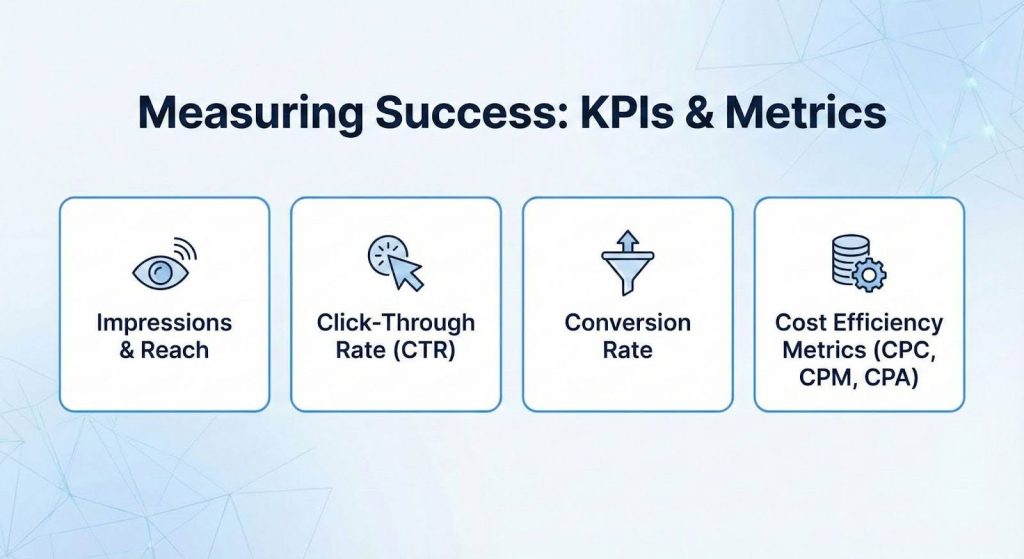
Measuring Success: KPIs & Metrics
A programmatic campaign really hinges on the quality of the data that supports it.Â
- Impressions & Reach: These metrics give you a clear picture of how many people have seen your ads and the extent of your campaign’s reach. They’re essential for understanding your visibility and how well you’re connecting with your audience.
- Click-Through Rate (CTR): CTR is a great way to measure how captivating your ads are by tracking the number of users who clicked on them. A higher CTR indicates that your creative approach and targeting are hitting the mark.
- Conversion Rate: This metric tells you how many users took the action you wanted, whether that’s signing up or making a purchase. It’s the most straightforward way to assess how effective your campaign is.
- Cost Efficiency Metrics (CPC, CPM, CPA): These figures show what you’re spending on clicks, impressions, or conversions. They’re crucial for managing your budget and figuring out the overall return on your ad spend.
By tracking the right KPIs, you can gain insights into how well things are performing, identify areas that need improvement, and fine-tune your strategy for even better results.
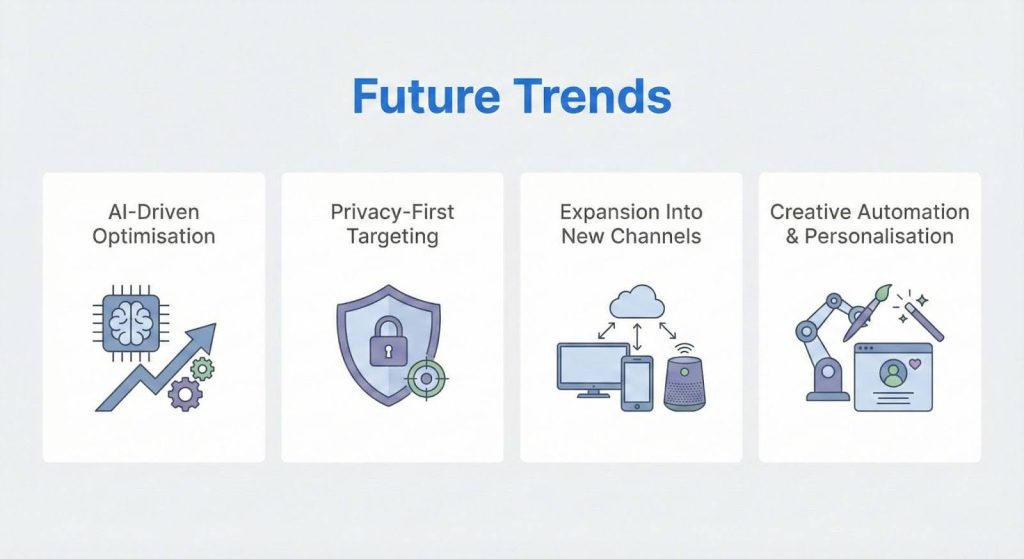
Future Trends
Programmatic advertising is entering an exciting new phase where automation, privacy, and innovative ad formats are evolving at a rapid pace.Â
- AI-Driven Optimisation: AI is set to enhance bid decisions, audience predictions, and placement accuracy even further. Campaigns will be able to adjust on the fly, cutting down on waste and boosting performance with minimal input from humans.
- Privacy-First Targeting: As cookies fade away, brands will pivot towards first-party data and contextual targeting. This strategy not only safeguards user trust but also allows for impactful, data-driven ad personalisation.
- Expansion Into New Channels: Programmatic advertising will take the lead in channels like connected TV, digital audio, DOOH, and even gaming spaces. These platforms present exciting new storytelling avenues with greater engagement potential.
- Creative Automation & Personalisation: Dynamic creative tools will customise ad visuals and messages for each user. This approach makes ads feel more relevant, increases conversions, and saves teams countless hours of manual design work.
The future is all about precision, building trust, and creating deeper connections with the audience.
Conclusion
Programmatic advertising has transformed into a dynamic force that seamlessly combines automation, data, and creativity. It empowers brands to connect with the right audience at just the right time, eliminating the need for guesswork.
As the industry shifts towards privacy-first approaches and AI-driven enhancements, being adaptable is the key to staying ahead. Marketers who welcome these changes will be in a prime position to create meaningful, personalised experiences.
Looking ahead, the future of programmatic is promising, versatile, and brimming with potential. Whether you’re scaling your campaigns, trying out new formats, or tapping into data-driven insights, this strategy paves the way for lasting digital success.Â
Deepak Wadhwani has over 20 years experience in software/wireless technologies. He has worked with Fortune 500 companies including Intuit, ESRI, Qualcomm, Sprint, Verizon, Vodafone, Nortel, Microsoft and Oracle in over 60 countries. Deepak has worked on Internet marketing projects in San Diego, Los Angeles, Orange Country, Denver, Nashville, Kansas City, New York, San Francisco and Huntsville. Deepak has been a founder of technology Startups for one of the first Cityguides, yellow pages online and web based enterprise solutions. He is an internet marketing and technology expert & co-founder for a San Diego Internet marketing company.