






Table of Contents
Introduction
Generative Engine Optimization (GEO) is the practice of optimizing content so it can be easily found, understood, and cited by AI-driven search engines and large language models like Google AI Overviews, OpenAI ChatGPT, Google Gemini and Perplexity AI.
GEO differs from traditional SEO by focusing on how content gets identified, summarized, and surfaced by AI models. While search engine optimization still matters, GEO ensures your content becomes part of the AI-generated answers users rely on.
In this guide, you’ll learn what GEO means, how generative search engines work, how to craft and structure content for optimal AI visibility, and how to measure and future-proof your strategy.
What is GEO?
Generative Engine Optimization (GEO) refers to tailoring your content to align with how generative AIs understand, process, and present information.
- Unlike SEO, which often operates on keywords and backlinks, GEO is all about context, structure, clarity, and credibility—essential factors when AI engines summarize or answer user queries
- The term has emerged alongside the rise of generative AI platforms—tools like ChatGPT, Perplexity, and Gemini, which interpret queries conversationally and generate direct, narrative-style responses
Instead of navigating a SERP, users now expect full, clear answers to their questions. Your content must be ready to serve as that answer.
What Is a Generative Engine?
A generative engine is an AI-powered system designed to create answers instead of just showing links.
- It comprehends queries, gathers data from various sources, and provides users with concise, understandable answers
- Generative search engines prioritize context and meaning, in contrast to conventional search engines
- To provide more pertinent and useful results, they examine language patterns, user intent, and the subject matter as a whole
High-quality, reliable, and well-structured content is essential for generative engines. AI-generated responses are more likely to choose and utilize context-rich, easily comprehensible content.
History of GEO
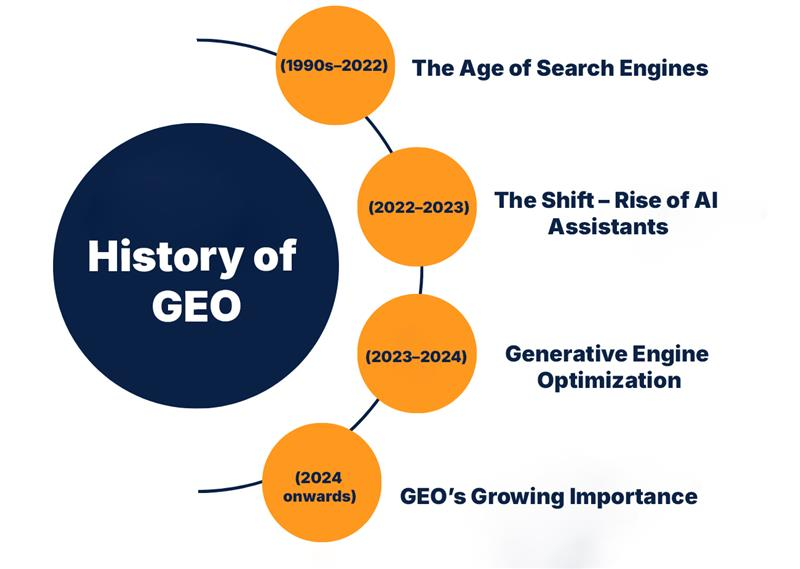
- The Age of Search Engines (1990s–2022): For decades, people used search engines like Google, Bing, and Yahoo, while businesses used SEO—keywords, fast sites, and backlinks—to rank on the first page and attract visitors.
- The Shift – Rise of AI Assistants (2022–2023): With ChatGPT’s launch in late 2022 and other AI assistants soon after, people began asking AI directly for answers instead of using Google.
- Generative Engine Optimization (2023–2024): By mid-2023, experts saw AI assistants like ChatGPT, Gemini, and Perplexity often quoting certain sites. Generative Engine Optimization (GEO) became the next step after SEO to help AI find and use its content in answers.
- GEO’s Growing Importance (2024 onwards): AI-powered search is now a daily habit for millions, especially younger users. Companies are creating content for AI visibility, and though GEO is new, it’s growing fast, giving early adopters the most benefits.
Core Components of GEO
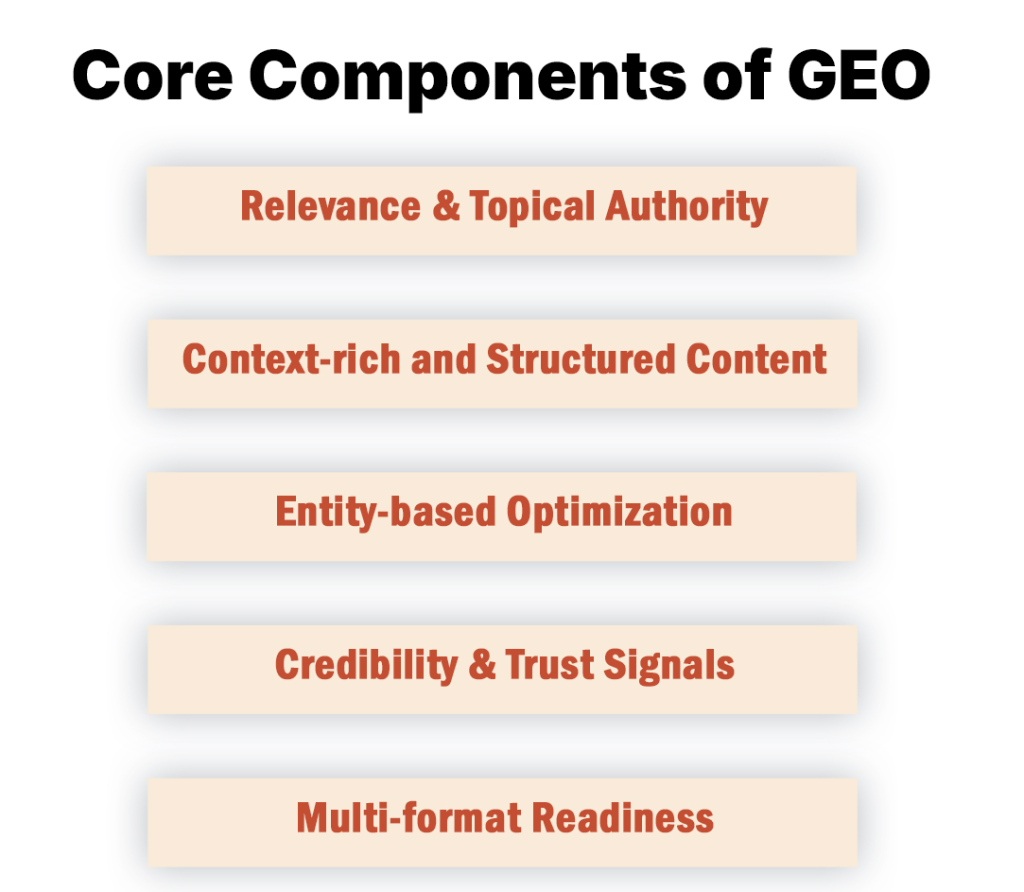
- Relevance & Topical Authority: Your content must thoroughly address a topic. AI favors content that demonstrates domain expertise and deep coverage through a clear structure.
- Context-rich and Structured Content: Use headings, lists, Q&As, and narrative flow. This makes it easier for AI to parse and identify key points.
- Entity-based Optimization: Identify people, places, products, and concepts. Entities provide semantic hooks for LLMs to latch onto.
- Credibility & Trust Signals: Add citations, author profiles, dates, data—these help AI and users trust your information.
- Multi-format Readiness: LLMs may include content from text, images (with alt text), tables, infographics, PDFs, structured data—your assets should be accessible and understandable.
Best Practices for GEO
Generative Engine Optimization (GEO) is the process of tailoring content for AI-driven platforms like ChatGPT and Gemini, ensuring accurate brand representation and strong visibility in AI-generated responses.
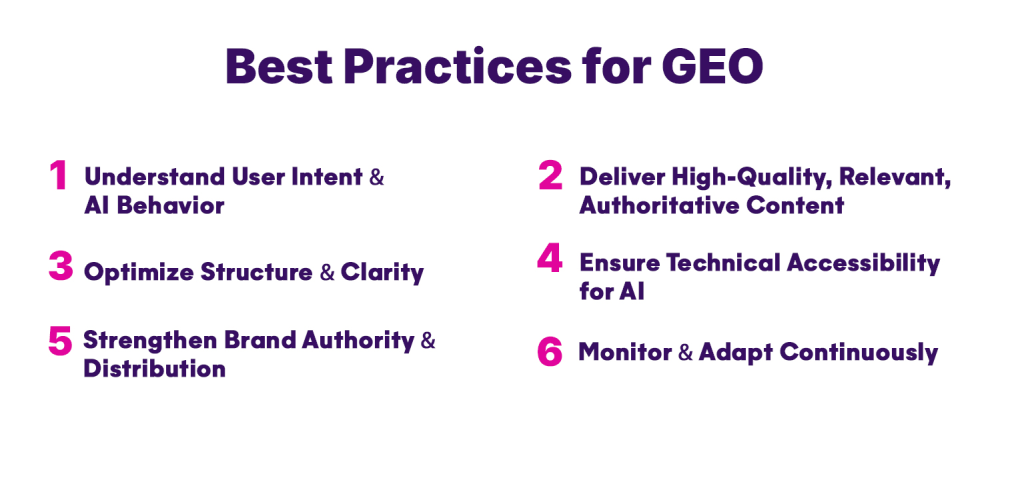
- Understand User Intent & AI Behavior: Give clear, complete answers in a friendly, easy-to-read tone, and learn how AI tools pick and use information, including the formats and sources they prefer.
- Deliver High-Quality, Relevant, Authoritative Content: Create accurate, well-researched content with credible sources, keep it updated, and add unique value through original insights or data.
- Optimize Structure & Clarity: Use clear headings, bullet points, and tables for easy reading, add schema markup for AI context, and give short answers to key questions early in the content.
- Ensure Technical Accessibility for AI: Make content easily crawlable by AI and search engines. Optimize for mobile and fast loading speeds.
- Strengthen Brand Authority & Distribution: Share content on relevant platforms, use user-generated content, build strong backlinks, keep messaging consistent, and engage in thought leadership.
- Monitor & Adapt Continuously: Track performance with analytics, stay updated on AI changes, and adjust based on competitor strategies.
By applying these GEO best practices, brands can boost their visibility in AI-driven results, establish authority, and ensure long-term digital relevance.
How Generative Search Engines Work
Generative search engines use artificial intelligence to comprehend queries and produce concise, insightful responses.
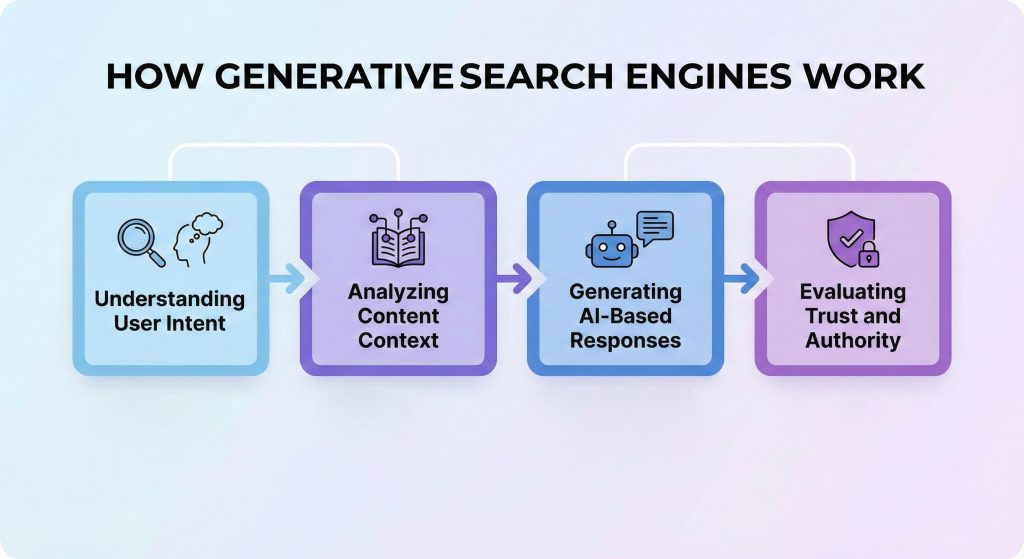
- Understanding User Intent: Generative engines interpret users’ true intentions rather than just the words they input. This makes it possible for them to offer responses that are consistent with the purpose of the search.
- Analyzing Content Context: Rather than merely searching for keywords, these engines evaluate the content’s overall context. They take into account the information’s quality, relevance, and clarity.
- Generating AI-Based Responses: Generative engines use reliable sources to generate summarized responses instead of just listing web pages. Clear and well-structured content is more likely to be included in these answers.
- Evaluating Trust and Authority: Content from reliable and authoritative sources is prioritized by generative search engines. Credibility, consistency, and accurate information are essential for visibility.
To produce precise and beneficial results, they concentrate on context, intent, and content quality.
Step-by-Step Content Optimization for AI Search
Write Clear, Search-Friendly Page Titles
- Use titles people actually search for
- Keep each title unique and focused
- Clearly communicate the page’s main value
Create In-Depth, Useful Content
- Answer real questions with clarity and detail
- Include examples, insights, or original ideas
- Avoid surface-level or generic explanations
Make Content Easy to Read and Quote
- Use short sentences and small paragraphs
- Structure content with clear headings (H2s, H3s)
- Add bullets, FAQs, and simple formatting
Focus on Topics, Not Keyword Repetition
- Write naturally, the way people speak
- Use variations of key terms without forcing them
- Prioritize clarity over keyword stuffing
Use Multiple Formats Thoughtfully
- Add visuals or videos only when they add value
- Use captions and descriptions for clarity
- Keep every element easy to understand
Build Credibility and Trust
- Show real expertise through author info or credentials
- Support claims with data or reliable sources
- Keep content updated and accurate
Optimize for Voice Search
- Write the way people speak, using natural, question-based phrases they’d ask a friend or voice assistant
- Focus on mobile-first content, since most voice searches happen on smartphones
- Use real-world context and problems instead of stiff, location-based or corporate language
Content that is clear, helpful, and written for real people—not algorithms—is what performs best across search, AI, and voice platforms.
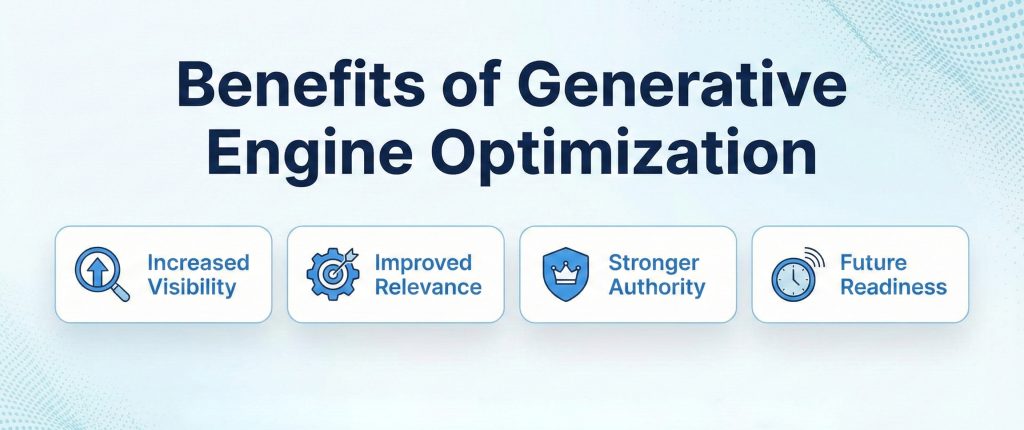
Benefits of Generative Engine Optimization
Content performs better in AI-powered search environments thanks to Generative Engine Optimization.
- Increased Visibility: GEO makes it more likely that your content will show up in AI-generated responses. This keeps your brand visible outside of conventional search results.
- Improved Relevance: GEO prioritizes context and user intent over keywords. As a result, content becomes more precise and relevant to user searches.
- Stronger Authority: GEO contributes to credibility by emphasizing accuracy and reliable information. This establishes your brand as a trustworthy source over time.
- Future Readiness: GEO gets your content ready for the expanding use of generative AI in search. It guarantees that your approach will continue to work as search engines change.
In a dynamic search environment, it enhances visibility, relevance, and long-term search performance.
Key factors influencing GEO rankings
- Content quality: High-quality, informative, and engaging content plays a major role in achieving strong search engine rankings.
- Keyword relevance: Using relevant keywords and phrases helps search engines understand your content and match it with the right search queries.
- Backlinks: Earning high-quality backlinks from reputable and authoritative websites strengthens your site’s credibility and improves rankings.
- User experience: A positive user experience, including fast loading times, clear structure, and easy navigation, is essential for SEO success.
- Mobile-friendliness: Optimizing your website for mobile devices is crucial to meet the needs of the growing number of mobile users.
- AI-friendliness: Following Generative Engine Optimization (GEO) principles helps make your content more accessible and understandable for AI algorithms.
By understanding these factors and applying effective strategies, you can optimize your content for generative AI while improving overall search engine performance.
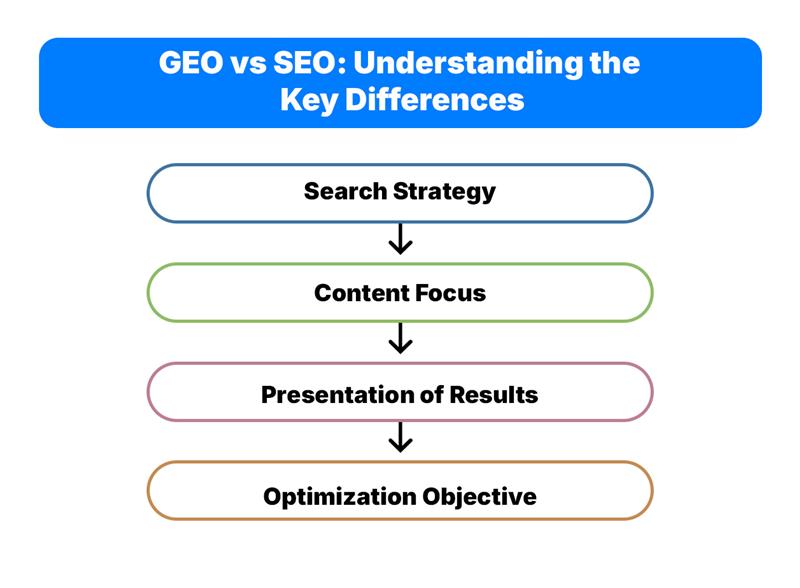
GEO vs SEO: Understanding the Key Differences
GEO is intended for AI-driven search engines that provide direct answers, whereas SEO concentrates on placing web pages in conventional search results.
- Search Strategy: Clickable links and keyword rankings are the focus of SEO. GEO focuses on the comprehension and application of content in responses produced by AI.
- Content Focus: On-page optimization and keyword placement are key components of SEO. GEO places a high value on meaningful explanations, clarity, and context.
- Presentation of Results: A list of ranked webpages is provided by SEO. GEO helps generative search engines produce condensed responses.
- Optimization Objective: Through rankings, SEO seeks to boost website traffic. GEO seeks to make content more visible in outputs produced by AI.
They both seek to increase visibility, but they do so in different ways.
Case Studies
WebFX
WebFX is a digital marketing agency specializing in SEO, Search Engine Marketing, and online visibility enhancement. WebFX applies Generative Engine Optimization to position brands prominently in AI-generated search results.
By combining traditional SEO with GEO-focused tactics—such as structured content formatting, schema markup, and AI-friendly copywriting—they ensure that information is easily interpreted by generative search engines like ChatGPT and Gemini.
BrainZ Digital
BrainZ Digital LTD is a proficient SEO agency offering comprehensive Search Optimization services, including keyword planning, technical audits, and AI-driven SEO strategies.
BrainZ Digital LTD integrates GEO into its AI-driven SEO strategies, creating content that not only ranks in traditional search but is also primed for AI assistants and answer engines. Through precise keyword mapping, structured data, and fact-rich content, they make brand information “AI-ready.”
97 Switch
97 Switch is a versatile digital marketing and web development company specializing in enhancing online visibility through SEO and website SEO services.
They blend clean technical foundations with semantically rich, question-answer-driven copy that feeds directly into AI summarization models. This dual approach enhances both human and AI search visibility, contributing to consistent client satisfaction.
Intero Digital
Intero Digital is an SEO agency specializing in search optimization and online visibility enhancement. Intero Digital uses GEO to align search optimization with AI-assisted query responses.
Their strategies focus on structuring content for natural language processing, optimizing for featured snippets, and ensuring that AI tools can reference verified brand data. This has resulted in measurable increases in organic rankings while improving the accuracy of AI-generated brand mentions across platforms.
Ignite Visibility
Ignite Visibility is an SEO agency renowned for enhancing digital visibility through services in SEO, social media, and digital marketing. Ignite Visibility merges advanced SEO with GEO by crafting AI-targeted content that addresses user intent in a conversational, structured way.
Their methodology includes optimizing for voice search, implementing schema for better AI parsing, and refining copy to match the information retrieval patterns of generative engines.
HawkSEM
HawkSEM is a distinguished SEO agency specializing in enhancing online visibility and search engine optimization for diverse clients. HawkSEM leverages GEO to strategically position client brands in the knowledge base of AI search tools.
Their work focuses on high-quality, context-rich content paired with robust technical SEO, making it easy for AI systems to extract and surface brand-relevant details. Clients report improved website traffic, better search rankings, and increased visibility in AI-generated summaries.
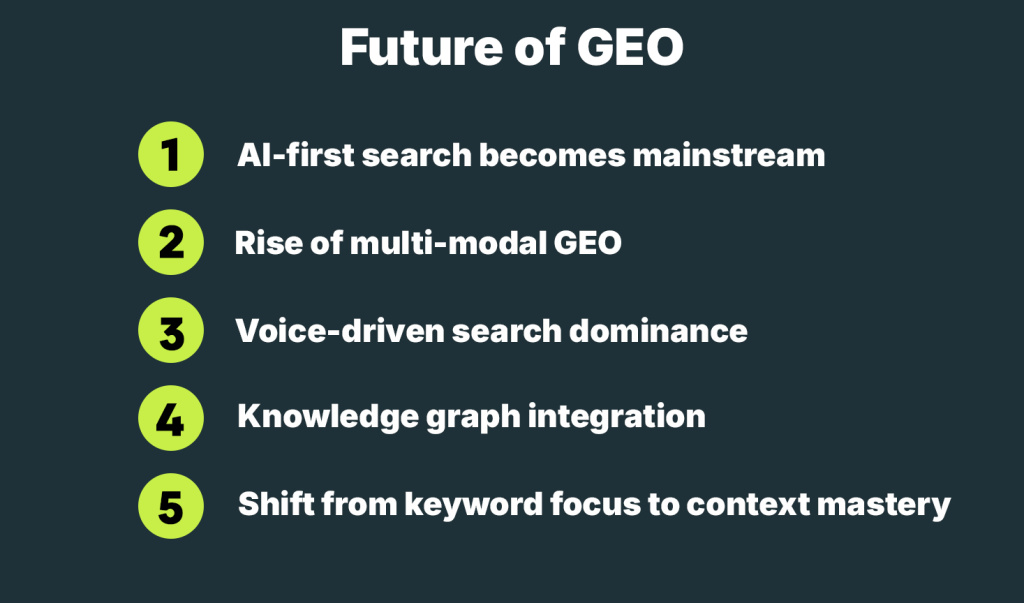
Future of GEO
- AI-first search becomes mainstream: Generative engines like ChatGPT, Gemini, and Perplexity will increasingly replace traditional SERPs as the primary search method.
- Rise of multi-modal GEO: Optimization will expand beyond text to include visuals, videos, audio, and structured datasets for richer AI responses.
- Voice-driven search dominance: Smart assistants and in-car systems will pull directly from GEO-optimized sources, rewarding concise, conversational content.
- Knowledge graph integration: Entity relationships, structured data, and cross-linking will play a bigger role in how AI selects and organizes information.
- Shift from keyword focus to context mastery: GEO will increasingly rely on semantic relevance, factual clarity, and contextual depth rather than pure keyword targeting.
Conclusion
Generative Engine Optimization marks a pivotal evolution in digital marketing, bridging the gap between traditional SEO and the AI-driven future of search. As generative engines increasingly replace static search results with dynamic, conversational answers, visibility will depend on how clearly, credibly, and contextually your content can be understood and cited by AI.
By embracing GEO now, businesses can secure their place in the next wave of online discovery, ensuring their content isn’t just found, but trusted and shared in the conversations that shape tomorrow’s digital experiences.
Deepak Wadhwani has over 20 years experience in software/wireless technologies. He has worked with Fortune 500 companies including Intuit, ESRI, Qualcomm, Sprint, Verizon, Vodafone, Nortel, Microsoft and Oracle in over 60 countries. Deepak has worked on Internet marketing projects in San Diego, Los Angeles, Orange Country, Denver, Nashville, Kansas City, New York, San Francisco and Huntsville. Deepak has been a founder of technology Startups for one of the first Cityguides, yellow pages online and web based enterprise solutions. He is an internet marketing and technology expert & co-founder for a San Diego Internet marketing company.