



Ultimate Guide to Deterministic AI

Ultimate Guide to Deterministic AI and Its Applications

Table of Contents

Introduction

A small business owner once experimented with two AI tools to forecast sales for the following month. Each time, one provided a different response. They were able to plan with confidence because the other produced the same result for the same data.

Many people are realizing that not all AI functions in the same way as it becomes more prevalent. While some systems are designed to be stable and predictable, others are innovative and adaptable. When making decisions in the real world, that distinction can be crucial.

Deterministic AI can help with this. It is helpful when businesses need answers they can rely on because it emphasizes dependability and logical reasoning. You will learn what it is, how it functions, and why it is important in this guide.

What Is Deterministic AI?

What Is Deterministic AI?

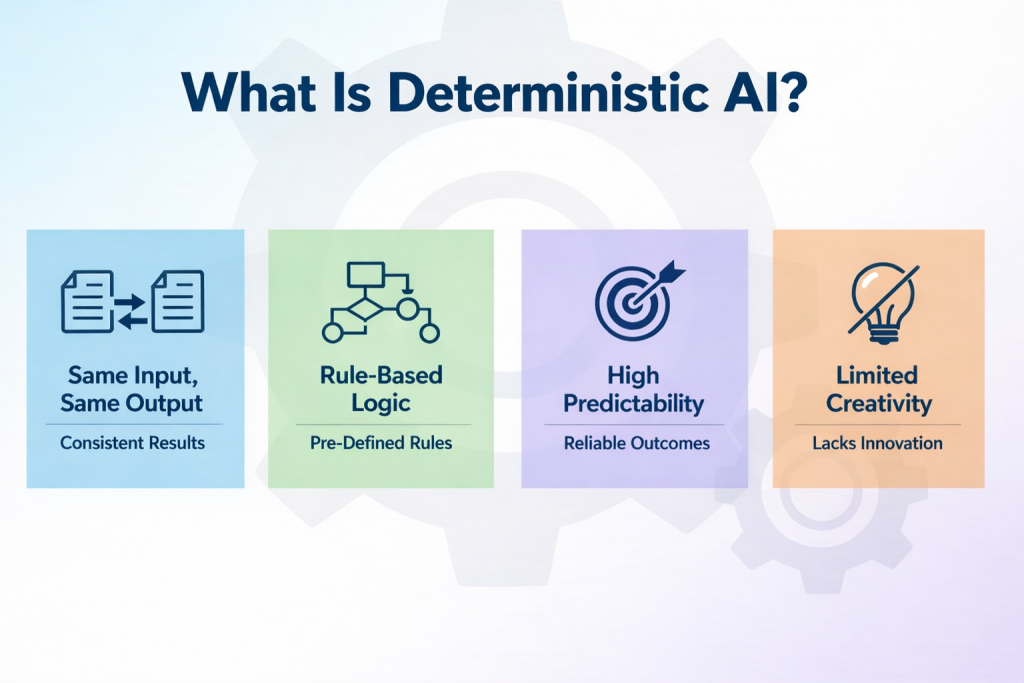
One of the easiest types of artificial intelligence to comprehend is deterministic AI. It generates consistent results by adhering to precise guidelines and reasoning.

  • Same Input, Same Output: When the input is the same, deterministic AI consistently produces the same result. Nothing is random about it. Because of this, its actions are reliable and predictable.
  • Rule-Based Logic: It operates using human-made decision trees, formulas, or predefined rules. The system doesn’t “guess.” It arrives at a response by following directions step-by-step.
  • High Predictability: Results are traceable and explicable due to their fixed logic. This is helpful in fields where accuracy and transparency are crucial.
  • Limited Creativity: It doesn’t produce original concepts or material as generative AI does. It is best suited for structured tasks because its strength is consistency rather than creativity.

How Deterministic AI Works

How Deterministic AI Works

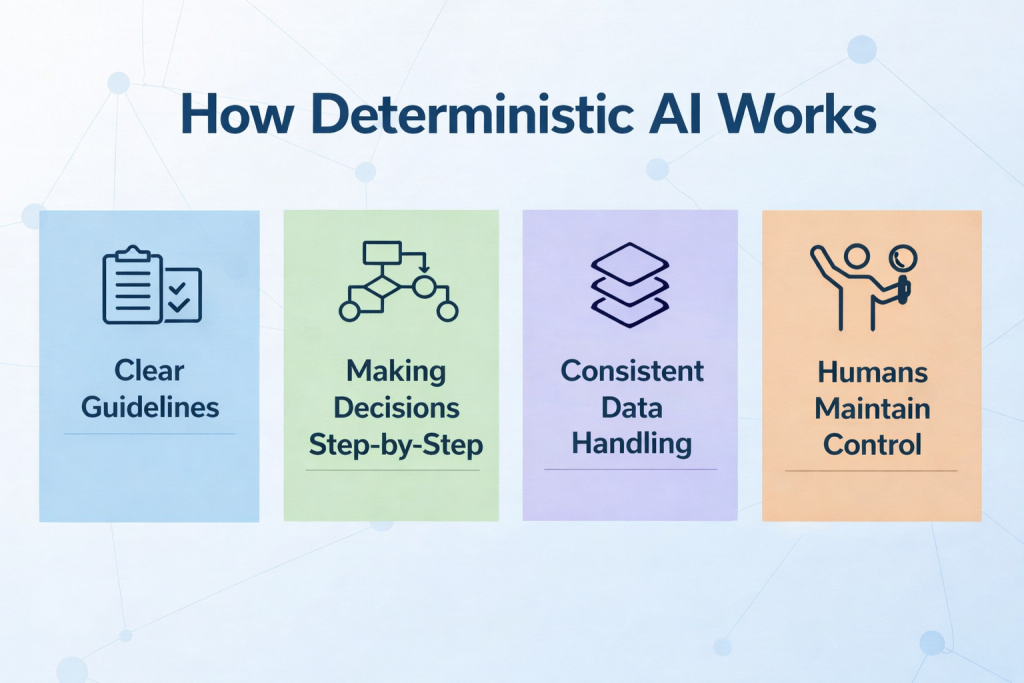
Deterministic AI works more like a careful planner than a creative thinker. It follows clear instructions and sticks to them. There are no surprises, which is exactly why many businesses trust it.

  • Clear Guidelines: Human-established guidelines are the foundation of everything. The system is instructed on what to do in every circumstance. It merely adheres to those guidelines in detail.
  • Making Decisions Step-by-Step: Consider it a flowchart. It advances to the following stage if one of the conditions is met. This facilitates tracking down the solution.
  • Consistent Data Handling: The same data is consistently handled in the same manner. It doesn’t guess or reinterpret. This maintains repeatable and stable results.
  • Humans Maintain Control: They make the decisions and revise the logic as necessary. The system won’t alter itself. Teams now have complete control over the results.

Key Features of Deterministic AI

Key Features of Deterministic AI

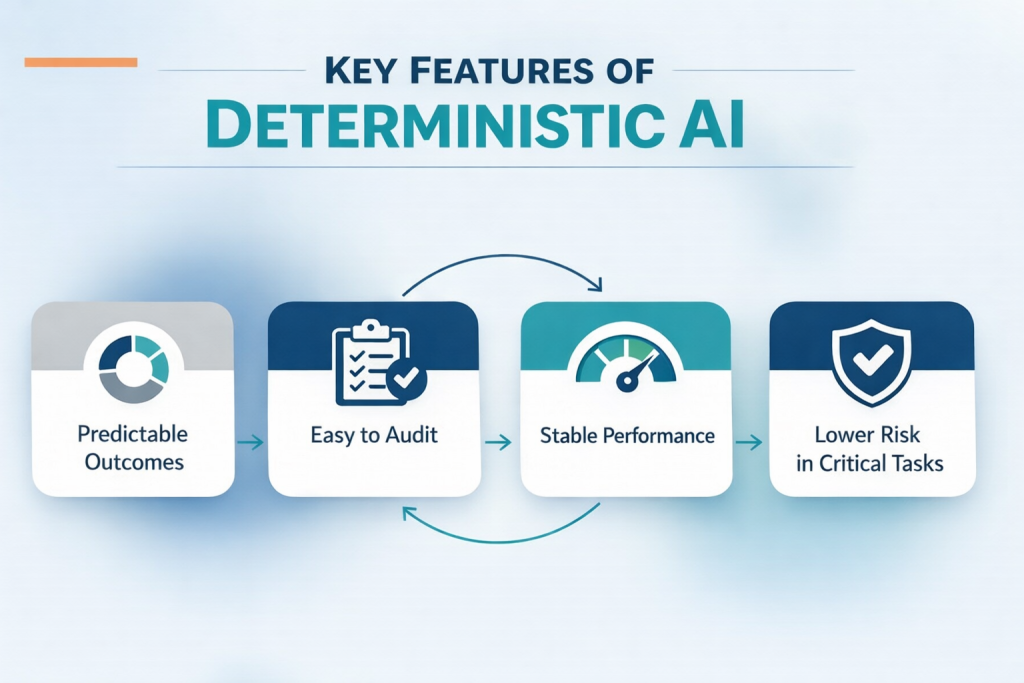
Deterministic AI is appreciated for its reliability and consistency. It’s built to follow instructions precisely, without any extra fluff.

  • Predictable Outcomes: You can count on what you’ll get because the results don’t change randomly. This predictability makes it much easier to plan and make decisions. Teams can trust the output they receive.
  • Easy to Audit: With its clear logic, you can easily follow how a result was achieved. This transparency is great for compliance and quality checks—nothing feels like a mystery.
  • Stable Performance: It delivers consistent results over time as long as the rules and inputs remain the same. Fewer surprises mean more reliability, which helps build trust.
  • Lower Risk in Critical Tasks: When errors can be expensive, consistency is key. Deterministic AI minimizes uncertainty, which is why it’s often the go-to choice for sensitive operations.

These qualities make it an excellent option for tasks where getting things right is crucial.

Benefits of Deterministic AI

Benefits of Deterministic AI

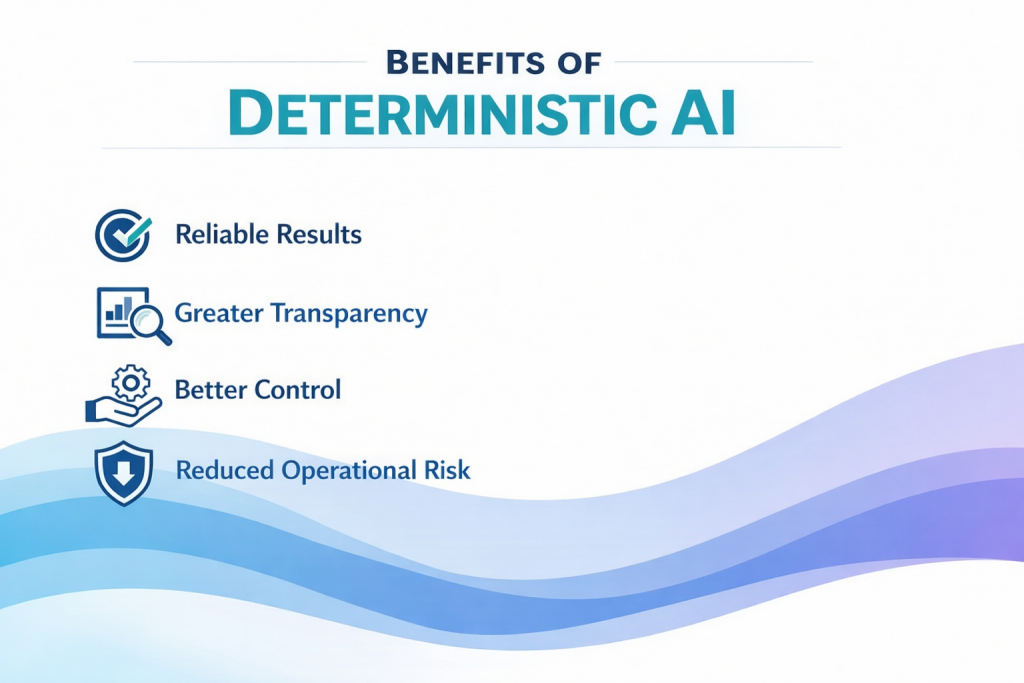
One of the main reasons organizations turn to deterministic AI is for the peace of mind it offers.

  • Reliable Results: You can count on getting the same output for the same input every single time. This kind of reliability empowers teams to plan and act confidently, eliminating any second-guessing.
  • Greater Transparency: The reasoning behind decisions is clear and easy to understand. Teams can grasp how results are generated, which is invaluable for audits and building client trust.
  • Better Control: Businesses maintain control over how the system operates. Rules can be tweaked as needs evolve, ensuring that nothing changes without human oversight.
  • Reduced Operational Risk: Fewer surprises lead to fewer costly mistakes. This is especially crucial in sectors like finance, healthcare, and those with strict compliance requirements.

It performs its tasks in a consistent and dependable manner. When reliability is key, this approach truly adds value.

Industries That Benefit Most

Industries That Benefit Most

Deterministic AI shines in situations where the rules are straightforward, and precision is key. In these environments, being consistent often outweighs the need for creativity.

  • Finance and Banking: This area relies on calculations, risk assessments, and fraud prevention measures. It’s crucial that decisions are consistent and can be traced back. Even the tiniest mistake can lead to high costs.
  • Healthcare: In this field, it’s invaluable for supporting diagnostics, managing lab systems, and processing patient information. Having clear logic minimizes the risk of errors. Reliability is absolutely key here.
  • Manufacturing and Logistics: This sector benefits from quality checks, inventory management, and automating processes. It’s important to repeat the same steps accurately to ensure everything runs smoothly.
  • Legal and Compliance: Here, it’s all about applying established rules to contracts, policies, and regulations. The results need to be understandable, which is essential for meeting stringent compliance requirements.

That’s why many traditional industries continue to depend on it.

How Businesses Can Get Started

How Businesses Can Get Started

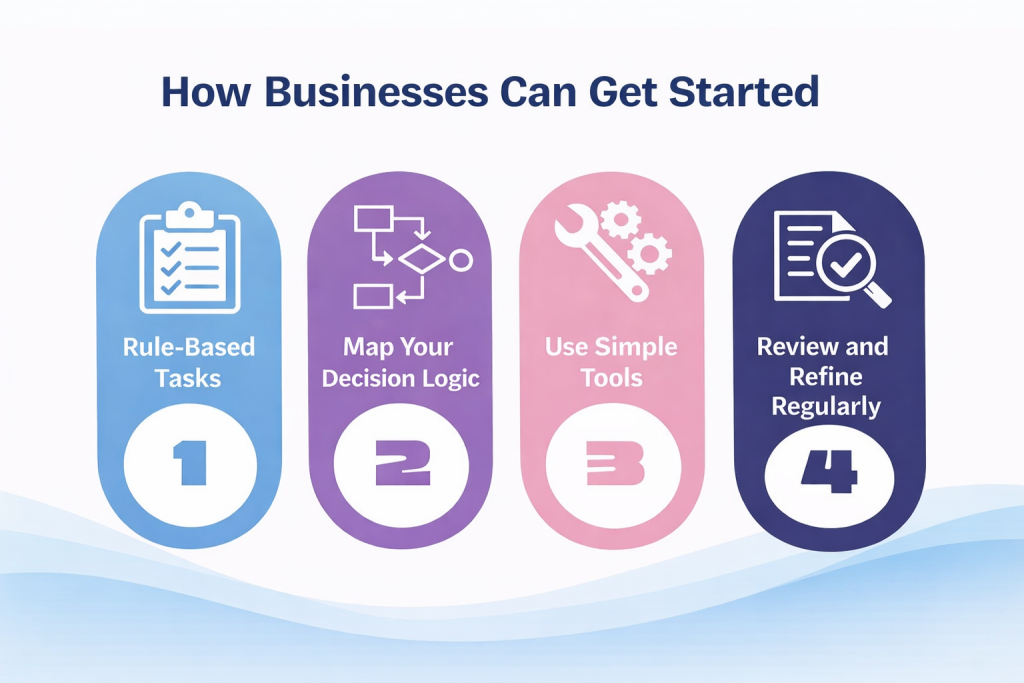
Getting started with deterministic AI doesn’t have to be a daunting task. It shines brightest when tackling clear, repeatable problems.

  • Rule-Based Tasks: Look for processes that already follow set rules. Things like approvals, calculations, or data checks are good candidates. These are easier to automate.
  • Map Your Decision Logic: Write down how decisions are currently made. Turn those steps into clear if-then rules. This becomes the foundation for your system.
  • Use Simple Tools: Not every project needs complex AI software. Many rule-based automations can be built with existing business tools. Start small and scale later.
  • Review and Refine Regularly: Business rules change over time. Schedule reviews to keep logic updated. This ensures the system stays useful and accurate.

A straightforward and focused approach usually leads to the quickest results.

Future of Deterministic AI

Future of Deterministic AI

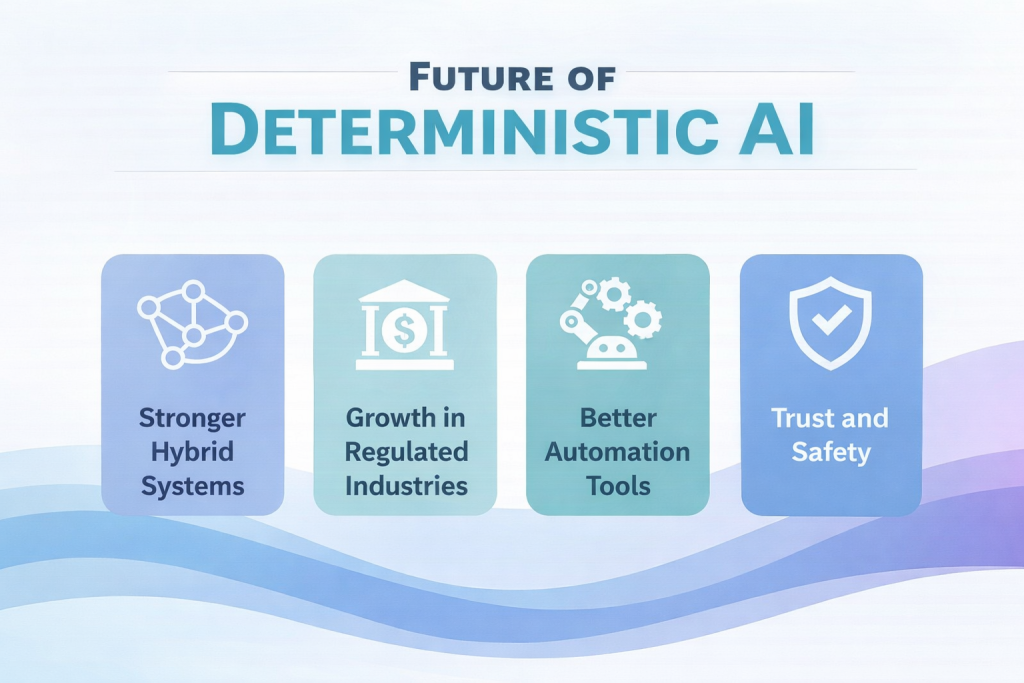
Deterministic AI is not going away, despite increased interest in more recent models. In actuality, it will keep playing a minor but significant role.

  • Stronger Hybrid Systems: A lot of companies are starting to blend deterministic and generative AI. One type is all about creativity, while the other keeps things in check. This combination strikes a great balance between innovation and reliability.
  • Growth in Regulated Industries: Industries like finance and healthcare are going to keep leaning on AI. With all the regulations out there, they need clear and understandable logic, and that’s where deterministic AI really shines.
  • Better Automation Tools: The tools for rule-based automation are becoming more user-friendly. Now, even non-technical teams can create their own workflows, which is going to boost adoption across the board.
  • Trust and Safety: As conversations around AI risks become more common, systems that are predictable are becoming more valuable. Businesses are looking for AI solutions they can trust, and deterministic models provide that peace of mind.

Systems that are completely trustworthy and explicable are still necessary for many organizations.

Conclusion

Despite its unassuming appearance, deterministic AI reliably solves practical issues. It provides the precision, consistency, and lucid reasoning that businesses require. The most straightforward method is sometimes the most useful.

Reliability builds trust, and trust is what turns technology into real business value.

There will always be space for stable, transparent systems as AI develops. Organizations can make decisions with confidence and control thanks to deterministic AI. When used properly, it can serve as a solid basis for more sophisticated AI tools.

The wise course of action for many teams is to use each form of AI where it is most appropriate rather than selecting one over the other. While deterministic AI can lock in dependable actions, creative AI can explore possibilities. When combined, they support companies’ growth through stability and innovation.

Scroll to Top