



Table of Contents
Introduction
Artificial intelligence has drastically altered how people write content, conduct information searches, and automate routine tasks. Large Language Models (LLMs), sophisticated AI systems trained to comprehend and produce human language, are the brains behind many of these tools.
Large language models are becoming a crucial component of contemporary digital technology, from chatbots and search assistants to content creation tools.
In order to learn language patterns, a large language model analyzes vast amounts of text data. This enables the model to generate new content, comprehend queries, predict words, and summarize data. Large language models are used by popular AI tools used by both individuals and businesses today to support decision-making, automate processes, and provide quicker responses.
Large language models are influencing the direction of artificial intelligence as technology develops. LLMs are being used by businesses in a variety of sectors to enhance software development, marketing, customer service, and research.
Businesses and professionals can stay ahead in the quickly expanding AI ecosystem by knowing how large language models function and why they are important.
Understanding LLMs
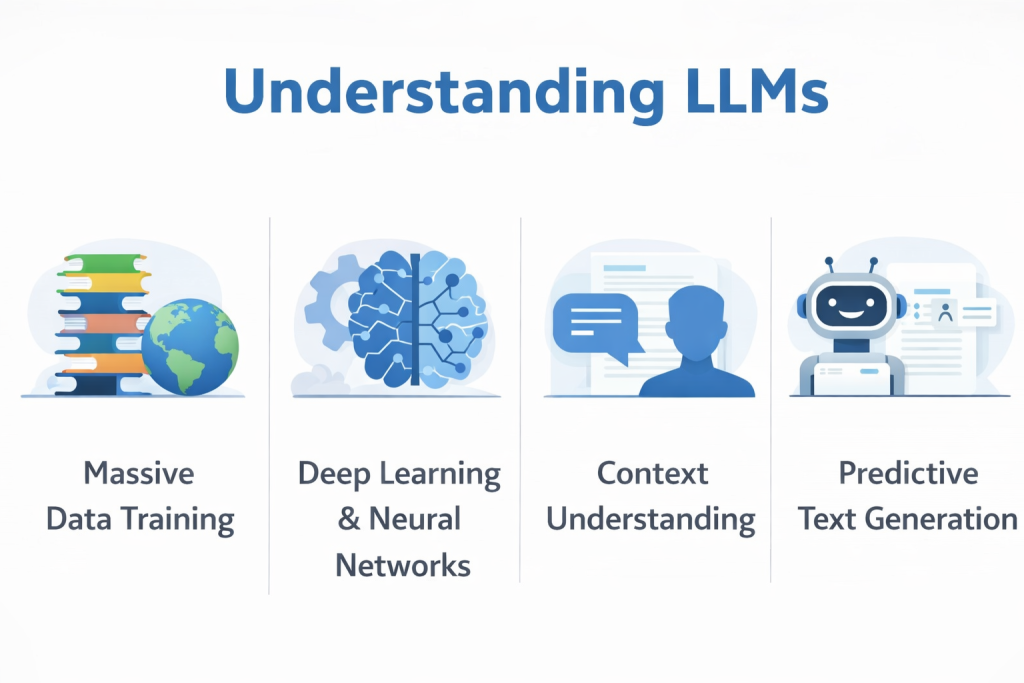
Advanced artificial intelligence systems called Large Language Models (LLMs) are made to comprehend, process, and produce human language. Large datasets from books, websites, articles, and other text sources are used to train these models.
- Massive Data Training: A vast amount of text data gathered from various sources is used to train large language models.
- Deep Learning & Neural Networks: Transformer-based neural networks and deep learning methods are used in the majority of large language models.
- Context Understanding: The capacity of large language models to comprehend context within a dialogue or document is one of their main advantages.
- Predictive Text Generation: Based on prior text, large language models predict the next word or series of words to produce responses.
Large language models can write content, provide answers to questions, summarize information, and help with a variety of digital tasks by analyzing patterns in language.
Key Features of Modern Large Language Models
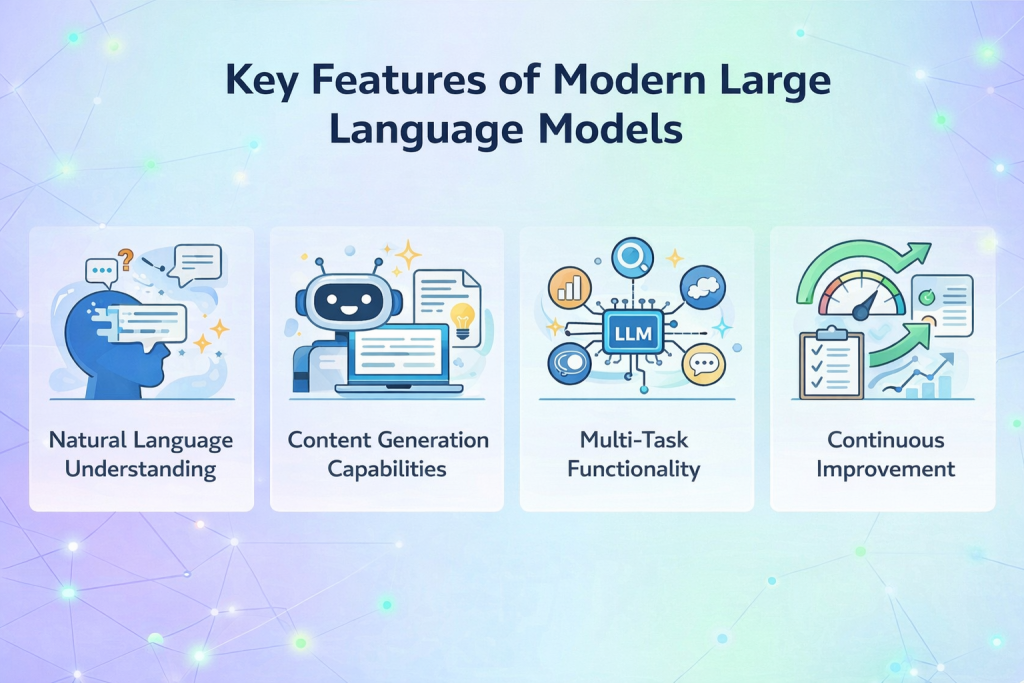
Many of the AI tools used in regular digital workflows are now powered by modern Large Language Models (LLMs), which have developed quickly.
- Natural Language Understanding: Large language models can comprehend questions, commands, and conversations written in natural human language. Users can engage with AI tools straightforwardly and conversationally thanks to this feature.
- Content Generation Capabilities: The capacity of large language models to produce content is one of their most potent features. Based on user-provided prompts, they can compose articles, emails, reports, summaries, and even marketing copy.
- Multi-Task Functionality: Contemporary large language models are capable of carrying out a variety of tasks, including summarizing, translating, helping with coding, and answering questions.
- Continuous Improvement: With the use of updated training data and model optimization, large language models get better over time.
These systems are made to comprehend intricate linguistic patterns, produce insightful answers, and help with a variety of tasks. Large language models’ capabilities are growing across industries and business applications as they continue to advance.
Benefits of Using LLMs in AI Systems
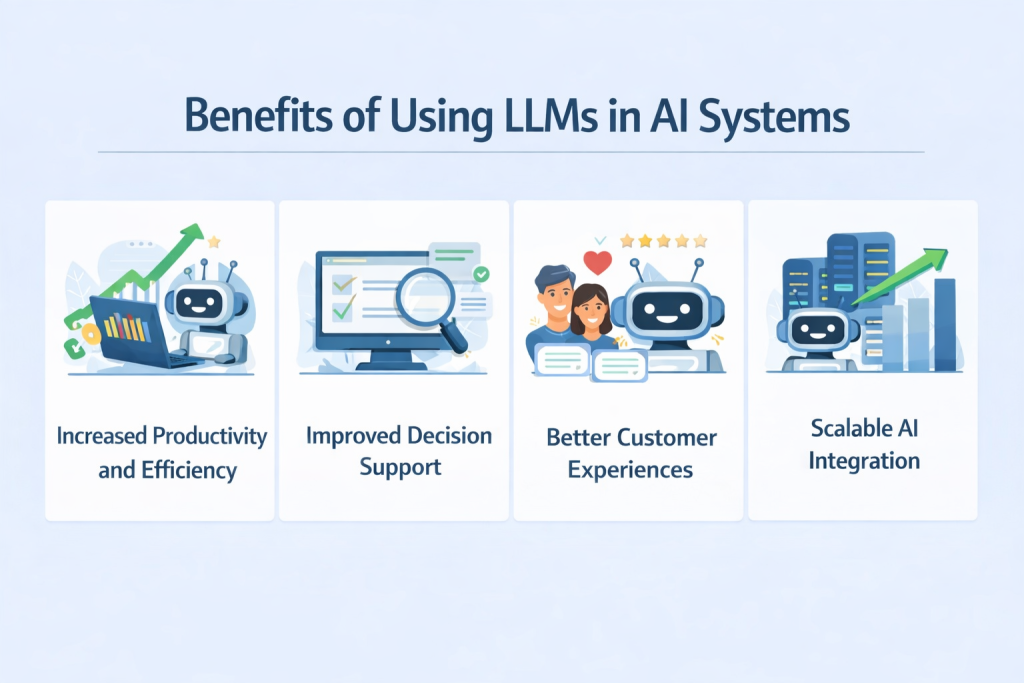
The rise of Large Language Models (LLMs) has made modern AI systems much better at what they do. These models can handle a lot of data, understand what people say, and come up with useful answers.
- Increased Productivity and Efficiency: Large language models assist in automating repetitive tasks like writing, summarizing, data processing, and customer communication.
- Improved Decision Support: By examining vast amounts of data and documents, large language models can deliver quick summaries and insights. Companies can leverage these insights for strategic planning and quicker decision-making.
- Better Customer Experiences: Numerous businesses utilize large language models to enhance chatbots, support systems, and AI assistants. These systems offer quicker responses, tailored communication, and better customer engagement.
- Scalable AI Integration: Large language models facilitate the scaling of AI across various departments within organizations. From marketing and operations to customer service and research, LLMs assist a broad spectrum of business functions.
Because of these features, big language models are becoming important tools for businesses, developers, and groups that are using AI.
Top Large Language Models in 2026
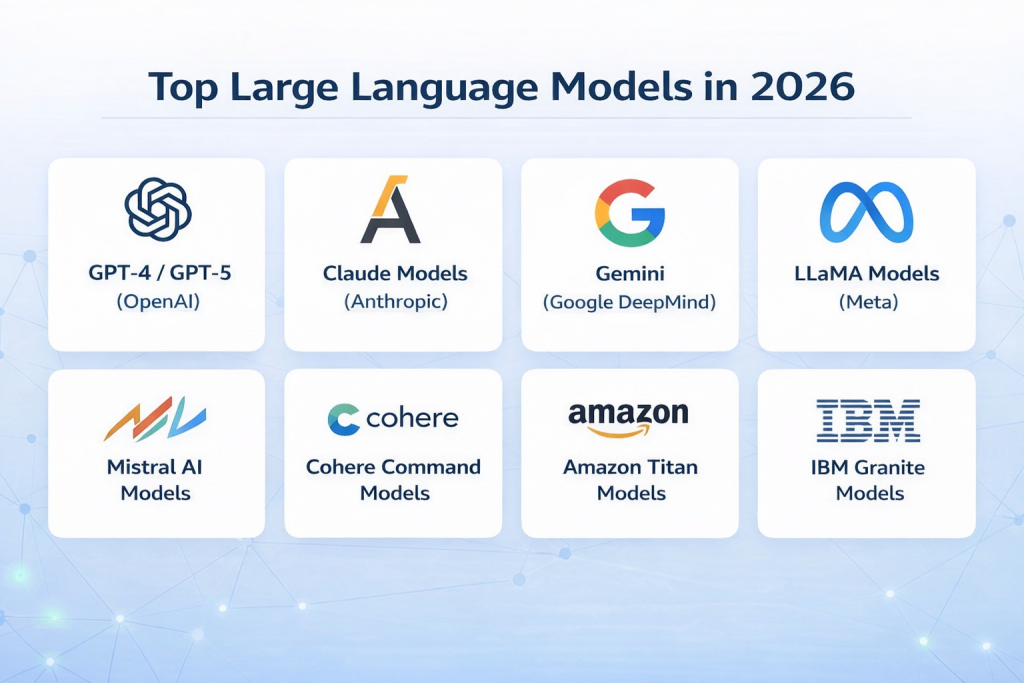
In the last few years, the growth of Large Language Models (LLMs) has sped up a lot. A lot of tech companies and AI research groups are making powerful models that can understand language, write content, help with coding, and help with business automation.
- GPT-4 / GPT-5 (OpenAI): OpenAI’s GPT models are among the most popular large language models. They excel in reasoning, conversational skills, coding assistance, and enterprise AI uses.
- Claude Models (Anthropic): Claude’s large language models prioritize safe AI interactions and long-context reasoning. Many businesses utilize Claude for document analysis, research, and organized business processes.
- Gemini (Google DeepMind): Google’s Gemini models drive various AI tools within Google products. These large language models integrate text, image, and data processing to enhance search, productivity, and AI assistants.
- LLaMA Models (Meta): Meta’s LLaMA series of large language models is favored in the open-source AI community. Developers leverage these models to create tailored AI applications and explore new AI technologies.
- Mistral AI Models: Mistral has created efficient large language models that emphasize high performance with reduced computing needs. These models are commonly used for developer tools and enterprise applications.
- Cohere Command Models: Cohere offers large language models specifically designed for enterprise AI tasks like search, text classification, and content creation.
- Amazon Titan Models: Amazon’s Titan large language models are embedded in cloud services to assist businesses in developing AI applications for customer support, analytics, and automation.
- IBM Granite Models: IBM Granite large language models cater to enterprise settings, focusing on secure AI deployment, compliance with regulations, and business data analysis.
In 2026, a few big language models are at the top of the AI field for business, research, and consumer use.
Business Applications of Large Language Models
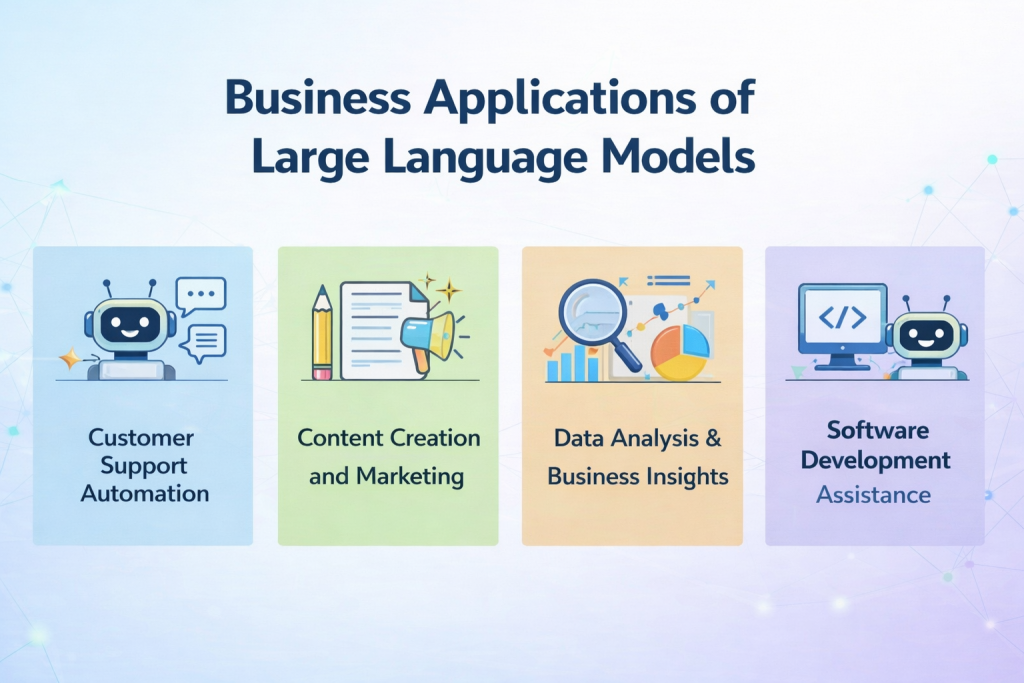
Businesses in many fields are quickly using Large Language Models (LLMs) to automate tasks, boost productivity, and give customers a better experience. These AI systems can handle a lot of data, come up with new ideas, and help teams make decisions more quickly.
- Customer Support Automation: Many businesses utilize large language models to enhance AI chatbots and virtual assistants.
- Content Creation and Marketing: Large language models assist marketing teams in creating blog posts, email campaigns, advertising copy, and social media content. This enables companies to generate high-quality content.
- Data Analysis & Business Insights: Organizations employ large language models to review reports, summarize documents, and extract essential insights from extensive datasets. This aids teams in making informed decisions based on data-driven insights.
- Software Development Assistance: Developers leverage large language models for coding help, debugging, and producing technical documentation. These AI tools facilitate faster software development and enhance productivity for engineering teams.
Large language models are becoming a key part of modern digital operations as businesses continue to use AI in their daily tasks.
How to Choose the Right Large Language Model
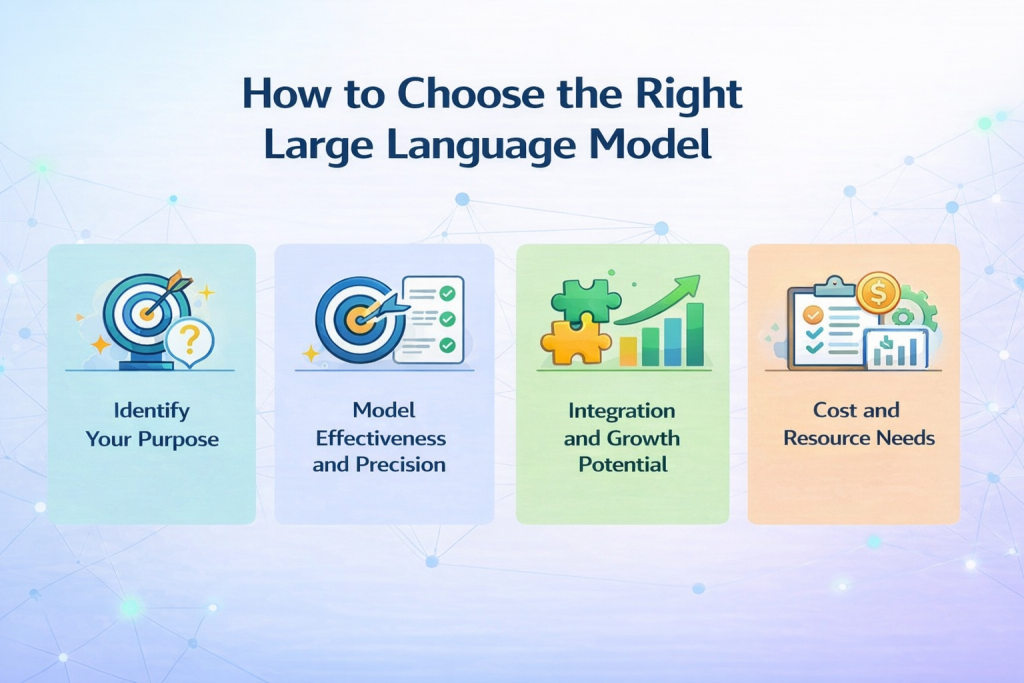
The type of work you want AI to do, your business goals, and your technical needs will all affect which Large Language Model (LLM) is best for you. Different large language models are made for different tasks, like making content, running business processes, doing research, or making software.
- Identify Your Purpose: Begin by determining what you want the large language model to accomplish. Certain LLMs excel in content creation and marketing, while others focus on coding, research analysis, or enterprise automation.
- Model Effectiveness and Precision: Assess the reasoning skills, quality of responses, and accuracy of the large language model. Models with high performance typically provide better contextual comprehension and more dependable results.
- Integration and Growth Potential: Think about how smoothly the large language model can connect with your current systems, like websites, applications, or enterprise platforms. Scalability is crucial if you intend to broaden AI use across teams.
- Cost and Resource Needs: Some large language models necessitate robust computing power or paid API access. Companies should evaluate pricing structures and infrastructure requirements before selecting a solution.
Knowing how you want to use the model will help you choose the best large language model for your needs.
Future Trends in Large Language Models
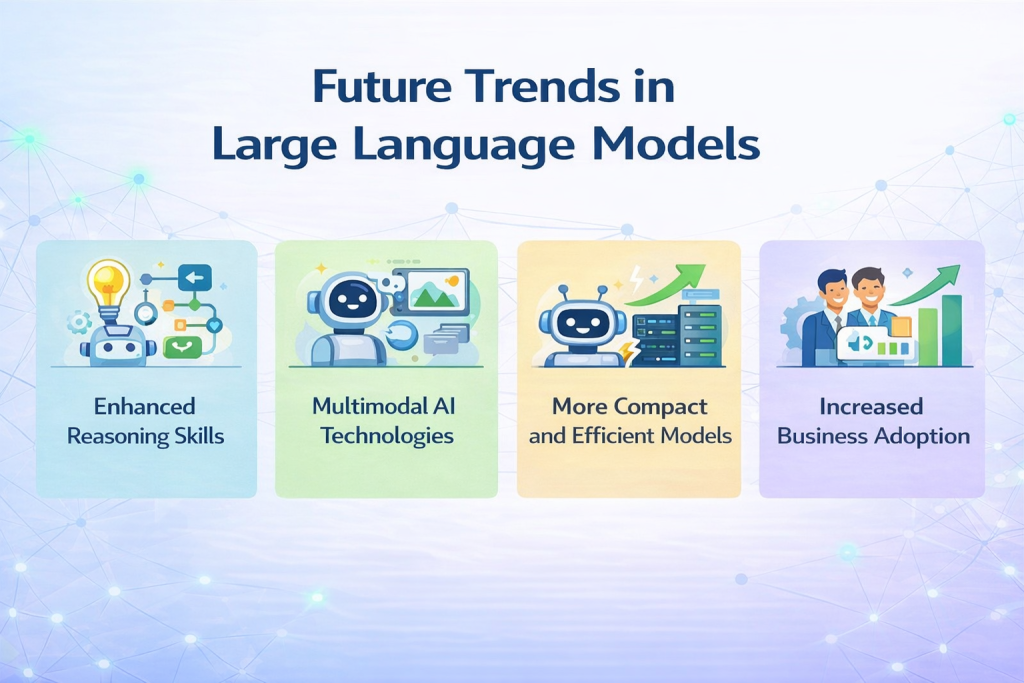
Companies are putting a lot of money into AI research, which is speeding up the growth of Large Language Models (LLMs). New developments are making it easier for these models to understand language, process information, and help with difficult tasks.
- Enhanced Reasoning Skills: Future large language models are anticipated to offer improved reasoning and problem-solving skills. This will enable AI systems to manage complex analysis, planning, and decision-support tasks more efficiently.
- Multimodal AI Technologies: Numerous new large language models are being developed to handle various types of data, including text, images, audio, and video.
- More Compact and Efficient Models: Researchers are focused on developing large language models that need less computing power while still delivering strong performance.
- Increased Business Adoption: As AI tools gain reliability, companies in sectors such as healthcare, finance, marketing, and technology will increasingly implement large language models to automate tasks and enhance productivity.
As AI technology gets better, big language models will become even more powerful and useful in many fields.
Conclusion
Large Language Models (LLMs) are becoming a central part of modern AI. These models can read and write in human language, which makes them useful for a lot of things, like writing, research, customer service, and data analysis. Large language models are helping people work faster and solve problems more effectively as AI continues to improve.
Businesses, developers, and groups are already using large language models to boost productivity and automate tasks that need to be done every day. LLMs help a lot of different fields, from writing marketing copy to making software to helping customers. Businesses can get the most out of AI technology by picking the right large language model and learning how it works.
As new technology makes large language models better, their role will keep growing in the future. LLMs will still be an important part of the future of AI and digital innovation because they will be able to think better, work faster, and be used by more people.

Deepak Wadhwani has over 20 years experience in software/wireless technologies. He has worked with Fortune 500 companies including Intuit, ESRI, Qualcomm, Sprint, Verizon, Vodafone, Nortel, Microsoft and Oracle in over 60 countries. Deepak has worked on Internet marketing projects in San Diego, Los Angeles, Orange Country, Denver, Nashville, Kansas City, New York, San Francisco and Huntsville. Deepak has been a founder of technology Startups for one of the first Cityguides, yellow pages online and web based enterprise solutions. He is an internet marketing and technology expert & co-founder for a San Diego Internet marketing company.