






Table of Contents
Introduction
You ordered a product online and within seconds, one AI agent checks inventory, another negotiates shipping rates, a third verifies payment risk, and yet another schedules delivery, all without human intervention.
- They exchange information instantly and make decisions collaboratively to seamlessly complete the task
- Recent multi-agent advancements and improvements in language models now allow AI agents to communicate directly with one another
- In 2026, AI has evolved beyond single-task assistants like ChatGPT and voice-based systems like Alexa and Google Assistant. Today’s AI agents are designed to collaborate across platforms, tools, and networks.
Various companies such as OpenAI, Google, and Microsoft are actively developing AI agents that can coordinate tasks, exchange structured data, and operate autonomously in enterprise environments.
From healthcare and finance to e-commerce and logistics, AI agents are now forming networks that share data in real time, make decisions, and learn collaborative intelligence.
What Does It Mean for AI to “Talk” to Each Other?
When we say an AI agent “talks” to another, we do not mean they speak with voices like humans. They send structured and designed messages to other systems for better understanding.
This process is called AI communication or Agent-to-Agent (A2A) communication.
Today, modern systems use collaborative intelligence, which means multiple AI agents work together like a team to complete complex tasks faster and more accurately.
When AI agents communicate, they follow clear technical processes which usually contain:
- The goal or request
- Important context or background information
- Instructions on what action is needed
- The expected output
Because the message format is standardized, the receiving AI agent understands exactly what to do. This reduces confusion and errors. This organized teamwork is the foundation of collaborative intelligence.
Let’s look at an example:
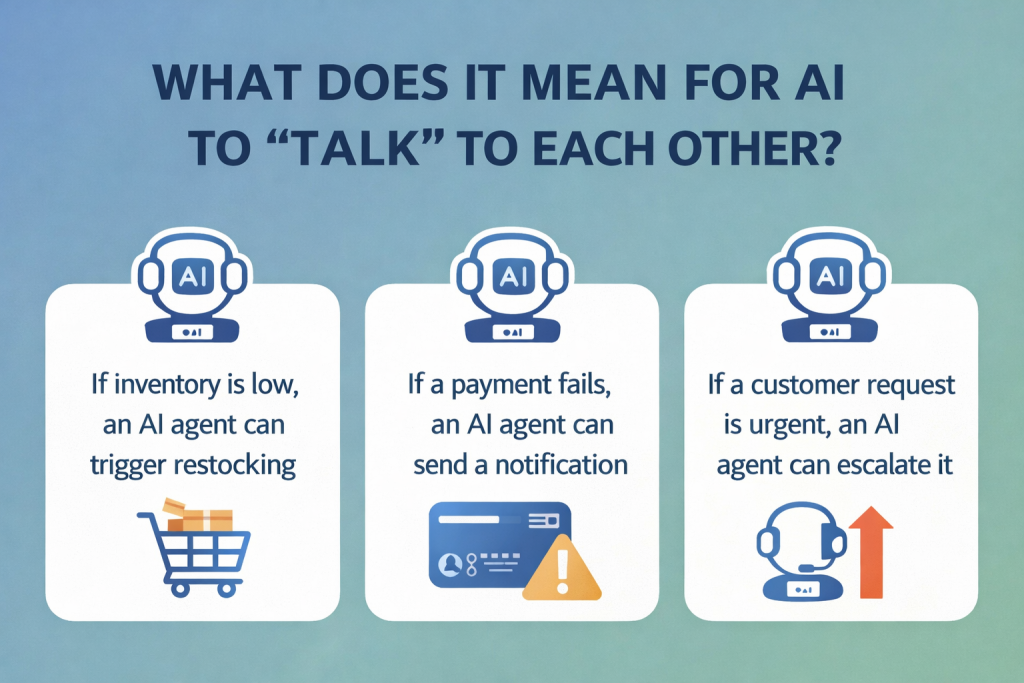
- If inventory is low, an AI agent can trigger restocking
- If a payment fails, an AI agent can send a notification
- If a customer request is urgent, an AI agent can escalate it
The goal is to maintain efficiency and accuracy, through predefined rules, machine learning models, and optimization algorithms.
AI communication is becoming essential in industries such as healthcare, finance, e-commerce, and customer service. As systems grow more advanced, AI agents will increasingly rely on direct collaboration to solve complex problems.
How AI Agents Actually Communicate
When we say an AI agent “communicates” with another, we don’t mean casual conversation. Instead, it refers to structured, goal-driven AI communication between autonomous AI systems.
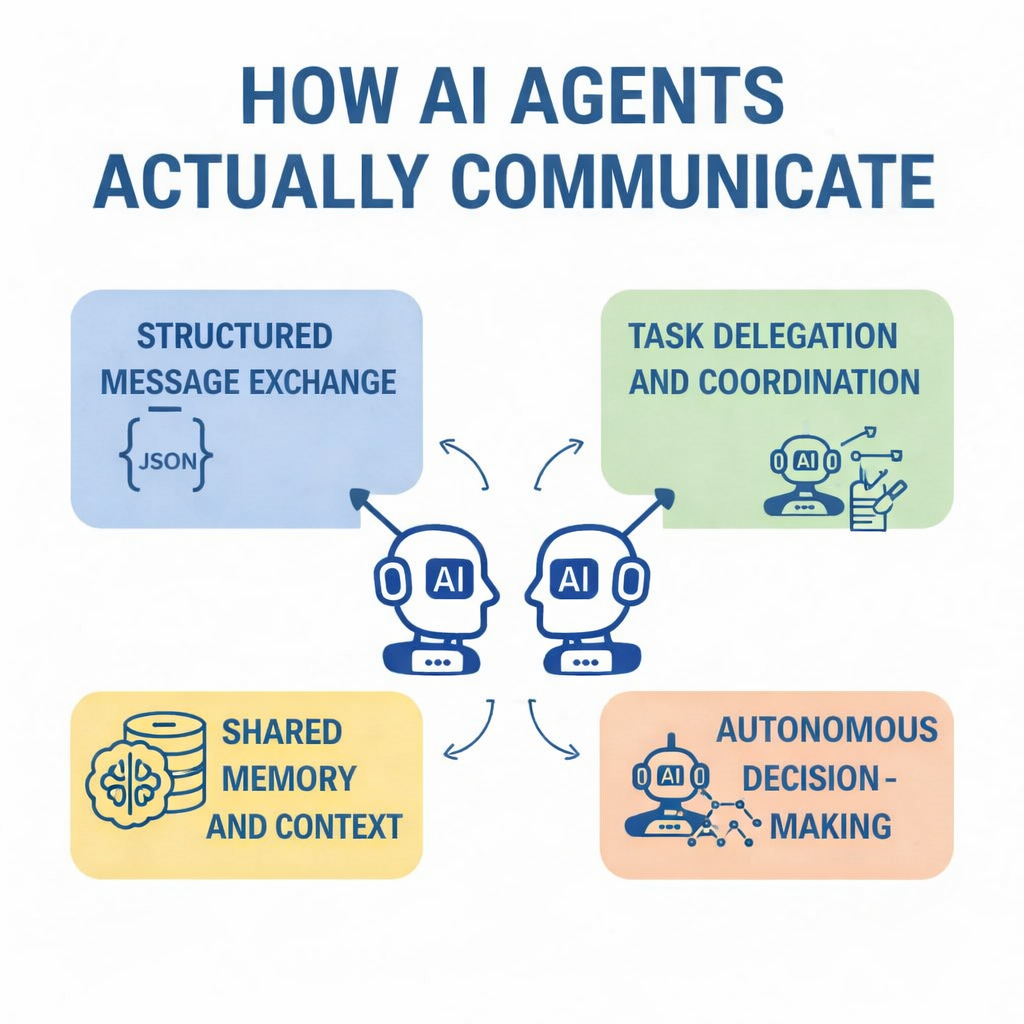
Below is the technical process of how AI agents actually communicate with each other:
Structured Message Exchange
AI agents send structured messages like JSON or protocol-based messages rather than plain text. These messages include:
- Intent
- Context
- Constraints
- Requested actions
- Expected outputs
This means that a customer-support AI might send a request to a billing AI agent to verify a transaction.The billing agent processes the request and sends back a structured response, all without human involvement.
Task Delegation and Coordination
Modern AI agents operate in multi-agent frameworks, where a central “orchestrator” AI agent assigns subtasks to specialized agents.
Helps in ways that include:
- A research agent gathers data
- An analysis agent processes it
- A writing agent generates a report
- A validation agent checks accuracy
Each agent communicates results back to the coordinator, forming a collaborative loop.
Shared Memory and Context
AI agents now operate with shared knowledge layers, allowing them to maintain context across interactions. This means one AI can build upon another’s output without restarting the process.
Autonomous Decision-Making
An AI agent can evaluate options, negotiate outcomes, and choose optimal actions based on defined objectives. This capability allows systems to operate with minimal human supervision.
Benefits of AI Agent Communication
When AI agents interact with each other, they don’t just share information; they work together in smarter, faster ways.
Today’s collaborative intelligence team up to complete tasks more efficiently than any single system could do alone. That’s why businesses and developers focus on building systems where AI agents can connect and coordinate.
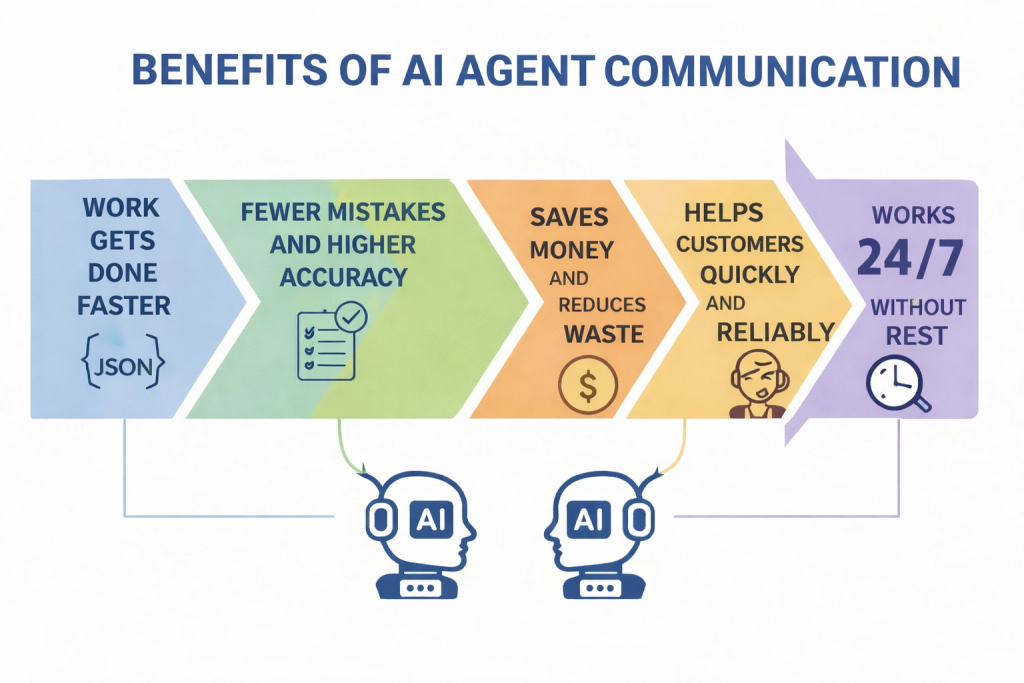
Below are the benefits of AI agent communication:
Work Gets Done Faster
When AI agents share tasks and information instantly, processes that normally take hours or days are completed in seconds. Each agent focuses on what it does best, so the whole system works more quickly.
Fewer Mistakes and Higher Accuracy
Collaborative intelligence means that each agent can cross-check results with others. This reduces human errors, repetition, and system miscommunication, leading to more reliable outcomes.
Saves Money and Reduces Waste
Automated AI agent workflows require less human supervision and fewer manual steps. This reduces labor costs, lowers error-related expenses, and improves resource allocation across departments.
Helps Customers Quickly and Reliably
Systems where AI agents talk to each other can respond to customer questions faster, provide real-time updates, and handle complex support issues without long wait times. Customers get answers, resolutions, and services immediately.
Works 24/7 Without Rest
Unlike humans, AI agents never get tired, need sleep, or take breaks. They continue operating around the clock, ensuring that systems stay active and responsive at all times.
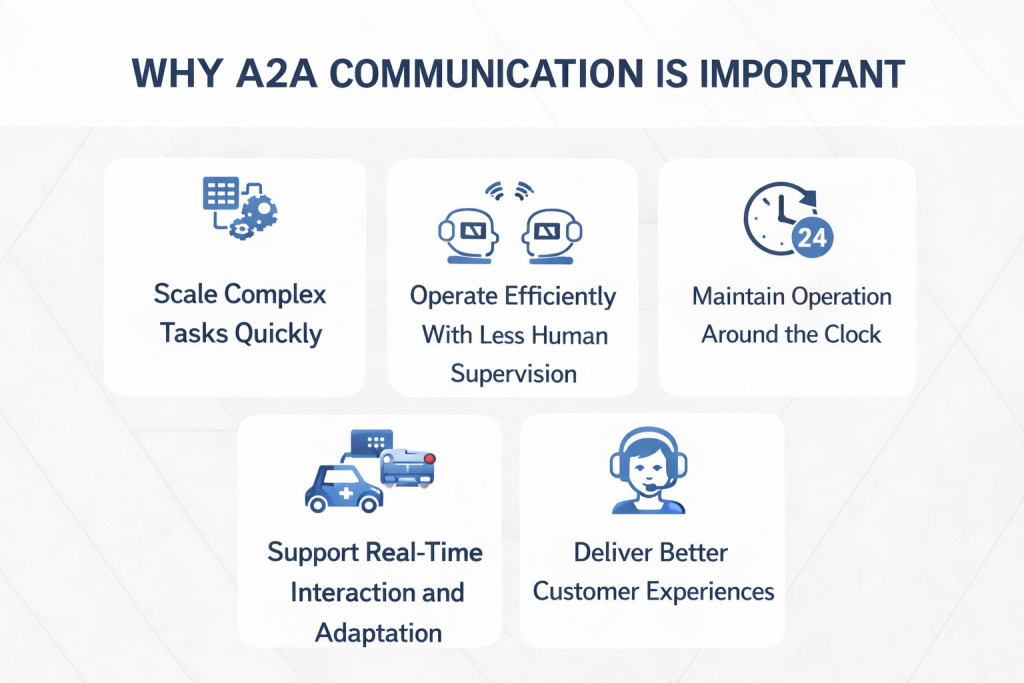
Why A2A Communication Is Important
AI-to-AI communication (A2A) is more than mere data exchange. It enables:
- When multiple agents communicate, they can divide work and solve complex tasks quickly, which makes the collaboration fast, reduces delay,s and boosts overall output
- When AI agents share results and cross-verify data improving accuracy and increasing system reliability
- A2A communication allows systems to operate efficiently with less human supervision to save time, and allows humans to focus on higher-level decision-making
- AI agents communicating with one another adapt faster to changes, spotting anomalies and adjusting behaviors within milliseconds
- AI agents can pass conversation context, user histories, and intent across specialized sub-agents to deliver better customer experiences
- Maintain continuous communication and operate 24/7 without interruption
Real-World Examples of AI Agents Talking
Below are the real-world examples showing how AI agents are transforming global enterprises:
Grupo Bimbo: Supply Chain & Risk Management Agents
As a global leader, Grupo Bimbo has implemented AI agents that communicate across different facets of their operations. They use Procurement Copilots that extract data from diverse internal sources to generate reports automatically.
- A data-extraction agent analyzes inventory levels, which then feeds that information to a logistics-prediction agent
- These agents, working together with Microsoft’s industrial AI, optimize production schedules and reduce manufacturing downtime across plants in Mexico
- Improved compliance, faster data analysis, and proactive risk management in supply chain operations
Virgin Pulse Revamps Chatbots for Smarter Member Support
Virgin Pulse wanted to improve its outdated keyword-based chatbot, which had only a 3% containment rate. In partnership with Cognigy, the company launched a fully integrated AI Agent connected to:
- Zendesk LiveChat
- Help Center knowledge base
- Automated ticket creation systems
The new AI Agent in Virgin Pulse provides:
- Achieved 97% intent recognition accuracy
- Covered 29 topic areas
- Automatically updated its knowledge base
- Seamlessly handed off complex cases to human agents
Loft: Real Estate & Mortgage Automation Agents
Loft, a real estate technology company operating in Mexico, uses multi-agent systems to connect different parts of its business via WhatsApp.
When a customer interacts via WhatsApp, one AI agent handles the customer’s query (a conversational agent). This agent talks directly to another backend agent that manages the database (BigQuery).
- The customer agent queries the mortgage simulation agent, which calculates rates, and then sends the personalized offer back to the customer
- 900 weekly mortgage simulations via WhatsApp and a 15% reduction in support tickets
DHL (Supply Chain & Logistics: Proactive Orchestration)
DHL is a global logistics company that employs multi-agent systems to manage inbound operations, reducing manual intervention by up to 50%.
- A “Planner Agent” breaks down a shipment, a “Vision Agent” scans pallets, and a “Reconciliation Agent” compares inventory
- When the Vision Agent detects a discrepancy (e.g., partial shipment), it instantly alerts the Planning Agent, which communicates with the ERP system to update the delivery schedule without human intervention
- Real-time warehouse reconciliation and reduced, often eliminated, manual paperwork
Autonomous Sea Ice Forecasting & Logistics (IceNet)
Predicting safe shipping routes through the Arctic Ocean is vital for Russian Northern Sea Route operations and Alaskan maritime traffic.
- The IceNet AI system uses deep learning to predict Arctic sea ice concentration months in advance
- It communicates this data to logistical AI agents managing ship trajectories
- These AI agents, when connected to vessel automation systems, can autonomously adjust a ship’s route to avoid hazardous ice, collaborating with weather forecasting systems to predict, analyze, and reroute without human input
The Future of AI Agent Communication
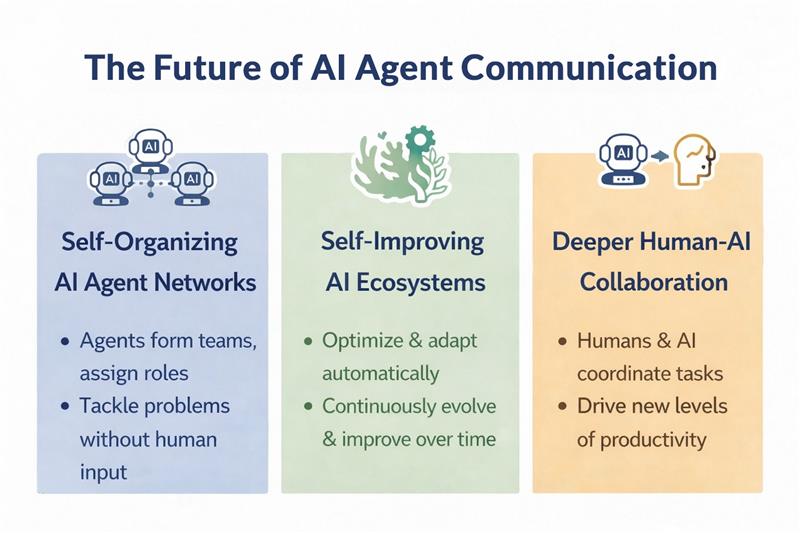
The growth of AI agent communication systems and collaborative intelligence is accelerating rapidly. Over the next decade, AI agents will move beyond simple automation and begin forming intelligent, adaptive ecosystems.
Self-Organizing AI Agent Networks
In the future, an AI agent won’t just follow fixed instructions. Instead, multiple agents will:
- Form teams automatically
- Assign roles among themselves
- Develop strategies in real time
- Solve new problems without waiting for human input
This means AI communication will become dynamic and continuous. Agents will “talk” to each other, share data, adjust decisions, and reorganize when conditions change.
Self-Improving AI Ecosystems
The next step in collaborative intelligence is systems that improve themselves. Instead of waiting for developers to update them, multi-agent systems could:
- Detect weak-performing AI agents
- Retrain or fine-tune models automatically
- Share new insights across the network
- Experiment with better strategies internally
Deeper Human with AI Collaboration
The future is not about replacing humans. It’s about expanding teamwork. In the future, workplaces may include:
- Human teams
- AI agent teams
- Hybrid workflows combining both
Employees might coordinate tasks with AI agents in real time, reviewing insights, approving automated decisions, or focusing on creative and strategic work. Without thoughtful design, AI partnerships will feel mechanical.
Deepak Wadhwani has over 20 years experience in software/wireless technologies. He has worked with Fortune 500 companies including Intuit, ESRI, Qualcomm, Sprint, Verizon, Vodafone, Nortel, Microsoft and Oracle in over 60 countries. Deepak has worked on Internet marketing projects in San Diego, Los Angeles, Orange Country, Denver, Nashville, Kansas City, New York, San Francisco and Huntsville. Deepak has been a founder of technology Startups for one of the first Cityguides, yellow pages online and web based enterprise solutions. He is an internet marketing and technology expert & co-founder for a San Diego Internet marketing company.