


Table of Contents
Introduction
There is a big change happening in how we look for information online. The introduction of AEO (Answer Engine Optimization) is leading the way in changing how search engines work. AEO is not just about getting the best ranking for keywords. It’s about giving users direct, clear answers to their questions, which changes how search engines show results.
As voice search, AI-powered assistants, and personalized content become more popular, people expect answers to be faster and more relevant. AEO meets this need by making content the “answer” that search engines give the most weight to. In a time when quick information is king, companies need to change their plans to make sure their content follows AEO rules.
Digital marketing strategies need to change as search engines do. Anyone who wants to stay ahead in a competitive environment needs to know what AEO is. We’ll talk about how AEO is changing search engine optimization and what businesses can do to adapt to this big change in this blog.
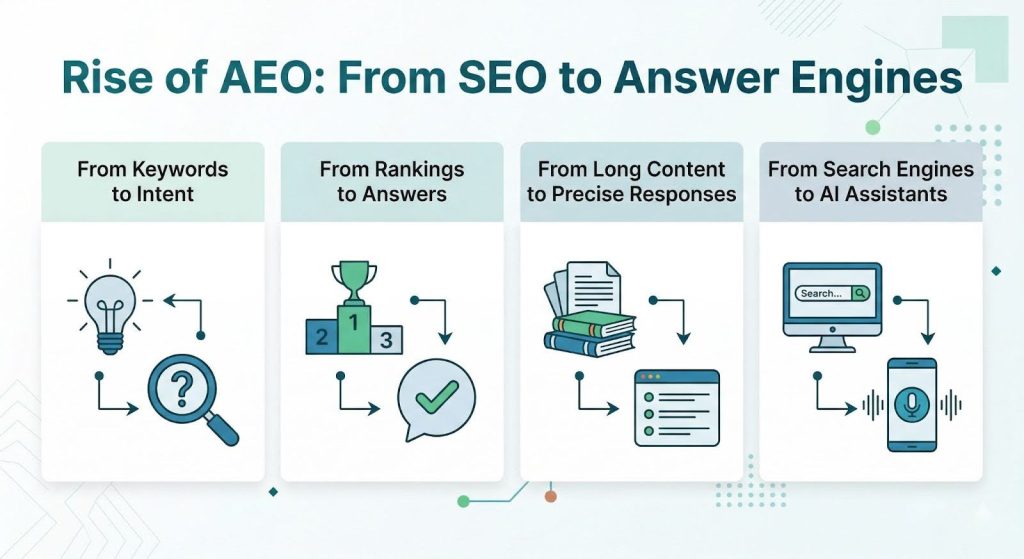
Rise of AEO: From SEO to Answer Engines
Links and rankings aren’t the only things that matter in search anymore. As AEO becomes more popular, search engines are turning into answer engines that give you exact answers instead of a list of options.
- From Keywords to Intent: Traditional SEO was centered on keywords, but AEO emphasizes user intent. Content must now directly address specific questions instead of merely including target phrases.
- From Rankings to Answers: Rather than striving for a spot in the top 10 links, AEO targets position zero. The aim is to be the featured answer that search engines show immediately.
- From Long Content to Precise Responses: Simply having lengthy content no longer guarantees visibility. AEO favors clear, concise, and well-structured answers that swiftly resolve user inquiries.
- From Search Engines to AI Assistants: As AI tools and voice assistants become more prevalent, AEO makes sure content is tailored for conversational queries and real-time responses across various platforms.
This change is affecting how content is made, organized, and improved.
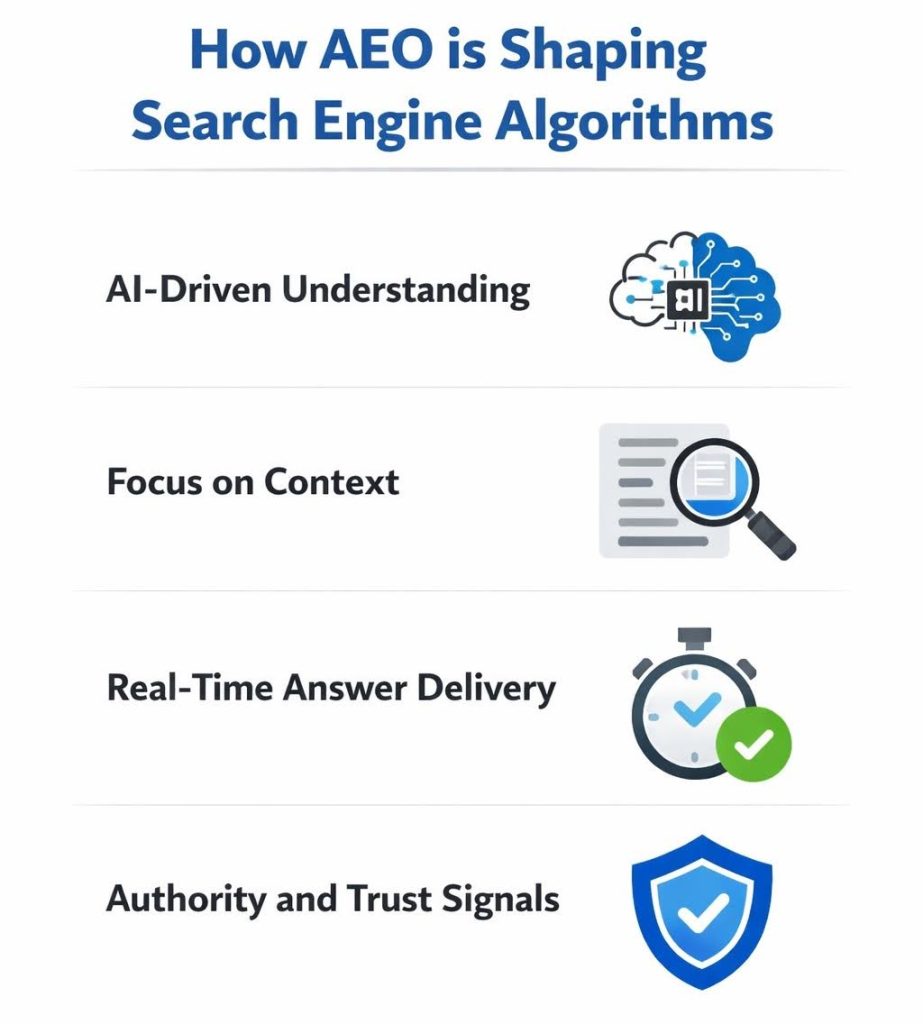
How AEO is Shaping Search Engine Algorithms
Search engines are no longer just putting pages in order; they are also figuring out what they mean and giving you answers. With AEO, algorithms are getting smarter by focusing on context, accuracy, and user satisfaction.
- AI-Driven Understanding: AI is used by modern algorithms to figure out what something means and what it means. AEO makes sure that content is in line with how machines understand human language.
- Focus on Context: Search engines now put more weight on context than on keywords. AEO makes sure that content answers the whole question, not just a few keywords.
- Real-Time Answer Delivery: Algorithms are made to give you answers right away. AEO helps with this by organizing content so that it can be quickly pulled out and shown.
- Authority and Trust Signals: Content that is reliable and accurate is more valuable than ever. To get a higher rank, AEO focuses on credibility, expertise, and reliable information.
This change is changing the way content is rated and ranked.
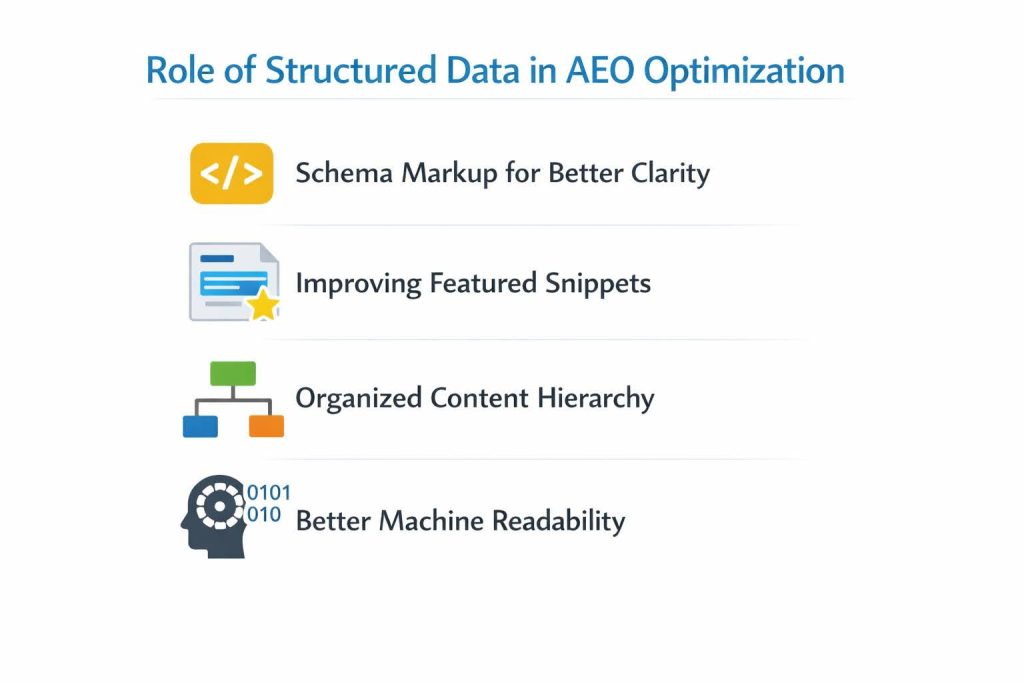
Role of Structured Data in AEO Optimization
As search engines shift to prioritize answer-first results, the way content is organized is increasingly important.
- Schema Markup for Better Clarity: Schema markup is a type of structured data that helps search engines understand content correctly. AEO uses this to make rich results and answer boxes more visible.
- Improving Featured Snippets: Content that is well-organized has a better chance of being chosen for snippets. AEO’s main goal is to format answers so that search engines can easily find them.
- Organized Content Hierarchy: Clear headings, bullet points, and sections make it easier to read. AEO makes sure that both users and algorithms can easily find what they need.
- Better Machine Readability: Search engines need structured formats to get the answers they need. AEO makes it easier for AI systems to scan, understand, and show content right away.
AEO depends significantly on clear formatting and structured data to assist search engines in quickly understanding and retrieving the correct information. If the structure is lacking, even high-quality content may be ignored.
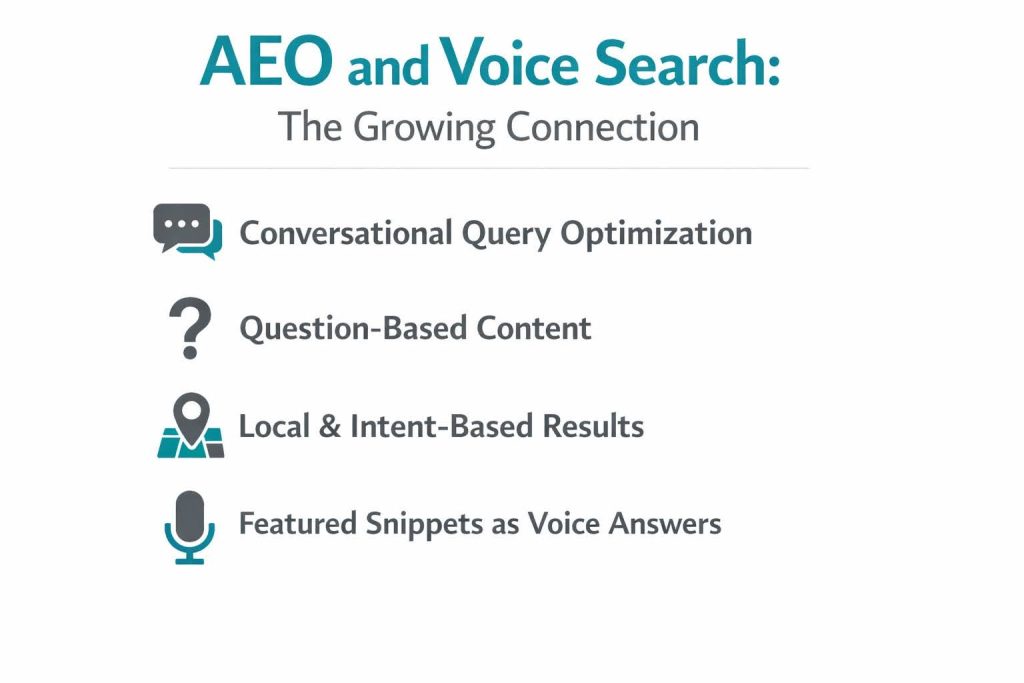
AEO and Voice Search: The Growing Connection
The manner in which individuals search is increasingly becoming conversational, particularly due to the growth of voice assistants.
- Conversational Query Optimization: Voice searches tend to be longer and more conversational. AEO prioritizes providing complete answers to questions instead of just short keyword phrases.
- Question-Based Content: The majority of voice searches start with words like who, what, where, or how. AEO makes sure that the content directly addresses these kinds of inquiries.
- Local & Intent-Based Results: Voice searches usually indicate a strong intent, particularly for local inquiries. AEO aids in delivering accurate and relevant answers swiftly.
- Featured Snippets as Voice Answers: Voice assistants frequently retrieve answers from featured snippets. AEO enhances the likelihood of being chosen as the spoken response.
AEO is crucial in this transition by ensuring that content aligns with the way users typically speak and pose questions. Consequently, voice search is a significant factor in AEO strategies.
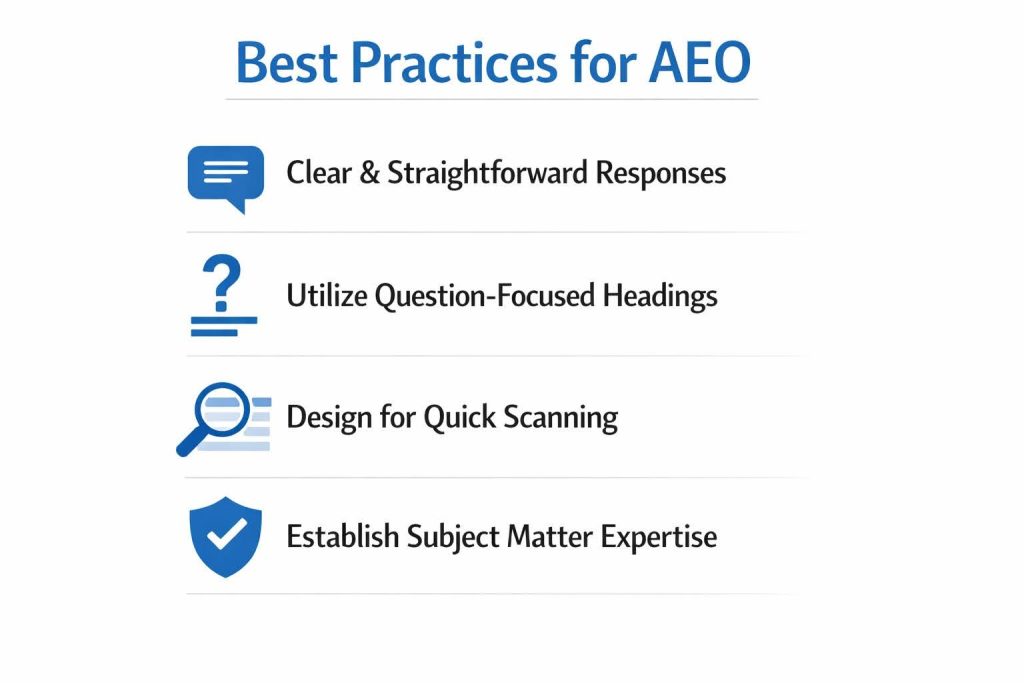
Best Practices for AEO
Content must be created to provide answers rather than merely focusing on rankings. AEO demands a straightforward, user-centered strategy where information is readily accessible, comprehensible, and delivered without delay.
- Clear & Straightforward Responses: Skip unnecessary details and address the main point swiftly. AEO prefers content that answers questions within the initial lines.
- Utilize Question-Focused Headings: Organize content based on actual user inquiries. AEO performs optimally when headings reflect common search phrases.
- Design for Quick Scanning: Incorporate bullet points, concise paragraphs, and straightforward layouts. AEO enhances when the content is easily readable for both users and AI.
- Establish Subject Matter Expertise: Explore topics thoroughly across several pages. AEO favors websites that reliably deliver comprehensive and trustworthy information.
Minor adjustments in structure and purpose can lead to significant improvements.
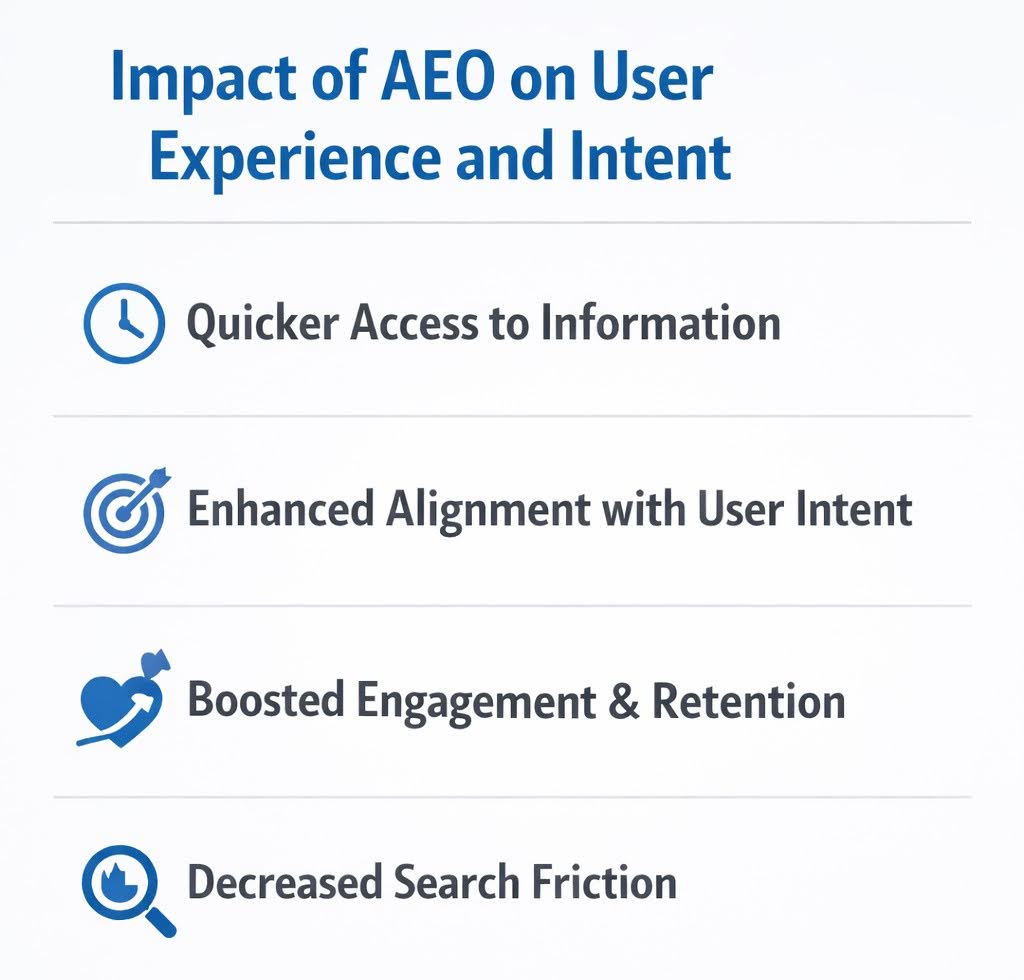
Impact of AEO on User Experience and Intent
User expectations have evolved over time; individuals now seek immediate answers rather than a collection of links to sift through.
- Quicker Access to Information: Users obtain what they seek without having to click multiple times. AEO guarantees that answers are straightforward and instantly visible.
- Enhanced Alignment with User Intent: Content is crafted based on what users genuinely want to learn. AEO assists in aligning queries with accurate, relevant answers.
- Boosted Engagement & Retention: When users quickly discover answers, they tend to stay longer. AEO builds trust and keeps users involved with the content.
- Decreased Search Friction: Finding information requires less effort. AEO streamlines the search process, making it more seamless and efficient.
AEO caters to this trend by prioritizing intent and providing
value right away. This significantly enhances user engagement with better search results.
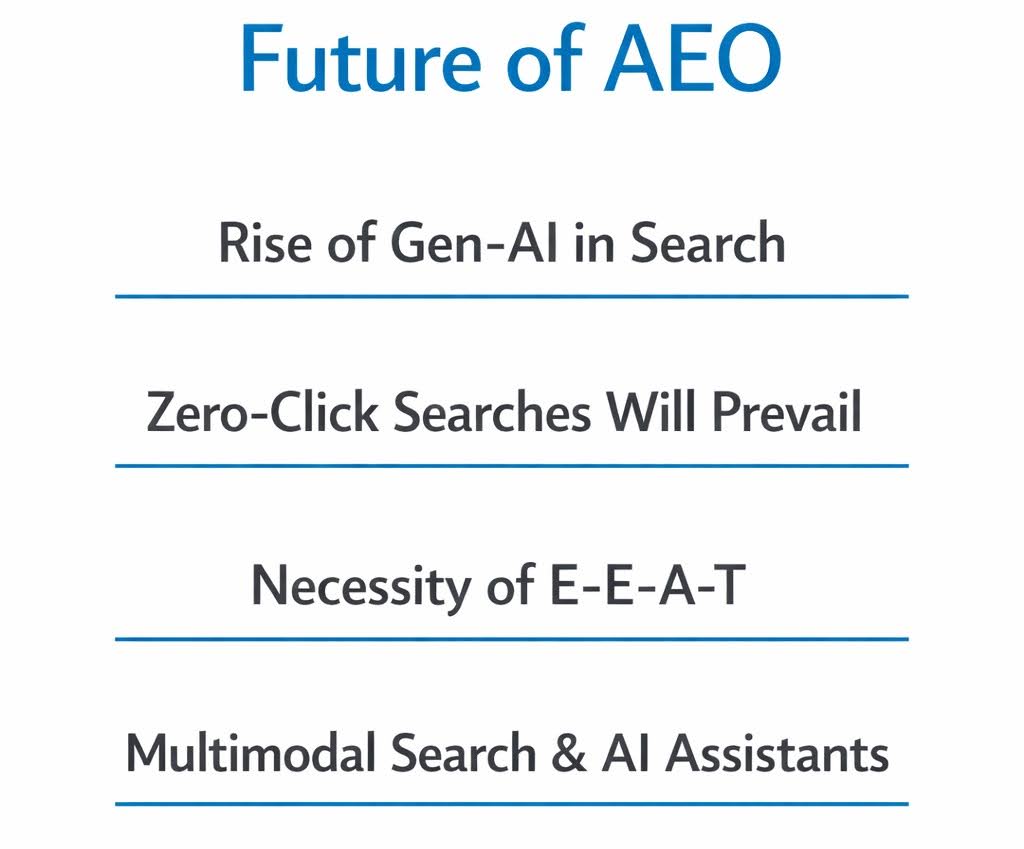
Future of AEO
Search is now shifting completely towards AI-driven experiences where responses are created rather than simply fetched. AEO will keep evolving as search engines such as Google and Microsoft incorporate more advanced AI features into their systems.
- Rise of Gen-AI in Search: Platforms such as Google Search Generative Experience and Bing Copilot are transforming search to provide AI-generated responses. AEO will concentrate on producing content that supplies these AI models with precise, organized information.
- Zero-Click Searches Will Prevail: Research from SparkToro indicates that a significant number of searches already conclude without any clicks. AEO will become vital as more users receive answers directly on the results page.
- Necessity of E-E-A-T: Google’s E-E-A-T framework will have a larger influence on answer selection. AEO will need to demonstrate strong credibility signals, content supported by experts, and reliable sources.
- Multimodal Search & AI Assistants: With progress in tools like Google Lens and voice assistants, search will extend beyond just text. AEO will broaden to optimize for voice, image, and video queries, enhancing the versatility and accessibility of content.
This indicates that content needs to be crafted not just for ranking purposes, but also for clear understanding and presentation.
Conclusion
The move towards AEO is more than just a passing trend; it represents a significant shift in the way search operates. With the rise of AI-driven algorithms, voice searches, and zero-click results, the emphasis has shifted to providing straightforward, immediate answers. Companies that recognize this change early will have a better chance of maintaining their visibility.
Adjusting to AEO requires a reevaluation of content strategy. It involves crafting structured, intent-focused content that addresses user questions promptly while also establishing trust and authority over time. The brands that thrive will be those that prioritize clarity, precision, and genuine value.
As we progress further into 2026 and the years that follow, AEO will keep influencing the evolution of search. Adopting this approach now is not just advisable; it is crucial for remaining competitive in an environment where the quality of answers is more important than rankings.
Deepak Wadhwani has over 20 years experience in software/wireless technologies. He has worked with Fortune 500 companies including Intuit, ESRI, Qualcomm, Sprint, Verizon, Vodafone, Nortel, Microsoft and Oracle in over 60 countries. Deepak has worked on Internet marketing projects in San Diego, Los Angeles, Orange Country, Denver, Nashville, Kansas City, New York, San Francisco and Huntsville. Deepak has been a founder of technology Startups for one of the first Cityguides, yellow pages online and web based enterprise solutions. He is an internet marketing and technology expert & co-founder for a San Diego Internet marketing company.