
Definition of On-Page SEO
On-Page SEO is all about fine-tuning individual web pages to boost their rankings in search engines and draw in the right organic traffic. This process includes enhancing both the content and the HTML elements of a webpage, making it easier for search engines to understand, index, and rank the page for specific keywords.
In contrast to Off-Page SEO, which deals with external factors like backlinks, On-Page SEO is something that website owners can fully control. It ensures that a webpage is not just friendly to search engines but also valuable and focused on the user experience.
Understanding On-Page SEO
Fundamentally, On-Page SEO serves as a link between users and search engine algorithms. The goal of search engines is to provide the most authoritative, user-friendly, and pertinent results for a query. In addition to enhancing user experience, on-page SEO aids in conveying a page’s quality, relevance, and purpose to these algorithms.
Efficient On-Page SEO guarantees that:
- It is evident to search engines what a page is about.
- Users find the content interesting, readable, and helpful.
- Keywords are employed contextually and organically.
- Technical components facilitate the discoverability of content.
It is among the most essential components of SEO.
Key Elements of On-Page SEO
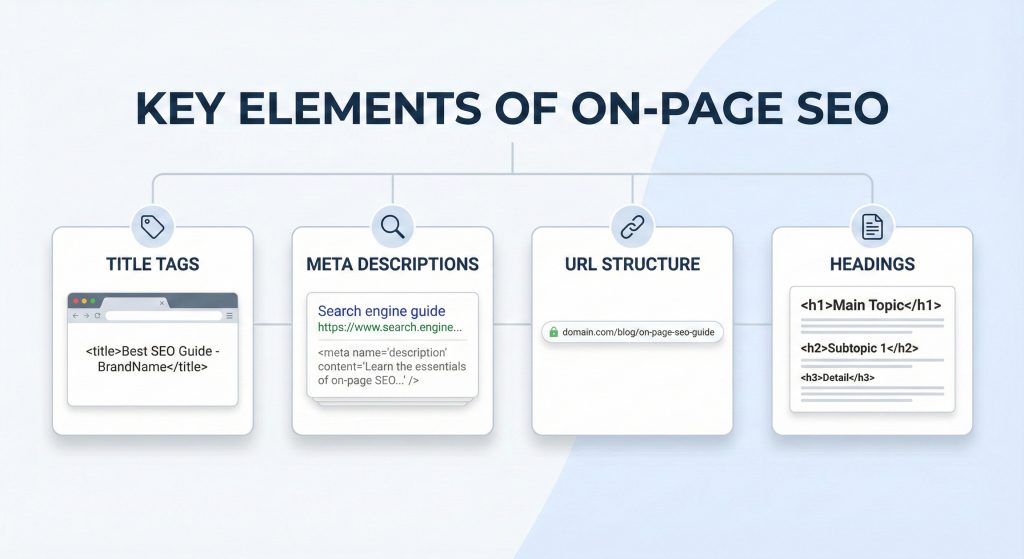
- Title Tags: An important component of On-Page SEO is the title tag. It is crucial because it appears in browser tabs and search engine results.
- Meta Descriptions: Although they have no direct impact on rankings, meta descriptions significantly increase click-through rates (CTR).
- URL Structure: In order to be user-friendly, SEO-friendly URLs should be brief, clear, and descriptive.
- Headings: Headings improve readability and aid in content organization. While the H2 and H3 tags aid in breaking down supporting sections, the H1 tag should explicitly state the topic of the page.
Content Optimization
The foundation of On-Page SEO is, in fact, content. Both users and search engines receive a powerful signal of value when you produce original, relevant, and high-quality content. The following are some essential techniques for content optimization:
- Use keywords organically.
- Concentrate on answering search intent.
- Provide accurate and comprehensive information.
- Avoid keyword stuffing.
- Update your content frequently to keep it current.
Content that successfully resolves issues, provides answers to queries, and demonstrates expertise is typically favored by search engines.
Keyword Optimization
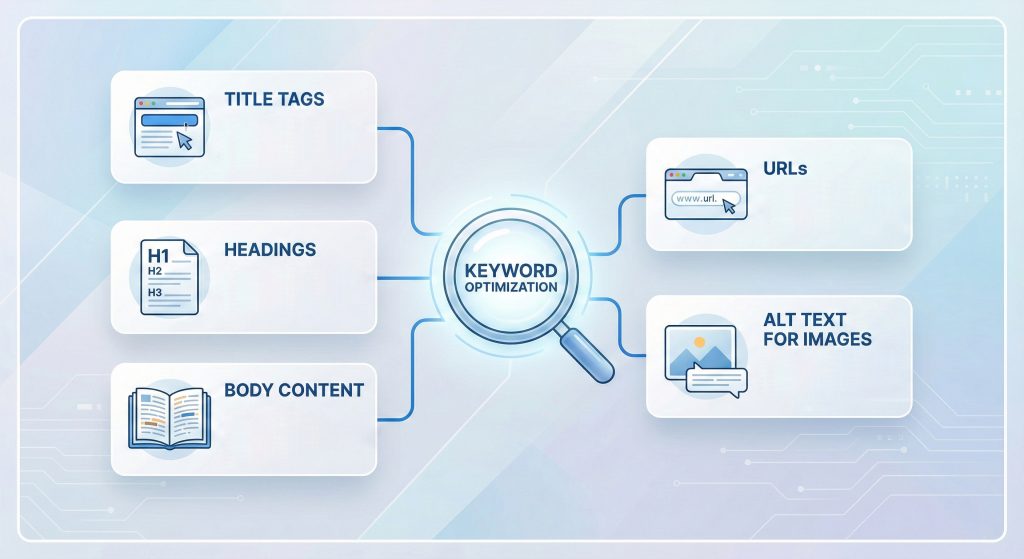
The goal of keyword optimization is to strategically place pertinent keywords throughout a website while maintaining readability. Make sure those keywords appear in:
- Title tags
- Headings
- Body content
- URLs
- Alt text for images
Instead of merely repeating exact matches, contemporary On-Page SEO places more emphasis on employing semantic keywords and guaranteeing contextual relevance.
Image Optimization
Images increase user interaction, but if they are not optimized, they can slow down a webpage. The following are some on-page SEO best practices for images:
- Making use of informative file names
- Including alt text to improve search visibility and accessibility
- Images are compressed to speed up page loads.
- Making use of suitable formats
Additionally, alt text aids in the comprehension of non-text content by search engines.
Internal Linking
Internal links, which connect various pages within the same website, are like the glue that keeps a website together. They are essential to:
- Increasing crawlability,
- Distributing link equity,
- Pointing users to relevant content,
- Creating a distinct hierarchy of content
Effective internal linking can improve your SEO performance and facilitate user navigation when done correctly
Page Speed and Performance
A key component of On-Page SEO is page speed. When pages take too long to load, it can really hurt user experience and your search rankings. Here are some effective optimization techniques you can use:
- Minimize your code
- Compress images
- Utilize browser caching
- Cut down on server response time
Fast-loading pages not only keep users engaged but also help lower bounce rates.
User Experience (UX) Signals
Improving user experience is the main goal of modern on-page SEO. Important components such as:
- Easy navigation
- Low bounce rates
- Readable content layout
- A logical arrangement of pages
Have a significant impact on rankings by demonstrating the value and interest of your content.
Importance of On-Page SEO in Online Marketing
On-Page SEO is important for a number of reasons.
- It increases your website’s organic visibility.
- Improves user experience.
- Establishes the legitimacy of your website.
- Promotes steady traffic growth.
- It complements both off-page and paid strategies.
This is especially crucial for companies that wish to develop consistent organic traffic without relying solely on advertisements.
On-Page SEO vs Off-Page SEO
When it comes to SEO, Off-Page SEO focuses on external factors like backlinks and the frequency with which your brand is mentioned elsewhere, whereas On-Page SEO is all about optimizing the content and design of your website. Both are essential for success, but consider On-Page SEO to be the cornerstone; your Off-Page efforts won’t be as effective without it.