
Definition of Impression
An Impression refers to the number of times a specified ad or piece of information appears on a web browser, also known as “imps”. An impression is registered every time a webpage or ad loads and is not dependent on whether the viewer clicks on, interacts with, or notices the presentation of the page or ad.
If the content is displayed on the screen, it’s an impression. Impressions are fundamental in digital marketing and analysis. Impressions help in assessing the exposure and penetration of marketing campaigns across search engines, social media platforms, display networks, email marketing software, and websites.
Understanding Impressions in Online Marketing
Impressions are about exposure, not interaction. Very important. Clicks, conversions, and sales are about what someone did; impressions are about what they could have done, the potential to see a brand message.
Say a banner ad is shown 1,000 times on a page, it "earns" 1,000 impressions even if nobody clicks on it. So, impressions are a top-of-the-funnel indicator, usually measuring brand awareness and campaign distribution rather than immediate results.
Types of Impressions
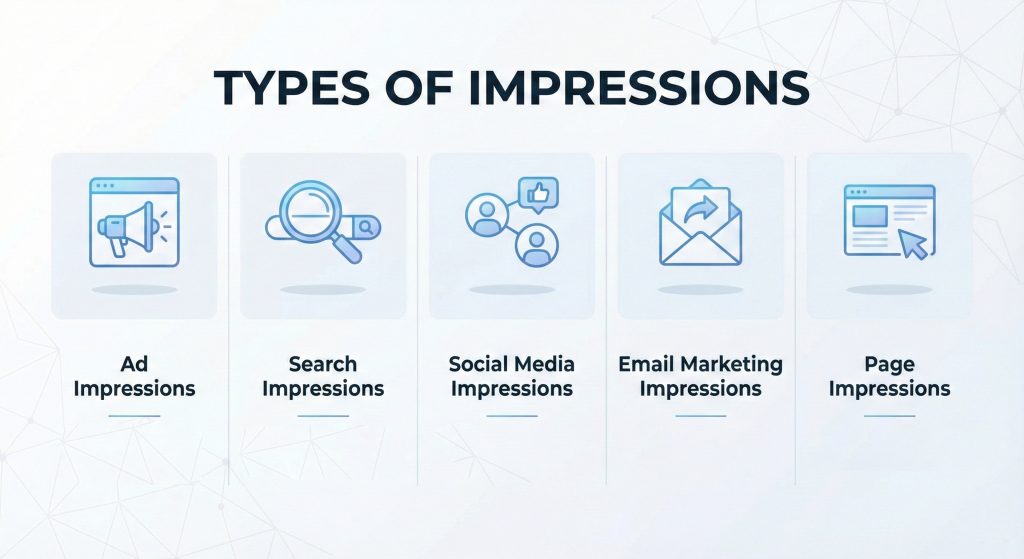
Impressions can differ based on the platform, the way a campaign is structured, and how the reporting is done.
- Ad Impressions: An Ad Impression is a metric leveraged in digital or programmed advertising. It is an advertisement that appears on a user’s screen while they are active on a website.
- Search Impressions: Search Impressions are all about how many times a website, webpage, or ad pops up in the search engine results pages (SERPs).
- Social Media Impressions: Social Media Impressions measure how frequently content like posts, stories, reels, or ads show up in users’ feeds. Social Media Impressions can tallt multiple views from the same user.
- Email Marketing Impressions: Email Marketing Impressions refers to the number of times an email or an image within that email is shown to recipients. This is often tracked using embedded tracking pixels, and the count can vary based on the settings of the client.
- Page Impressions: Page Impressions or page views refer to counting the times a webpage gets loaded or refreshed in a browser.
How Impressions Are Calculated
Impression measurement is based on algorithms and tracking tools proprietary to each platform, which include cookies, pixels, and ad servers. Commonly, an impression is counted when:
- Any ad is loaded on a website or mobile device
- A message is seen in a social stream
- A webpage is loaded in a browser window
- An email image is displayed.
Note that viewability criteria could be a factor. For instance, a few platforms label an impression as measurement only when at least 50% of the ad is on the screen and exposed for a minimum duration.
Impressions-Based Pricing Models
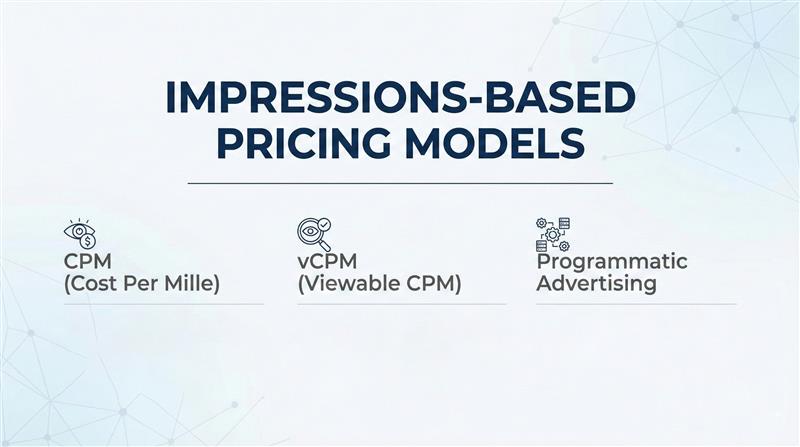
Impressions play a crucial role in various online advertising pricing models:
- CPM (Cost Per Mille): Advertisers have to pay for every 1000 impressions served. This model is ideal for brand awareness and large-scale visibility campaigns.
- vCPM (Viewable CPM): In this case, charges kick in only when ads meet specific viewability standards, which helps enhance the quality of those impressions.
- Programmatic Advertising: This approach involves real-time auctions for impressions, enabling advertisers to zero in on particular audiences using data signals.
Best Practices for Using Impressions Effectively
To truly harness the power of impression data, marketers should:
- Combine impressions with click-through rates (CTR) and conversion metrics.
- Keep an eye on frequency to prevent ad fatigue.
- Fine-tune targeting to enhance the quality of impressions.
- Utilize A/B testing to boost creative performance.
- Prioritize viewable impressions over sheer numbers.
Smart marketers know that it’s not about chasing impressions; it’s about making the most of them.
Why Impressions Matter
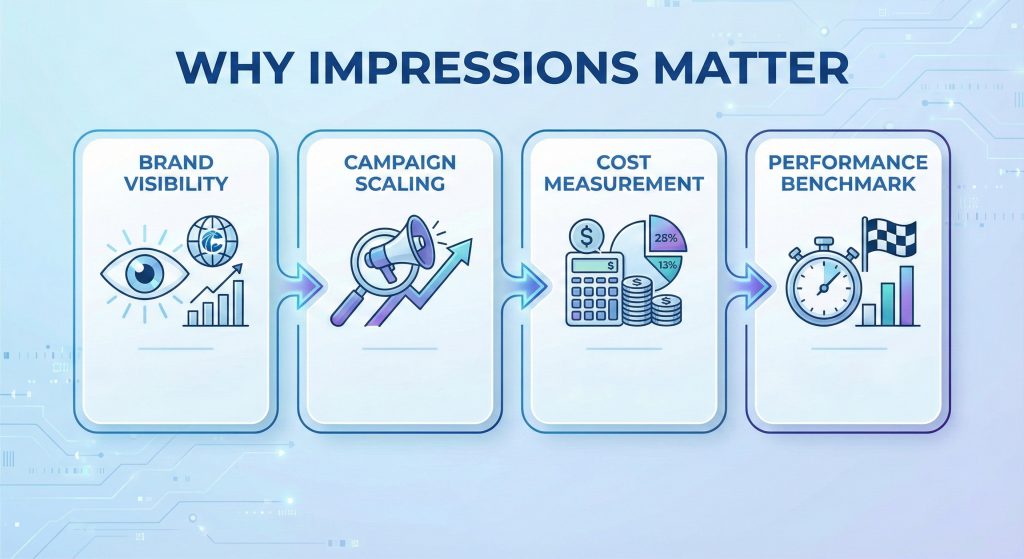
Impressions are absolutely vital when it comes to shaping marketing strategies, particularly for campaigns focused on building awareness.
- Brand Visibility: A high number of impressions means your brand is getting noticed, keeping it fresh in the minds of consumers.
- Campaign Scaling: Impressions allow marketers to gauge whether their campaign is reaching a wide enough audience across various platforms.
- Cost Measurement: In pricing models like CPM(Cost Per Mille), advertisers are charged for every 1000 impressions, making this metric crucial for budgeting and calculating return on investment(ROI).
- Performance Benchmark: Impressions serve as a foundational metric, enabling marketers to assess Click-through Rates(CTR) engagement levels and how effectively conversions are happening.